Among others, this release includes BoseHubbard in Jax, generalized Slater determinants, a stable Parallel Tempering sampler, timing utilities, and much more! 2/2
NetKet 3.12 is out, check the release notes here https://t.co/HSODWzZQtj ! Special thanks to @philipVinc@Polytechnique and Clemens Giuliani @cqs_lab@EPFL_en for the hard work to make this possible. 1/2
🌟🚀 2023's Top Papers on Neural Quantum States!
A year of many innovative approaches blending ML with quantum science. Here are my top picks:
1. Fast Quantum Natural Gradient (SR), our favorite optimizer, now scaling linearly for small batch sizes https://t.co/iFnS6jr4Do
2. Fidelity with variance-reduced estimators, and projected tVMC without bias https://t.co/jXfnb4d2QC
3. Excited states with an extended-space determinant trick https://t.co/AxzHT3DTbu
4. Neural Pfaffians in continuous space for electron pairing and more https://t.co/8o6wZhGb6B
5. Generalized Neural Wave Functions for chemistry https://t.co/3F3mwdWgvs
6. Free-Energy optimization for dense hydrogen https://t.co/EkMuyfDalU
📈 Overall, we have seen incredible progress on hard benchmarks, and NQS are the most accurate techniques now available for many ground-state problems: e.g., the electron gas https://t.co/qct1jFZ7GI, the J1-J2 model https://t.co/IXirpCFH8D, and much more https://t.co/gjKK7gFZq4.
Most of the methodological developments above are available or will be available shortly in https://t.co/LbFcVVcA3j, so make sure to check it out and discover the future of NQS with @NetKetOrg !
#NeuralQuantumStates #ML4Science #TopPicks2023
@NetKetOrg 3.10 is out! This release is probably our largest to date, and the highlights include a blazing-fast natural gradient- VMC optimiser that works with millions of NN parameters, PySCF integration to build the electronic hamiltonians, better documentation and more!
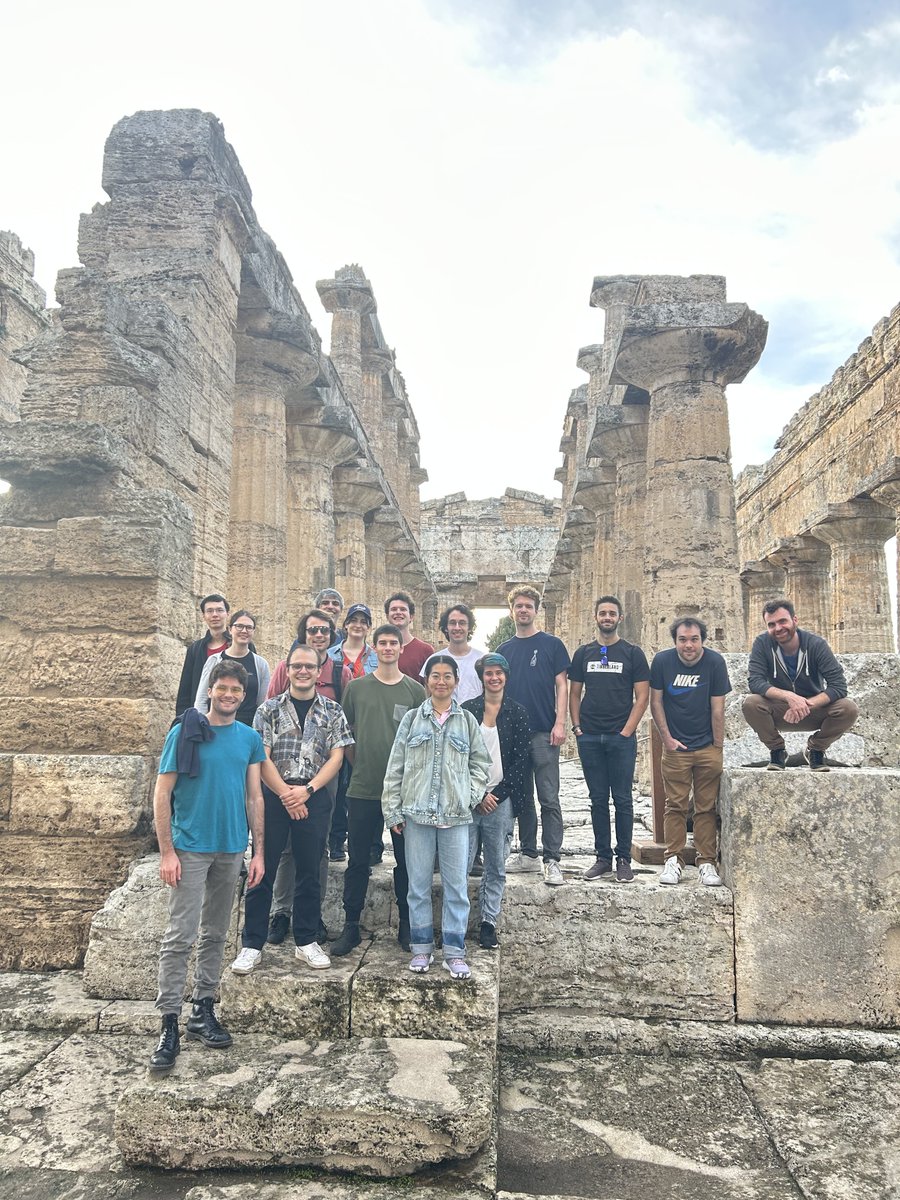
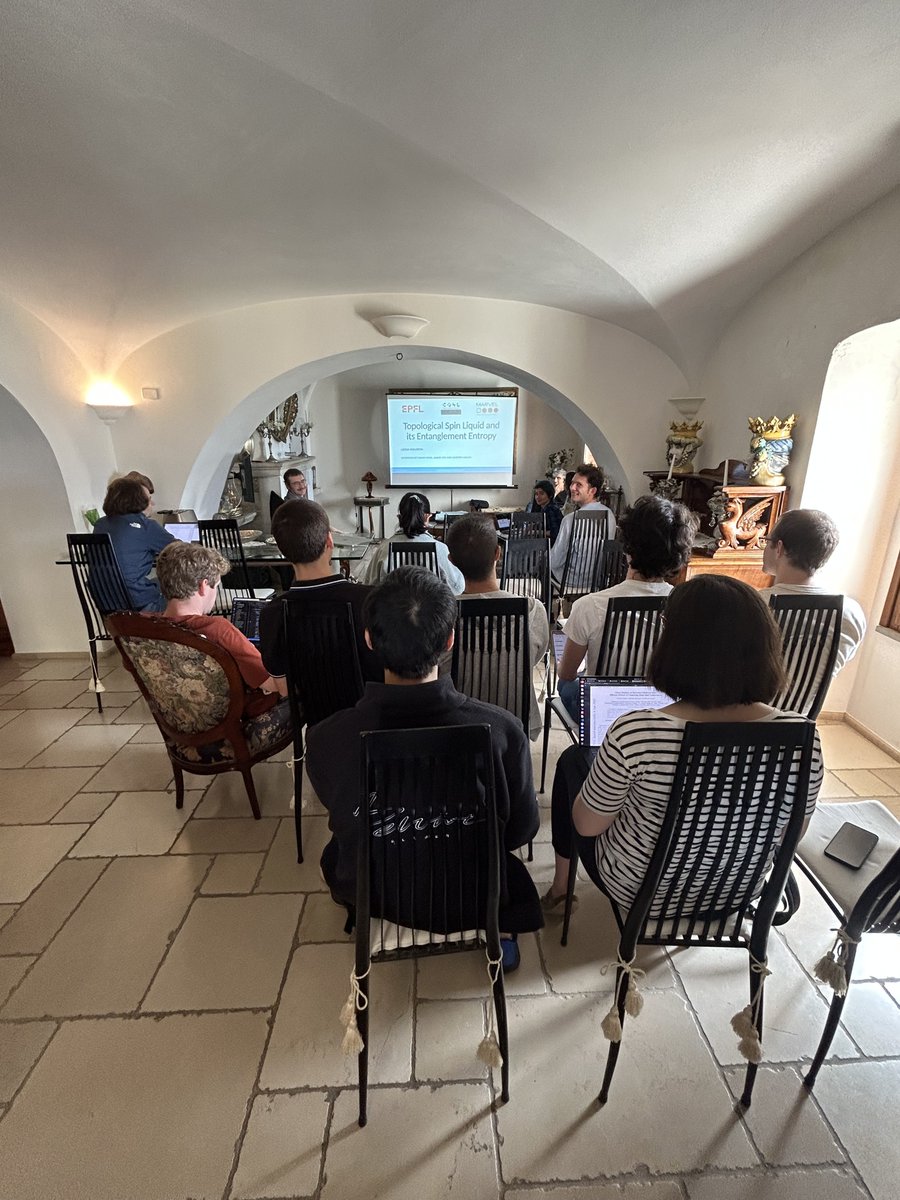
We had a very productive @cqs_lab group retreat last week, enjoying the beauty of southern Italy (Greek temples, pizzas, and buffaloes included) and discussing quantum physics, @NetKetOrg and more!
It's time for another brand new @NetKetOrg tutorial!
This week, thanks to @pgabbo0 of @cqs_lab@EPFL, we explore bosonic systems in continuous space: first, a 3D harmonic oscillator and then 1D confided particles with Gaussian interactions, using a DeepSet NQS https://t.co/cVDckHa6k0
Started in 2018, NetKet @NetKetOrg was the first open-source library for machine learning and many-body quantum physics ever released, and we are proud to see it being used by an increasing number of researchers!
With version 3 (released in 2021 thanks to the efforts of many and coordinated by @philipVinc@cqs_lab@EPFL), NetKet has acquired many new functionalities, some of which are less known, including support for systems in continuous space, fermions, dynamics, and much more. In fact, it is the only library with full support for essentially all of the applications of neural quantum states across domains, from lattice spin models to the electron gas.
To help discover all these fantastic functionalities, we are progressively releasing new Tutorials.
We start today with a new Tutorial on Lattice fermions, from Slater determinants to Neural Backflow.
Have a look here to learn how to treat strongly interacting lattice fermions with fermionic NQS:
https://t.co/kBmUaYwuHC
Finally, thank you @JannesNys for implementing the much-needed support for lattice fermions used (also) in this Tutorial!
2022 has been a fantastic year for @cqs_lab: we deployed neural quantum states to accurately study many-body systems at vastly different scales, from superfluid Helium to Neutron Stars; @NetKetOrg 3.0 was released; new hybrid ML-quantum algos were introduced. Stay tuned for 2023!
The NetKet 3 manuscript is finally published in @scipost_dot_org Codebases (manuscript here https://t.co/CHy4rHxudU). Check the great thread below by our lead developer @philipVinc to learn more! 👇👇
#UnitaryHack 2022 (June 3-17) Hackathon Project‼️
Netket 🧰 (@NetKetOrg): The Machine-Learning toolbox for Many-Body Quantum Physics: Neural-Network Quantum states and much more. Learn more: https://t.co/x7mOk0842A
Sign up now!➡️: https://t.co/3IQads3RIE
CONF: me and @JannesNys (@cqs_lab) are organising a workshop on Quantum and Classical Variational algorithms for quantum systems.
"Variational Learning Quantum Matter" will be hosted at the @EPFL_en Bernoulli Center in Lausanne, 4-8 July 2022.
https://t.co/5T6FZaKb2A
Glad to advertise a summer school (April 4-8) on Machine Learning techniques for Quantum Many-Body Physics, in Toulouse, France. The school will feature several lectures and tutorials on NetKet. Deadline for registrations is March 8! https://t.co/dn4m6wlk6K @gppcarleo@philipVinc
@NetKetOrg retweet me: How would you like the time-evolution driver of NetKet to be named?
It will work with real/imaginary time unitary dynamics (TDVP), lindblad dynamics, variational states + monte-carlo sampling, variational states without sampling.
mpi4jax is the library that netket uses to exploit multi CPU-GPU parallelism under MPI and XLA/Jax. Developed by netket's lead developer @philipVinc@cqs_lab and by Dion Häfner @uni_copenhagen, it is now published in JOSS (@JOSS_TheOJ) https://t.co/1YLSuc3M2R