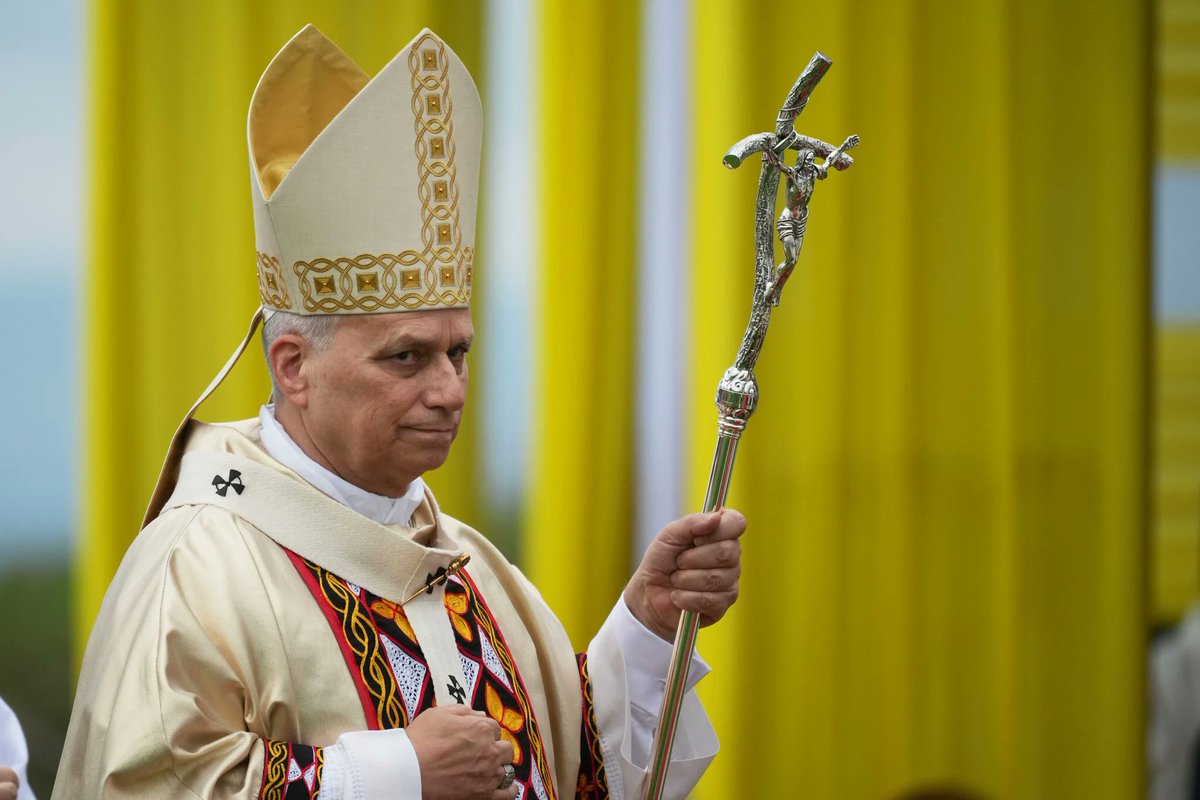
Dear friends: I don’t know any Catholic in the United States, from the most traditional to the most progressive, who does not have strong feelings about the comments from President Trump and Vice President Vance about Pope Leo XIV. These include not only President Trump’s initial disrespectful Truth Social post about the Holy Father, but also Vice President Vance’s similarly disrespectful comments about Pope Leo having to be “careful” when he speaks about theology.
Let me share some of my own feelings. First of all, it is shocking that a President and Vice President would treat such a good, holy and learned man with such disdain. Imagine telling a man with the Holy Father’s learning and experience (and authority) that he doesn’t understand theology sufficiently. What’s more, imagine attacking him as, ridiculously, “weak on crime” or somehow not understanding foreign policy.
Second, I’m edified by Pope Leo’s charitable and courageous response to all this. Charitable because he has not responded in any way other than with charity and respect. As some of you may know, I know the Holy Father slightly, thanks to our being seated together at the Synod for two weeks, and know him to be a kind, reserved, discerning and highly intelligent person. In a word, holy.
But courageous too: as we have seen during his time in Algeria and Cameroon, Pope Leo has not shied away from continuing to preach the Gospel, and speaking out in favor of peace (and yes, he understands St. Augustine’s concept of the “just war”) and against, as he said today, tyrants and those who would use God’s name to support violence of bloodshed.
So, where will this all end? It’s hard to say. But I would imagine that now that the taboo has been broken, politicians will continue to denigrate him and thus try to persuade people, without saying it explicitly, to think that the Pope’s words do not need to be listened to.
But this will be in vain for two reasons. First, Pope Leo is clearly fearless. A few hours after he was elected as pope, I spoke with a fellow Augustinian priest who had known “Bob” for decades. “He’s a great listener, very kind and much loved.” Then he paused. “But he’s no pushover.” But the main reason that the Pope’s words will be heard is less about Robert Prevost’s own many virtues but something else: the Vicar of Christ will be heard because he is preaching the Gospel. As Jesus told his disciples, “Heaven and earth may pass away, but my words will never pass away.” So, in these strange times, fear not.
The contrast cuts to the existential bone. On the day empire reached for destruction, its grassroots chose the opposite: rooting deeper in place, each other, and the peacework of regeneration. That choice—what we build or what we destroy—is the fundamental divide of our moment.
Thomas Merton did much to recover the Christian contemplative tradition. Translating a collection of the sayings of the desert fathers, Merton embraced their style of teaching, emphasizing the importance of experiencing their wisdom for ourselves. https://t.co/UxXqP0AIYT
The Fall is not simply something that happened to Adam and Eve in one historical moment. It’s something that happens in all moments and all lives.
Join us this week as we explore fallenness in the “Daily Meditations.” https://t.co/fflZAm9Lx7
“Experts” & “expertise” can be very dangerous to change interventions.
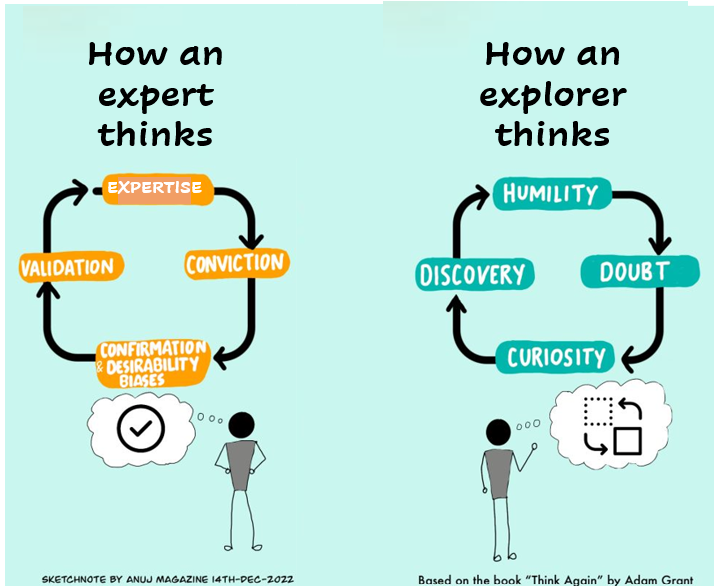
In leading change, it’s better to think like an explorer than an expert. See the graphic below.
An “expert” way of thinking can become a loop where knowing a lot turns into strong certainty. That leads us to mainly look for information that backs up what we already know, which then makes us feel confirmed. Experts can become oriented toward being right & getting affirmed, which can make their thinking narrower & more self-sealing over time.
An “explorer” way of thinking is a loop focused on learning. It starts with being humble enough to admit we might not have the full picture, then asking questions, staying curious & trying to find out more - so new information keeps shaping our views & change practice over time.
One of the greatest dangers in change experts (especially prevalent in external change experts coming into an organisation) is bias. Common biases are:
- Confirmation bias: we search for information/evidence that supports what we already think & overlook anything that contradicts this.
- “Solutioneering”: We jump quickly to a preferred intervention (new structure, operating model, digital tool etc) before fully understanding the local context & constraints.
- Authority bias: we can give extra weight to the opinion of the most senior person (or the loudest “expert”) & discount what others (especially people closer to the work) are seeing or can contribute.
- Overconfidence effect: we can be too sure we’ve got this under control, so we plan as if the future is predictable & leave too little room for learning & adaptation.
- One-size-fits-all / template bias: we over-apply what worked elsewhere (reusing change models, templates & assumptions) even when culture, incentives, capability or demand patterns differ.
- Case-study trap: We lean too heavily on successful past engagements & familiar sectors (“this looks just like Y”) & under-sample what is unique about this organisation.
In a relatively stable world, expert-led change can deliver results. But as AI accelerates the pace of disruption, the edge shifts from having the answers to staying open to better ones. The most effective change leaders will be those who keep their curiosity switched on, run experiments, learn quickly & humbly adapt when the evidence changes. In other words, the future belongs to explorers - because in an AI-shaped world, agility is likely to beat expert ability when it comes to change.
For experts/explorers see Joey Davis: https://t.co/Ya2L36fAPO
For more on biases, see the review by @grahamkmann of the work of Rolf Dobelli: https://t.co/54H7jtZBPs
Graphic adapted from one by @anujmagazine.
Let’s talk about “emergence” in organisational change initiatives.
Emergence is when new ways of working & new forms of order grow out of the interactions of people, practices & structures, rather than through implementation of a fixed, top-down change plan. Top‑down, programme‑driven approaches assumes change is predictable & that leaders can design the route in advance. Research on emergent change shows our change environments are complex, fluid & cannot be fully understood or controlled in advance.
It’s not surprising that, in many situations, top down approaches on their own are failing to deliver the outcomes we need. Emergent approaches (which blend strategic intent & accountability with high local autonomy on how to move things toward) are clearly the way to go. Yet organisational leaders are reluctant to adopt them. Why?
· The wider accountability & governance systems we operate in expects linear plans, business cases & RAG reports, so leaders worry that explicitly adopting emergent approaches will be seen as vague, indecisive, or not having “management grip” of the change, even in obviously complex environments.
· Under high levels of scrutiny & pressure, leaders may worry that inviting more emergent, adaptive ways of working will look like ‘losing control’ & create chaos, especially in cultures where it still feels unsafe for leaders to name fear, uncertainty, or not having all the answers.
· Most leadership development does not include practices for emergence such as inquiry‑based facilitation, safe‑to‑fail experimentation, joint sense‑making & adaptive framing, so “emergence” is often heard as “no plan”.
We can build emergence into our daily leadership practice by adding new ways of working around experimentation, learning & distributed leadership, without losing focus on accountability & delivery:
1) Take a “tight-loose-tight” approach: tight on strategic intent, loose on multiple local routes & experiments towards it & tight on accountability for results
2) Introduce safe‑to‑fail experiments: many small, parallel interventions around key priorities that enable learning & can fail without harm
3) Make experimentation routine: require major programmes to allocate a proportion of budget & capacity to designed experiments before any big‑bang roll‑out
4) Measure improvement in adaptability & collaboration - not just results: add measures for experimentation, collaboration & responsiveness (e.g., number of safe‑to‑fail tests, time from idea to first trial, cross‑team initiatives started) alongside traditional KPIs
5) Build the likelihood of emergence into the business case process: add “learning system design” to the template - how data, stories & signals will be gathered, discussed & used to pivot or stop; align incentives, risk & culture so people are rewarded for stopping or redirecting initiatives when evidence changes, not just for delivering the original plan
6) Institutionalise collective sense‑making: forums across the system where data, stories & experiment results are interpreted together, & next moves are agreed adaptively.
7) Replace blame or failure language with forward‑looking learning language (“what did we discover?”), especially in reviews & governance meetings
8) Develop leadership capabilities for emergence: build skills in inquiry, facilitation, “holding space”, & working with uncertainty, not just project & programme management & “technical” improvement methods.
A favourite “classic” article on leading for emergence by Gervase Bushe & Robert J Marshak: https://t.co/oJRDnjatUZ.
Graphic by Joss Colchester of @Sys_innovation: https://t.co/5YKqM5HdrL
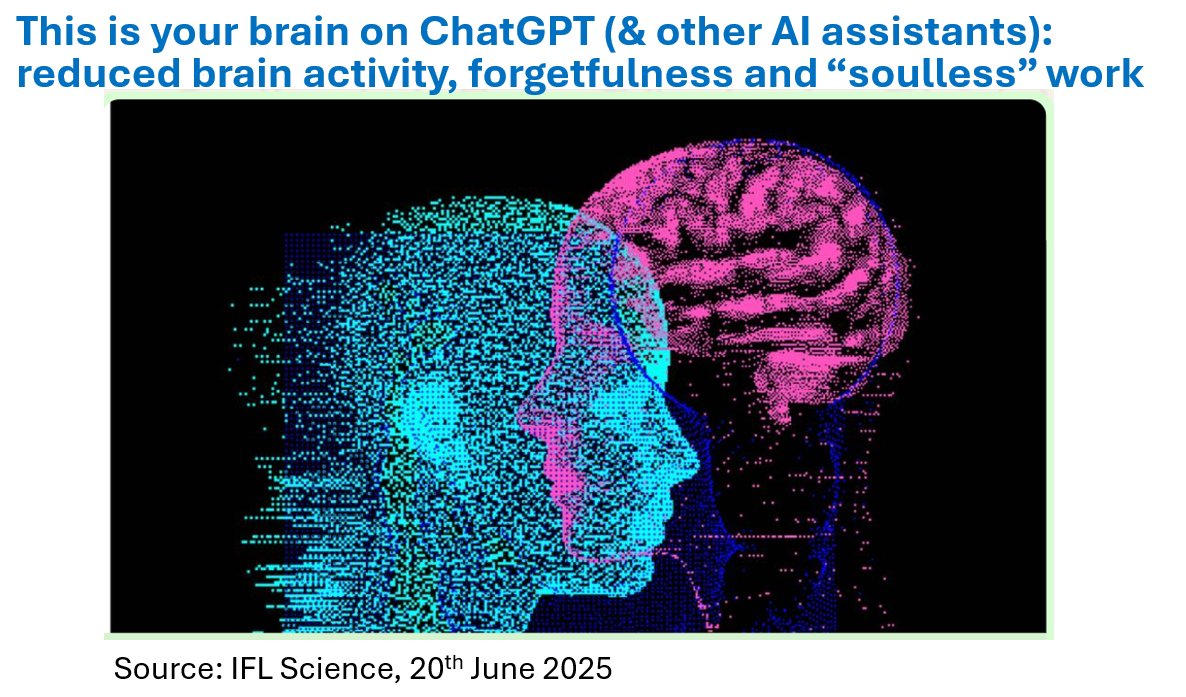
A new study looked at how using AI assistants like ChatGPT for writing tasks impacts the brain & thinking skills. It focussed on students writing essays but the findings have implications for workplace leaders.
The researchers found that people who used AI used their brains less, created work that was “shallow” & “soulless”, remembered less & had less ownership of their work.
Starting a piece of work with AI created a “cognitive debt” – people get short term benefits like more efficient writing but pay a price in reduced creativity & a mental laziness that sticks around & makes it harder to think critically later on.
Even when peopled stopped using AI, their brain engagement stayed lower. People who started the work unaided by AI produced more original content with wider vocabulary & critical analysis. They retained stronger cognitive engagement even when later using AI.
Implications: actions for workforce development
1. Prioritise critical thinking & problem-solving training: ensure people regularly engage in tasks that require independent thought & reasoning without AI assistance.
2. Encourage hybrid workflows: human first, AI second.
3. Implement continuous upskilling & reskilling: as AI rapidly changes job requirements, ensure people stay adaptable, resilient & capable of meeting evolving demands.
4. Use AI judiciously & monitor cognitive impact: regularly assess how using AI affects people’s engagement, learning & critical thinking & adjust policies to avoid undermining core human skills.
Original article: https://t.co/9WwtW4O2Se via @PietroMicheli13
Summary & graphic from @IFLScience https://t.co/Z1TruvhXqf
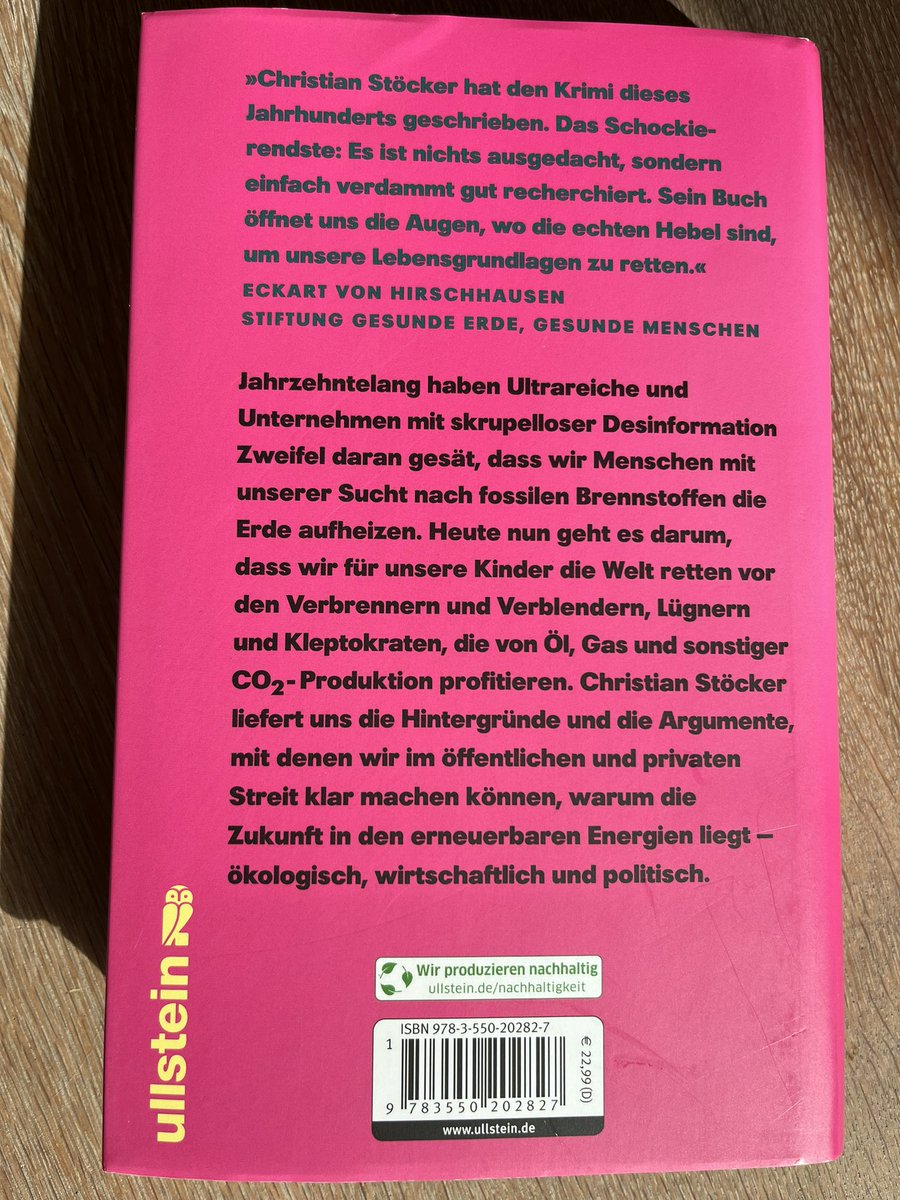
Ab jetzt kann man „Männer, die die Welt verbrennen“ kaufen und darin lesen:
- Warum wir zu wenig gegen die #Klimakrise tun
- Wer daran Schuld ist
- Warum diese Leute wissen, dass sie verlieren werden.
Ich verlose unter allen, die diesen Post teilen, ein Exemplar mit Widmung.
Wie ungezählte Schülerinnen und Schüler - hier in der Paulusschule - werden wir Margot Friedländer und ihr Lebenszeugnis als Mahnung und Ansporn zur Versöhnung nie vergessen.