RIP prompt engineering ☠️
This new Stanford paper just made it irrelevant with a single technique.
It's called Verbalized Sampling and it proves aligned AI models aren't broken we've just been prompting them wrong this whole time.
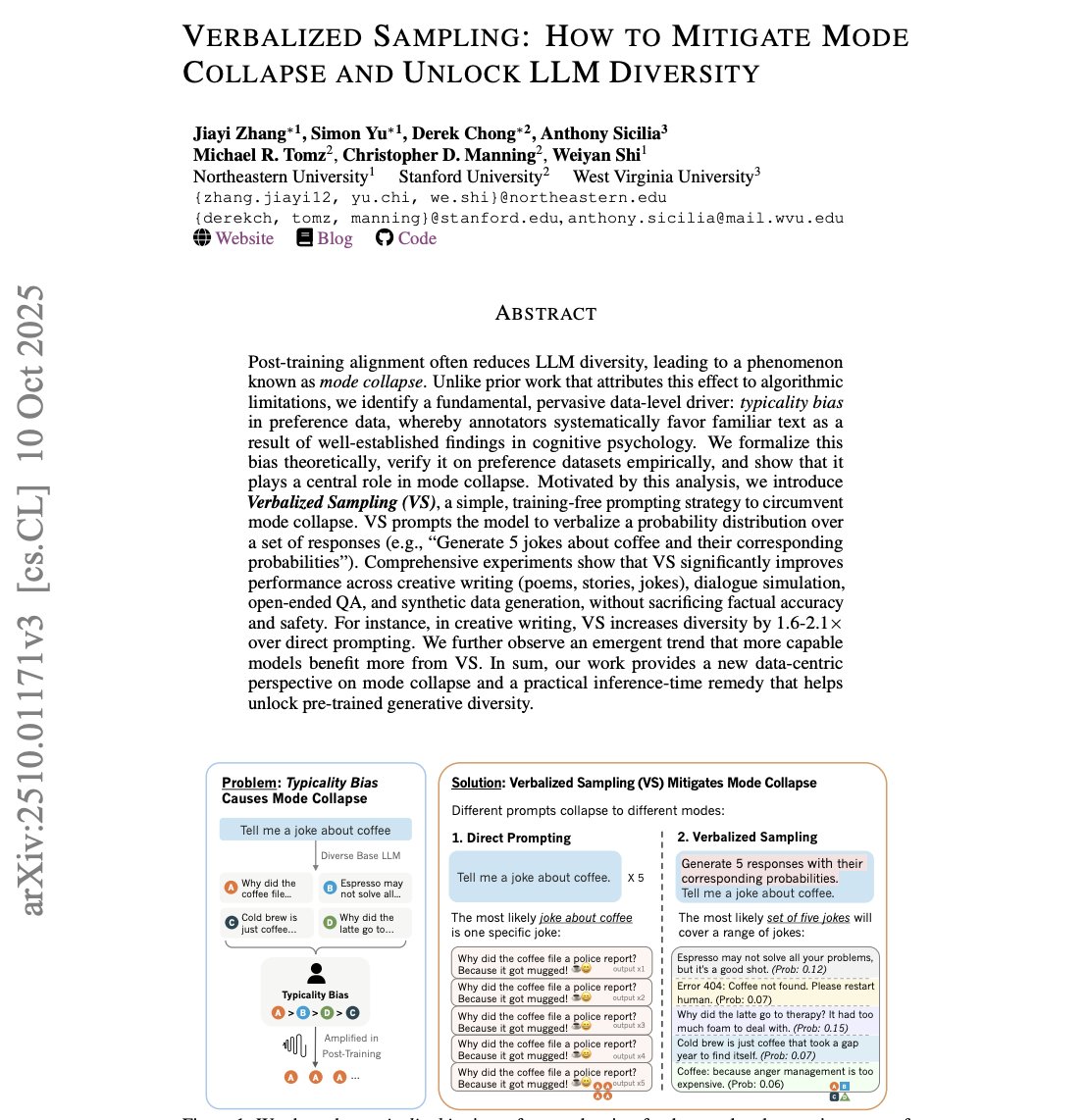
Here's the problem: Post-training alignment causes mode collapse. Ask ChatGPT "tell me a joke about coffee" 5 times and you'll get the SAME joke. Every. Single. Time.
Everyone blamed the algorithms. Turns out, it's deeper than that.
The real culprit? 'Typicality bias' in human preference data. Annotators systematically favor familiar, conventional responses. This bias gets baked into reward models, and aligned models collapse to the most "typical" output.
The math is brutal: when you have multiple valid answers (like creative writing), typicality becomes the tie-breaker. The model picks the safest, most stereotypical response every time.
But here's the kicker: the diversity is still there. It's just trapped.
Introducing "Verbalized Sampling."
Instead of asking "Tell me a joke," you ask: "Generate 5 jokes with their probabilities."
That's it. No retraining. No fine-tuning. Just a different prompt.
The results are insane:
- 1.6-2.1× diversity increase on creative writing
- 66.8% recovery of base model diversity
- Zero loss in factual accuracy or safety
Why does this work? Different prompts collapse to different modes.
When you ask for ONE response, you get the mode joke. When you ask for a DISTRIBUTION, you get the actual diverse distribution the model learned during pretraining.
They tested it everywhere:
✓ Creative writing (poems, stories, jokes)
✓ Dialogue simulation
✓ Open-ended QA
✓ Synthetic data generation
And here's the emergent trend: "larger models benefit MORE from this."
GPT-4 gains 2× the diversity improvement compared to GPT-4-mini.
The bigger the model, the more trapped diversity it has.
This flips everything we thought about alignment. Mode collapse isn't permanent damage it's a prompting problem.
The diversity was never lost. We just forgot how to access it.
100% training-free. Works on ANY aligned model. Available now.
Read the paper: arxiv. org/abs/2510.01171
The AI diversity bottleneck just got solved with 8 words.
Qwen introduces:
Parallel Scaling Law for Language Models
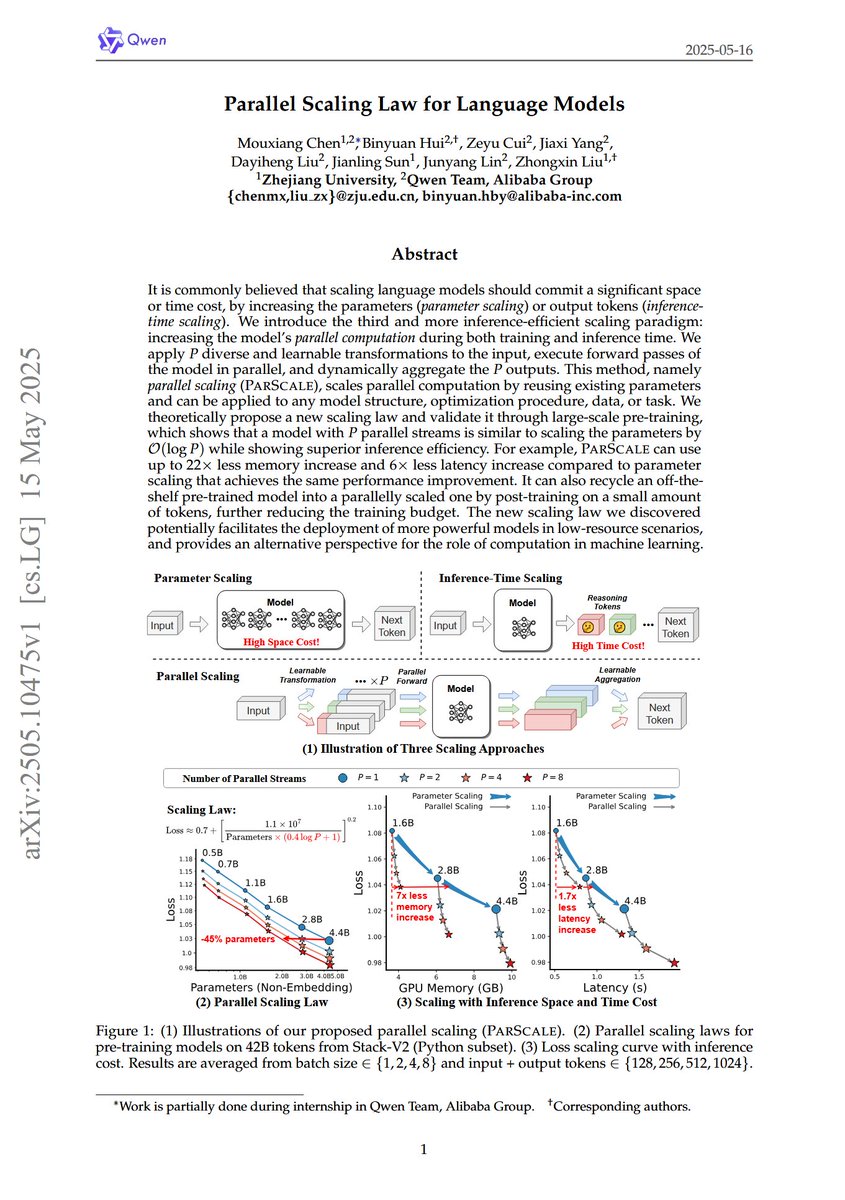
"We introduce the third and more inference-efficient scaling paradigm: increasing the model’s parallel computation during both training and inference time."
"We draw inspiration from classifier-free guidance (CFG)"
"In this paper, we hypothesize that the effectiveness of CFG lies in its double computation."
"We propose a proof-of-concept scaling approach called parallel scaling (PARSCALE) to validate this hypothesis on language models. "
"parallelizing into P streams equates to scaling the model parameters by O(log P)"
"for a 1.6B model, when scaling to P = 8 using PARSCALE, it uses 22× less memory increase and 6× less latency increase compared to parameter scaling that achieves the same model capacity"
You haven't seen complexity in art until you've seen this 600-year-old painting.
It's so detailed that modern medicine has been able to diagnose this man's exact type of blindness.
And that's where things get mind-bendingly strange — this whole thing is an illusion... 🧵
To create wealth, you don't have to WORK for money, you need to make the money work FOR YOU.
Here are 9 books that will help you achieve this:
1. "Passive Income, Aggressive Retirement" by Rachel Richards
"The Innovator's Dilemma" is a must-read survival guide for any leader, entrepreneur or innovator who wants to create the disruptions of the future instead of being disrupted into obsolescence.
You'll discover:
- Why doing what's best for today's customers can cause you to miss disruptive opportunities
- How small, insignificant innovations can blossom into massive new markets
- Strategies for embracing disruption rather than being disrupted
Disruption is Inevitable - Are You Ready?
In business, there's no greater threat than being disrupted by an upstart competitor with a game-changing innovation. Just ask former industry giants like Blockbuster, Kodak, and BlackBerry.
Through detailed case studies and powerful insights, Christensen reveals the crucial distinctions between sustaining innovations and disruptive innovations that create entirely new markets.
In his groundbreaking book "The Innovator's Dilemma," Clayton M. Christensen uncovers the shocking reasons why many of the best-run, most successful companies are rendered obsolete virtually overnight by disruptive innovations.