In 2014, the actress Laverne Cox appeared on the cover of Time magazine, becoming the first trans woman to do so. The accompanying article, which proclaimed the arrival of “The Transgender Tipping Point,” argued that increased visibility had brought about unprecedented acceptance. Twelve years later, it’s impossible not to look back at that more hopeful time with a sense of grim irony. “I feel that this is a moment where we have to make some really important decisions about who we are, who we want to be, and how we’re going to proceed,” she said in an interview with Grace Byron. Read more:https://t.co/setl5iD8Rs
“When I was ten years old, I looked up the word ‘homosexual’ in the family dictionary,” Robert Giard writes in the introduction to his book “Particular Voices.” “Symbolic act: I’ve been a gay reader ever since.” Giard grew up to become both a voracious reader and a foremost chronicler of writers. His book, published in 1997, collects portraits he made of more than 600 L.G.B.T.Q. authors.
In an effort that spanned decades, Giard photographed writers working across many genres—playwrights, poets, novelists, theorists, memoirists, critics, even cookbook authors. (Remarkably, Giard made a point of reading some or all of the work of every writer he photographed.) Fame was in no way a prerequisite, though he did photograph contemporary luminaries and lightning rods, among them Allen Ginsberg, Edmund White, Audre Lorde, Andrea Dworkin, and Tony Kushner. Some young writers he captured, such as Sapphire, Wayne Koestenbaum, and Alison Bechdel, went on to become cult figures. Others have been largely lost to history. “I had arrived at a decision about my work,” he once said, after watching Larry Kramer’s play “The Normal Heart,” a semi-autobiographical work about an AIDS activist.“It should be of use to gay people by recording something of note about our experience, our history, and our culture.” Read Chris Wiley’s full story: https://t.co/WSfGpIvqVX
Andrew Tate referred to his webcam workers as slaves, branded them with tattoos, and subjected them to harrowing abuse. In this week’s issue, Heidi Blake interviews more than a dozen alleged victims—and Tate himself. https://t.co/uYDZGYlKle
A new book argues that the oldest Americans, because of their retrograde politics and ever-increasing presence, are profoundly reshaping our collective life. We all know that there are lots of boomers, and that Joe Biden and Donald Trump are the oldest Presidents in history. Even so, the Yale Law School professor Samuel Moyn writes, the extent of America’s transformation has, like aging itself, snuck up on us.
The age of the median voter is now 52. In primaries, it is 65—meaning that the oldest voters ordain the choices for the rest of us. There are 435 members of the House of Representatives; only one was born in the 1990s, and only 64 in the 80s. “The age group most likely to own a home in America, at a rate of over 80 percent, is 70 to 74,” Moyn writes. The second most likely group is people 75 and older.
“The fault lines between young and old are real,” Joshua Rothman writes. But is gerontocracy the right diagnosis for what ails us? Read his latest column: https://t.co/qsRzkYIJLD
The 22-year-old Elizabeth Levine remembers the moment that she became aware of her misophonia: at 12 years old, hearing her father tap his fingers on the dashboard of a car. When she hears a triggering sound, her fight-or-flight reaction quickly follows.
https://t.co/5IhTHSCqzW
According to Thomas Jefferson, the First Amendment established “a wall of separation between Church & State.” Reality turned out to be more complicated. With deregulation, Christianity moved into a thriving marketplace, in which churches were forced to innovate and compete for customers. For the past two centuries, religious leaders have sparred over the changing face of Christianity in America—from the revivalist movement in the early 19th century to the fundamentalists who scorned the acceptance of Darwin’s theory of evolution in the 1920s. The result was the rise of the modern religious right. “By the end of the twentieth century, this fundamentalism-inflected evangelicalism, with its muscular politics, was the unequivocal winner in America’s religious economy,” Michael Luo writes.
Luo looks at two new books that attempt to trace the evolution of American Christianity—as both a belief system and economy. “It seems possible that Christianity is once again on the upswing in America,” he writes. “As in the past, its form will be determined by the religious marketplace.” Read Luo’s analysis of the extraordinary rise of evangelicalism: https://t.co/8ThGHBbeOW
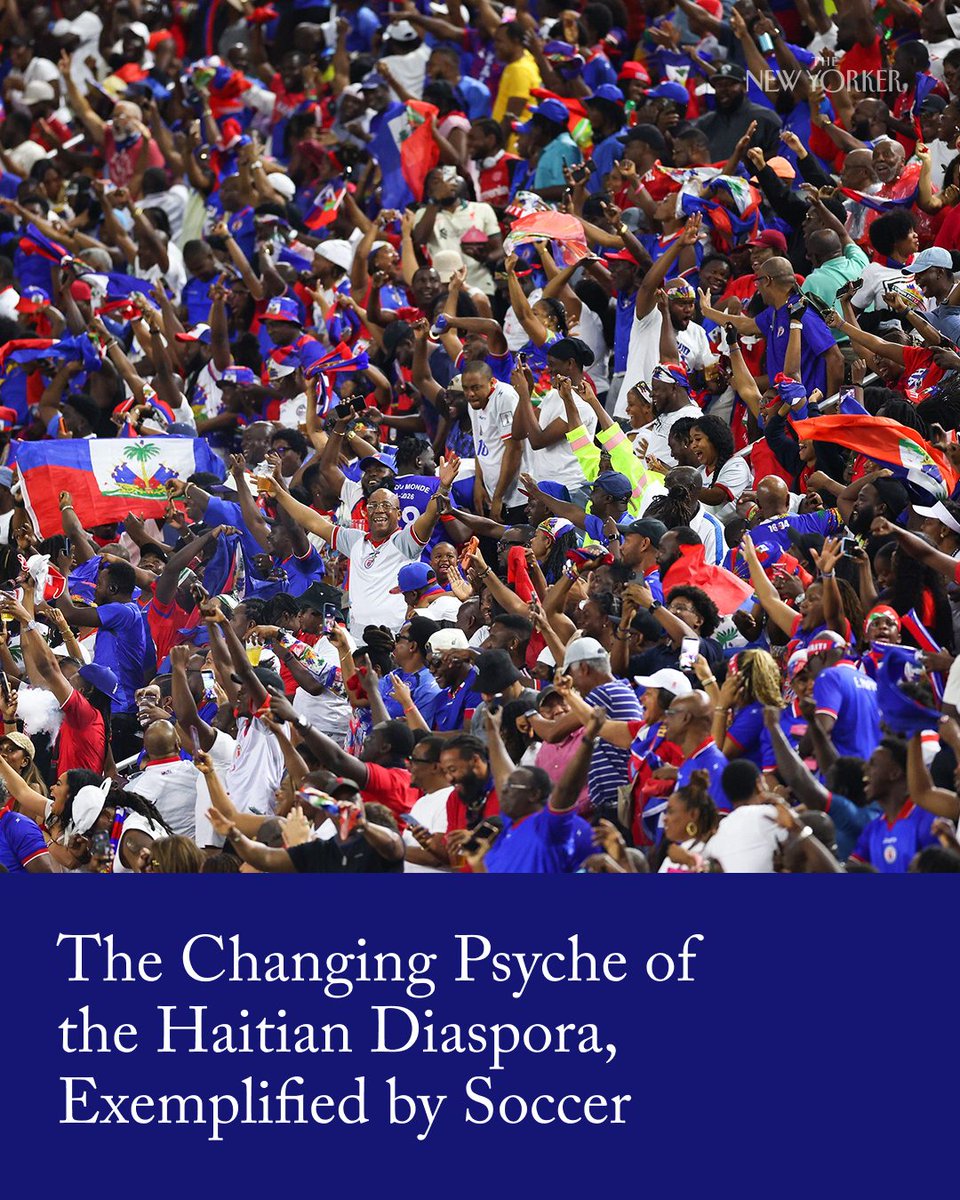
Before 2026, the Haitian men’s soccer team had not qualified for the World Cup since 1974. They haven’t practiced on Haitian soil since after the assassination of President Jovenel Moïse, in 2021.
For seven days and seven nights, a Catholic church based in Port-au-Prince which has flourished as a sort of digital assembly area for the Haitian diaspora devoted its YouTube and radio broadcasts to the project of fortifying the team against its many obstacles, in preparation for the Cup. Read more about the Haitian national team, and how it doubles as a microcosm of the nation’s demographic: https://t.co/7ovZarG1lD
In 1980s Britain, bright blue held political significance. It was the color of the party rosettes worn by the Tories, who had come to power under the leadership of Margaret Thatcher—and a favorite of her wardrobe. During the photographer Paul Graham’s time spent documenting the lives of people along Britain’s longest thoroughfare, the fissures in the nation’s identity were visible in vibrant color. See more of his work: https://t.co/3ElMOeFqOj
Misophonia, a neurophysiological disorder characterized by a severe adverse response to sound, drastically affects the lives of those it afflicts. “I’m never able to fully just be present,” one person with the condition says. “I can’t just walk into places and be excited or happy.”
https://t.co/CY1wctu0vk
Right now, Knicks fans are embracing joy. From Gun Hill Road, in the Bronx, to Hylan Boulevard, on Staten Island, from Times Square to Grand Army Plaza; from the watch parties in Bryant Park and outside the Garden and on countless city corners; they’re feeling it in all the filled-to-bursting bars in Elmhurst, Boerum Hill, Astoria, the West Village, and Harlem; on all the buzzing chat groups; in suburban living rooms, in hospital waiting rooms, in the backs of cabs, in all the far-flung corners where the Knicks are beloved—joy everywhere.
Game after game, the Knicks fell behind to start. And game after game, they fought back. On Saturday night, with Karl-Anthony Towns and OG nagged by foul trouble and the bench players struggling, Jalen Brunson refused to give in—earning New York its first N.B.A. championship since 1973. “Savor the joy, New York,” David Remnick writes. Read his reflections on his “happiest sports moment”: https://t.co/ZbbYhaQagB
In the U.S., the age of the median voter is now 52. In primaries, it is 65—meaning that the oldest voters ordain the choices for the rest of us. https://t.co/pTddxNnWJZ
In 2014, the “Orange Is the New Black” star appeared on a Time cover heralding a new era of acceptance for trans people. These days, the picture looks very different. https://t.co/g9InNX0GDW
Americans want to Americanize the Revolutionary War, but the third Duke of Richmond may have helped create its ideological underpinnings. https://t.co/5tHPy8Xc6x