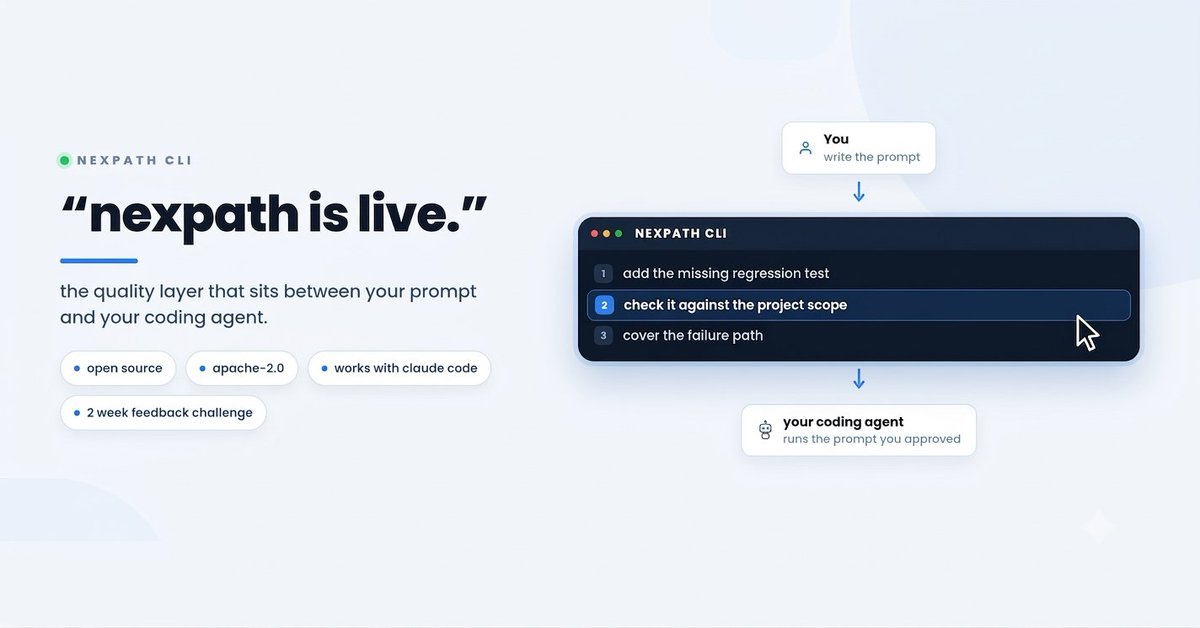
Not a coding agent. The quality engineering layer for vibe coding.
NexPath is live and open source. It sharpens the prompt before your coding agent runs it, and every suggestion waits for your approval.
A 2 week feedback challenge is open on GitHub Discussions. Tell us what breaks, not what looks good. The three most useful reports get a small thank you reward.
https://t.co/mD4t9YiWkd
Give Spacexai two assertions for a sort fix. A higher score moves ahead of a lower one. Two rows with the same score keep their input order if that's what users rely on.
A fixture with unique scores can prove the first and miss the second.
Before asking an agent to add retries, test the timeout that counts. Save the ticket, drop the response, and retry with the same submission key.
Expect one ticket and the same ID. A timeout before the save misses the duplicate case.
A fresh submit gets a new key.
A useful coding-agent nudge should fit the moment. Sometimes you need a full review; sometimes one small check is realistic. Nexpath offers decision-session prompts at three levels, from thorough to minimum viable, and leaves the choice with you.
Agent memory needs provenance. Store the source, timestamp, and whether a note was observed or inferred. Recheck facts that can change before acting on them. Otherwise, a stale guess can return later with the confidence of a standing instruction.
Happy New Year from ParseOS!
New beginnings bring new ideas, fresh perspectives, and opportunities to build something meaningful.
Here's to a year of innovation, learning, progress, and exciting possibilities.
Wishing everyone a successful and wonderful New Year!
Team ParseOS
#HappyNewYear #ParseOS #Innovation #BuildAndGrow #Technology #NewBeginnings
🪔 Happy Diwali from ParseOS!
May this festival of lights inspire new ideas, brighter possibilities, and meaningful progress.
Wishing everyone happiness, prosperity, and success. Have a wonderful Diwali!
Team ParseOS
#HappyDiwali#DiwaliCelebration#ParseOS#Technology #Innovation #NewBeginnings
A holdout set stops being a clean final check when every disappointing result sends you back to tune the model.
Each round teaches you something about that set, even if no row enters training. Use validation data to iterate; keep one final set untouched until the end.
"All tests pass" can mean the agent fixed the code.
It can also mean it:
deleted the failing test
marked it as skipped
loosened the assertion to match the bug
regenerated the snapshot
Only the test diff tells you which. Read it before you read the code.
Myth: you need to memorise syntax.
Reality: you need to spot wrong code fast.
Myth: AI makes fundamentals optional.
Reality: fundamentals are how you catch AI.
Myth: more code shipped means more skill.
Reality: knowing what not to build is the skill.
Learning to code with AI, in pairs:
Use it to explain an error. Don't use it to skip reading one.
Use it for a first draft. Don't ship a draft you can't explain.
Ask it for three approaches. Don't let it pick.
Let it write tests. Don't let it decide what they test.
Life of a Spacexai-built codebase:
Day 1: everything works.
Week 2: three different ways to format a date.
Month 2: the agent copies the worst one, because it's the most common.
Month 3: nobody knows which one is canonical.
Agents copy what's frequent, not what's right.
Before sharing your Lovable app:
If it has logins, turn on row level security.
If it calls a paid API, the key stays out of the frontend.
If signup is open, bots will find it.
If it stores emails, write a privacy policy.
Built and public are two different steps.
Five levels of vibe coding:
1. You paste the error back and hope.
2. You read the diff before you accept it.
3. You define "done" before you prompt.
4. You know which parts you'd rebuild by hand.
5. You can tell the agent no, and why.
Nobody levels up by prompting more.
Pre-mortem for an overnight agent run:
It looped on a flaky test.
It compacted context and lost the goal.
It stopped to ask something nobody was awake to answer.
It "fixed" a failing test by changing the assertion.
Write the stop conditions before you sleep.
Anatomy of a tool an agent can actually use:
Name: a verb, not a noun.
Description: when to use it, and when not to.
Errors: written so the model can recover.
Output: the smallest payload that answers the call.
The agent reads your docs more literally than any human will.
Before blaming the model for a bad RAG answer:
1. Was the right chunk retrieved at all?
2. Did it make the top k you pass?
3. Did the context budget trim it?
4. Did a chunk boundary split the answer?
5. Now check the model.
Plenty of "hallucinations" are retrieval bugs.
Lines worth deleting from a CLAUDE.md:
"Write clean code." It already thinks it does.
"Be careful." A mood, not an instruction.
Rules your linter already enforces.
Old file paths. Stale context is worse than none.
Keep what the repo can't say: why the weird thing is weird.
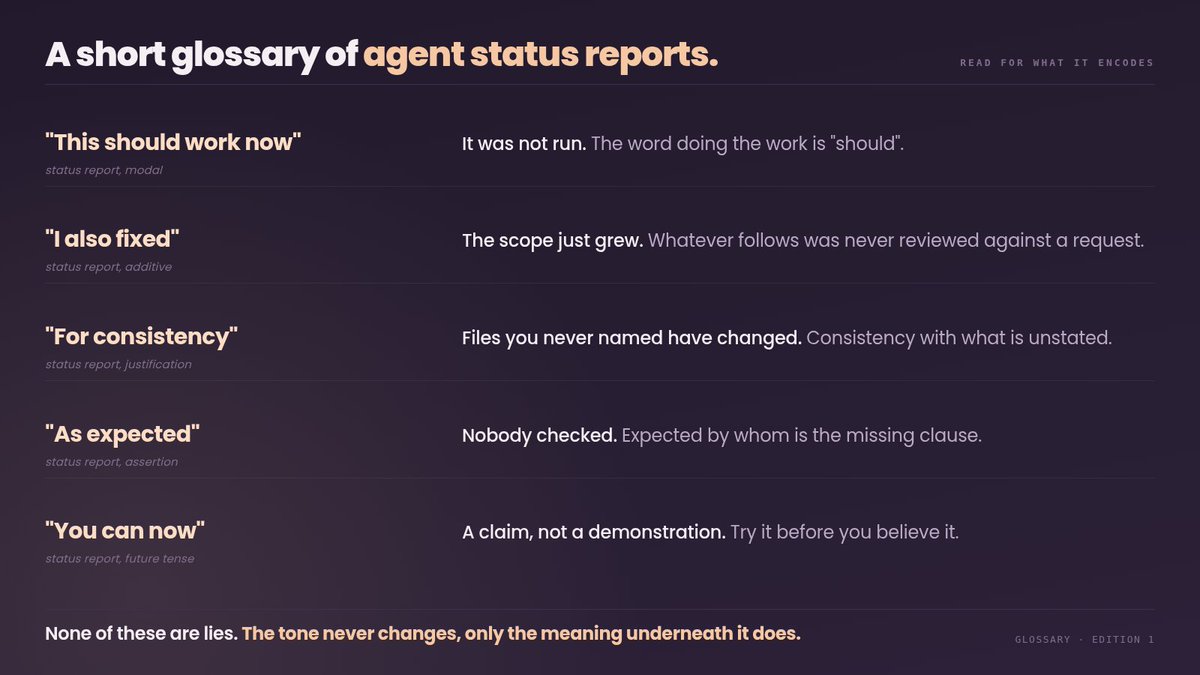
A short glossary of agent status reports.
"This should work now" = it was not run.
"I also fixed" = the scope grew.
"For consistency" = files you never named changed.
"As expected" = nobody checked.
"You can now" = a claim, not a demo.
None of these are lies. They are precise.
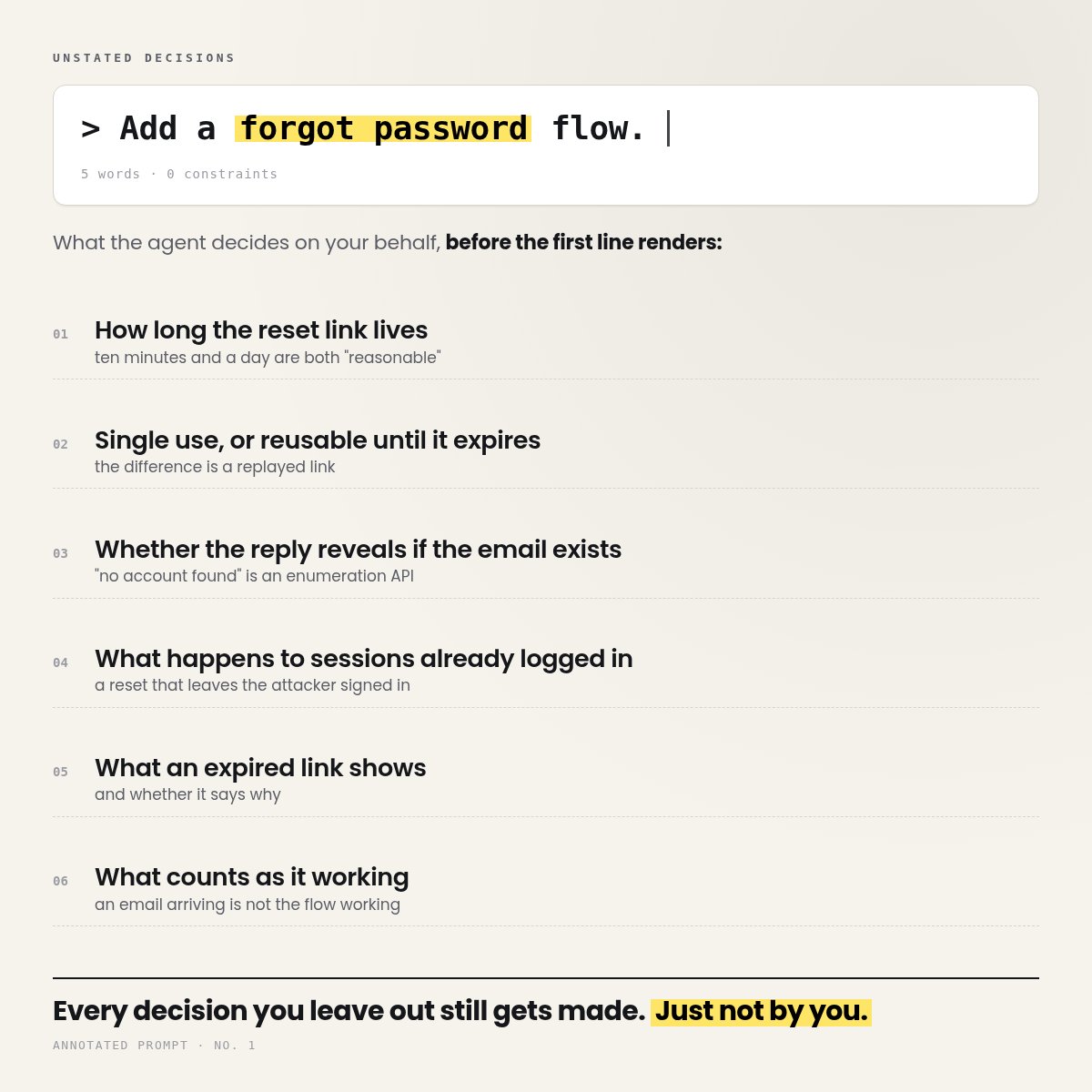
"Add a forgot password flow."
Five words. The agent decides for you:
token lifetime
single use or reusable
whether the reply reveals if the email exists
what happens to active sessions
what an expired link shows
Every decision you skip still gets made. Just not by you.
Nexpath asks for feedback rarely, enforced in code, not tone.
Before a prompt can appear: two hours of active use, idle time not counted, two days since the last ask, clock global across every project.
Four gates, closed by default.
https://t.co/wTvKqsXbJf