10 calendar days to agree on one arbitrator in one treaty. 30 days to appoint your own in another. 45 days in a third. Same kind of dispute, three different clocks, written years before anyone argues.
North River and Ranger, effective 1 March 1999: 10 calendar days after a written request to agree on a single arbitrator. If there is no agreement, each side nominates three names, declines two of the other side's, and a federal court in New Jersey picks from what is left.
Vesta Fire and Affirmative, effective 31 December 2003: 30 days to appoint, umpire by drawing lots if the two arbitrators cannot agree, decision due within 60 days of the hearings closing.
American Hallmark and its affiliates, attaching 1 January 2006: 45 days to appoint, hearing in Fort Worth.
In all three the clock runs from the written request.
$1,805,000 of cover for one loss occurrence. $3,610,000 for the whole year. The gap between them is one reinstatement, and it is not free.
Lebanon Mutual's 2008 property catastrophe treaty with Munich Re America reinstates the exhausted limit automatically from the time of the loss. The additional premium is pro rata on the fraction of the limit reinstated and 100 per cent of the annual premium regardless of the unexpired term. A loss in November costs the same reinstatement premium as a loss in February.
The Commerce Group layer for 2007 writes it without the time phrase and lands on the same arithmetic: pro rata of the annual premium on the fraction of the $25,000,000 face value reinstated.
Penn Millers in 2009 bought something different. First four million reinstated, no additional premium. Next four million, none either. Only the third is charged.
The reinstatement premium is the second invoice of a bad year. The clause sets it, not the calendar.
A Lloyd's member can be told to put more capital in halfway through the year, and it can also be told it may take some out. The two lines are twenty points apart.
Lloyd's own capital guidance, dated April 2026, sets out the quarterly corridor test. Each quarter a member's assets and liabilities are compared against its latest Adjusted ECA. Where assets fall below 90 per cent of that figure, more Funds at Lloyd's is required, and the guidance adds that underwriting restrictions or other measures may be imposed to mitigate the risks until capital is lodged at Lloyd's. Above 110 per cent, surplus Funds at Lloyd's can be released.
Coming into Line itself runs annually in June. The corridor test runs each quarter in between.
The figure being tested sits above the solvency capital requirement. Lloyd's applies an economic uplift to the ultimate SCR to set member capital, and the guidance says that uplift is reviewed annually by its board.
Everything between the two lines stays where it is. Only the part above 110 per cent comes out, and only when the quarterly test says it can.
A reinsurer took on losses above $4.1 billion of someone else's reserves last October. Its right to read the policy files behind them ends one year after the contract does.
Everest told the SEC on 27 October 2025 that State National Insurance Company would cover 100 per cent of losses in excess of $4,119,448,704, up to an aggregate limit of $1.25 billion, effective 1 October 2025. The consideration was $250 million kept as funds withheld plus $1.0 billion of transferred assets.
Article 14 of the filed agreement gives the reinsurer the right to visit the offices and inspect, examine, audit and copy any policy, accounting or claim file, at its own expense, on fifteen working days notice. After a commutation notice that drops to five.
The same article narrows what counts as a Record. Policy files drop out one year after the agreement terminates. Closed claim files drop out three years after the claim closes, and that one bites while the cover is still live.
The notice gets shorter exactly when the exposure is ending. Article 6 says the reinsurer is not liable for anything paid or recorded after the commutation effective date. Five working days to look, at a file set already smaller than the one it priced.
A debut catastrophe bond is in the market at 60 million euro this week, and its price came down while its size went up.
VIG Re, the reinsurance arm of Vienna Insurance Group, launched Charles Bridge Re 2026 DAC seeking 50 million euro of European windstorm retrocession on a weighted industry loss index trigger, four years from 1 January 2027. Artemis reports the target now at 60 million, initial guidance of 3 to 3.5 per cent revised to 2.5 to 3, and guidance now at a fixed spread of 2.5, the bottom of that revised range. Initial expected loss 1.77 per cent.
In the same week VKB is renewing in Germany through King Max Re II DAC, launched at 175 million euro of indemnity multi-peril cover and now targeting 200 million, with guidance at a 2.75 per cent spread against an initial expected loss of 1.68 per cent.
The 60 million tranche is the one worth watching. That is the size a mid-market programme actually needs, and its guidance has come down below the range it launched with.
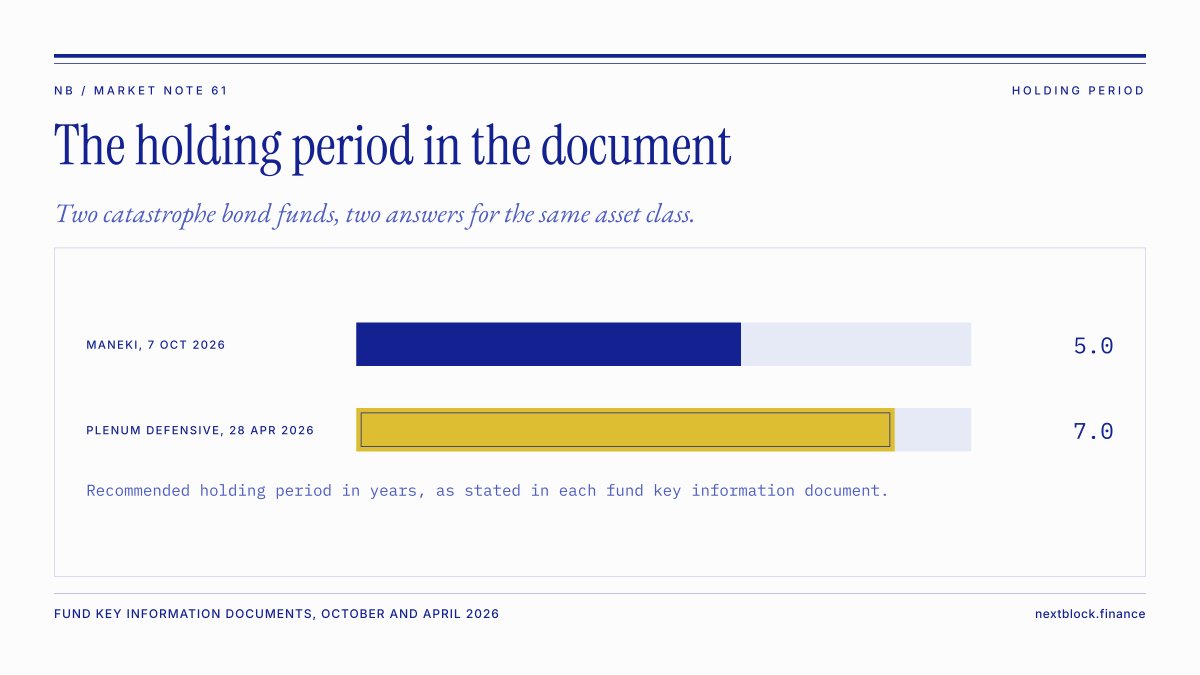
Two catastrophe bond funds tell investors how long to stay. One says five years, the other seven.
Maneki Cat Bond Fund, key information document accurate as of 7 October 2026: recommended holding period five years, weekly dealing, notice by 4pm Irish time five business days before the valuation day, proceeds normally three business days after it. Redemption without penalty, with an anti-dilution levy of up to 5 per cent reserved in the supplement.
Plenum CAT Bond Defensive Fund, class P2 USD, document dated 28 April 2026: recommended holding period seven years, no minimum holding period, no exit fee charged by the fund.
Same risk indicator for both, 2 out of 7.
The way out is weekly. The stay the documents ask for is measured in years. After an insured event, one of them says, the impact "could take a long period of time to be determined".
NB Market Note 61
A reinsurance book that suspended underwriting in December 1982 changed owner this year, and the paperwork to move it cost about a million dollars.
The independent expert report on the transfer of IRB-Brasil's UK branch to Community Reinsurance, dated 29 August 2025, puts the costs and expenses of preparing and implementing the scheme at around $1 million. The transferring side paid that $1 million, so the net cost to the buyer was nil.
The High Court judgment that sanctioned the transfer, handed down on 9 September 2026, records 2,298 claims outstanding at 31 December 2023 under approximately 173 policies, with gross and net claims reserves including IBNR of approximately $32.84 million. The expert report counts 38,066 policies still on the books out of 41,966 ever written, and 2,303 open claims a year earlier.
Part VII asks for an independent expert and a court hearing whatever sits underneath.
$3,000 to list a catastrophe bond note in Bermuda, $1,500 a year after that. $2,500 plus $3,500 annual in Cayman, $6,000 payable on application. Both schedules are published.
The structuring and trustee fees are not. Most cat bonds are placed under Rule 144A and their circulars do not reach a public register. The World Bank is the exception: the prospectus supplement for its $150m Jamaica named storm notes is dated 25 April 2024 and those notes are listed in Hong Kong.
What the record usually gives you is the total. Florida Citizens told its board on 25 June 2025 it had placed $4.49bn of coverage at a cost of about $530.6m. One figure, no breakdown.
A carrier weighing a $5m cession can price the listing and not the deal.
NB Market Note 60
One reinsurance manager handed investors back more money last quarter than it raised from them.
RenaissanceRe's third quarter release, dated 27 October 2026, reports $152.6m of third-party capital raised, $150.0m of it through the Lighthouse Cat Bond Fund, against $249.3m returned.
The release itemises the return: $171.2m from Upsilon Diversified on the release of collateral, $61.6m of excess capital to investors in Fontana driven by retained earnings.
Most of that was not an exit. Collateral comes back when the risk period it secured has run.
When an insurer fails, the reinsurance it bought does not reach its policyholders by default.
The standard insolvency article pays the cedent or its liquidator, without diminution. Then the same article names two exceptions: another payee written into the treaty, or a reinsurer that has taken on the policy obligations as its own.
A cut-through endorsement is the second case. One filed with the SEC obliges the reinsurer to pay the insured directly within three business days of notice.
The notice clock is not uniform either. One treaty allows the estate a reasonable time after the claim is filed. Another allows thirty days.
Who gets paid, and how quickly, is settled in drafting.
NB / MARKET NOTE 59
SafePoint has two catastrophe bonds in the market at the same time, at opposite ends of its own tower.
Nature Coast Re 2026-3: $100m target, annual aggregate industry loss index, $450m attachment, initial expected loss 4.082 per cent, price guidance 7.25 to 8 per cent.
Nature Coast Re 2026-4: $100m, indemnity per occurrence, effective first-event attachment $1.9bn, initial expected loss 0.46 per cent, price guidance 3 to 3.5 per cent.
One pays off an industry index, the other off the cedent's own losses, so the two expected losses are not measuring the same event.
Both are still being offered. The guidance is not a final price.
An insurer pays for its reinsurance before anyone knows what the cover will cost.
Four US treaties filed with the SEC, 2002 to 2009. The cedent pays a deposit premium in four equal quarterly installments, and the real premium is computed only after the year closes.
Lebanon Mutual, 2008: deposit $145,000, installments of $36,250, adjustment within 60 days of year end.
Penn Millers, 2009: deposit $275,396, installments of $68,849.
Donegal, 2002: deposit $7,150,000, installments of $1,787,500.
Commerce Group, 2007: deposit $3,750,000, statement within 90 days, refund within 45.
All four carry a minimum premium underneath.
NB Market Note 58
Two catastrophe bonds priced within days of each other, and the riskier one pays less.
SafePoint's Nature Coast Re 2026-2, Class A: $350m, initial base expected loss 1.66 per cent, final spread 6.25.
Hamilton's Easton Re 2027-1, Class A: $300m, initial expected loss 2.66 per cent, spread reported at 4.25.
One is indemnity property cat cover for a Florida insurer. The other is industry-loss retrocession for a Bermuda reinsurer. Expected loss alone does not set the spread.
A reinsurance treaty carries a date on which the two sides can settle the outstanding reserves for cash and close the contract early. In US treaties filed with the SEC that date lands anywhere from three months to seven years.
2005 workers compensation quota share: three months after the last underlying policy expires.
2011 private motor quota share: three years after inception, with a maintenance fee past four.
2010 workers compensation catastrophe layer: eighty-four months after the contract expires.
2002 quota share: a calendar date, 31 December 2004 or any 31 December after it.
One runs the other way. A 2007 excess layer commutes automatically twelve months after expiry, and the cedent pays 40 per cent of the developed reinsurance premium, minimum $296,000 net, to push that out to eighty-four months.
Until the date arrives the reserve stays where it was put.
NB Market Note 57
The catastrophe bond market has just had its biggest nine months on record. The average deal in it was $95.8m.
Artemis counts $18.9bn of issuance from 93 transactions in the first nine months of 2026, and $65.5bn outstanding at the end of September.
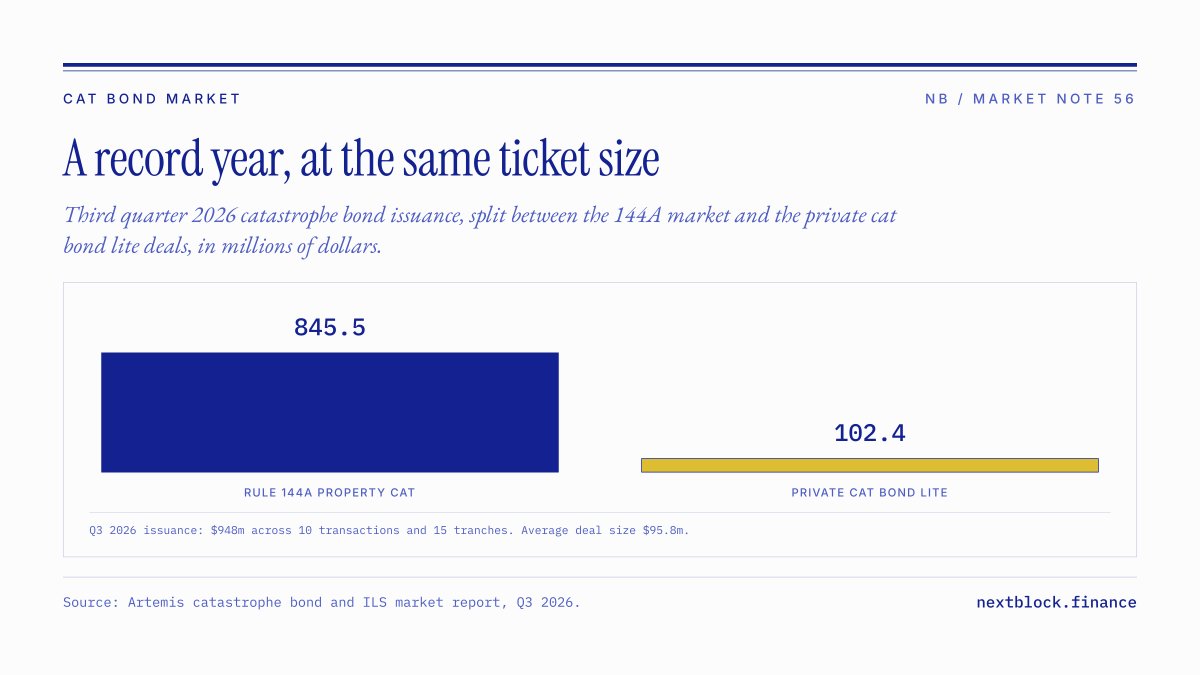
The third quarter brought $948m across 10 transactions and 15 tranches. Rule 144A property cat deals took $845.5m of that, about 89 per cent. The private cat bond lite segment, the corner built for smaller and simpler cessions, took $102.4m across four tranches.
So the format with the high entry cost took nine dollars in ten, in a quarter whose average ticket was $95.8m.
A mid-market carrier with $5m to $50m to place is not short of capital. It is short of a format sized for the cession it actually has.
NB Market Note 56
A clerical mistake in a reinsurance treaty does not change who owes the claim. Five US treaties filed with the SEC, 1998 to 2010, say that in almost the same words. What changes between them is the condition attached.
Three protect the party only if the error is put right quickly. Connecticut General Life and Lincoln Life and Annuity of New York, dated 1 January 1998. American Compensation and St. Paul Fire and Marine, effective 1 January 2001. Philadelphia Insurance and Axis Specialty, effective 1 July 2004. All three say rectified as soon as possible after discovery.
The 1998 one adds a price. If the error delays a transfer of funds, the party at fault pays interest on that amount at the 90-day Treasury rate until it arrives.
A 2010 coinsurance form goes a different way: correct it promptly, then adjust as soon as practicable to put both parties back where they would have been.
Virginia Surety and Tower Insurance Company of New York, effective 1 December 2004, attaches nothing at all.
The clause looks like boilerplate in all five. The proviso is where the money sits.
NB Market Note 55
Three of the nine run-off deals announced in the first three months of this year were worth less than $50m each.
PwC counts nine publicly disclosed non-life run-off transactions in that quarter, from five acquirers, carrying about $730m of gross liabilities across the five that disclosed a value. Two of those five were $250m or more.
Small legacy books do move. They move one negotiation at a time.
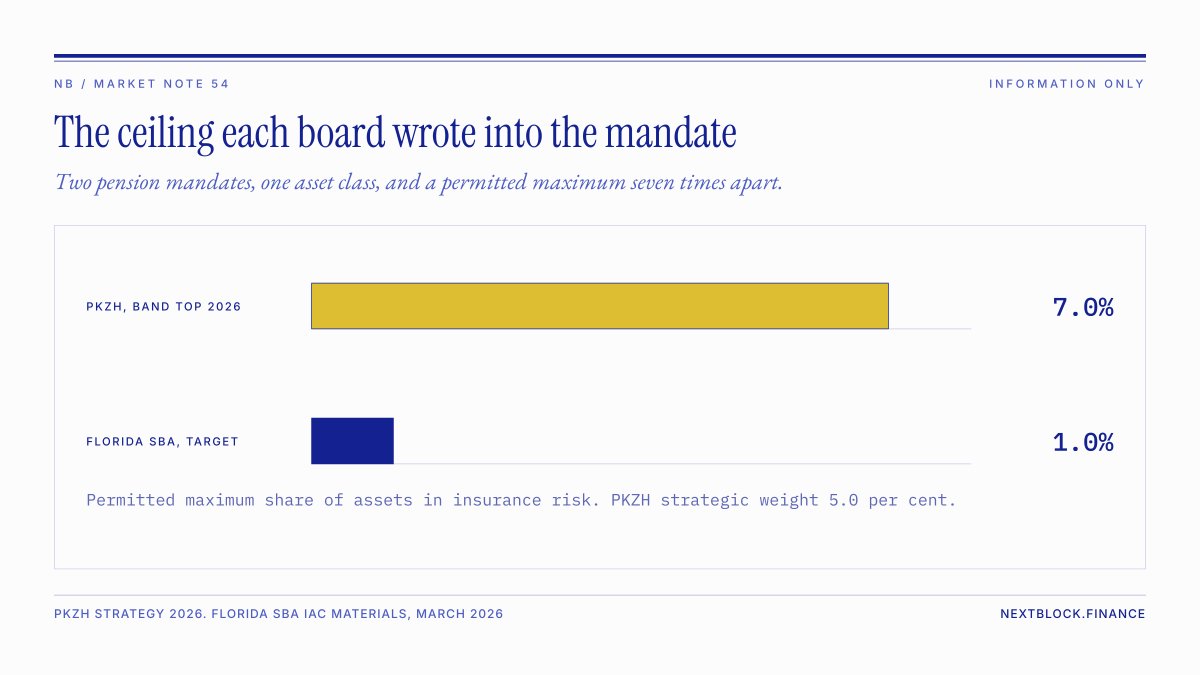
Two pension funds hold insurance risk. One may put up to 7 per cent of its assets in it, the other up to 1.
Pensionskasse Stadt Zurich: strategic weight 5 per cent, band 2.5 to 7, allocation rules in force since 1 January 2026. End 2025 the line stood at CHF 1,178m, 4.9 per cent.
Florida State Board of Administration: insurance target up to 1 per cent, inside a Strategic Investments bucket with a 4 per cent target.
Seven times apart at the ceiling, and the ceilings move. Luzerner Pensionskasse cut its ILS strategy from 3 to 2 per cent for 2026.
Neither ceiling reaches a $5m to $50m cedent programme.
NB Market Note 54
The catastrophe bond market is expected to pass $70bn before the end of this quarter.
The figure comes from Plenum Investments, speaking at a webinar last week. Their portfolio managers also expect spreads to keep easing into 2027, with performance coming down alongside them.
A market that keeps growing while it gets cheaper is one where capital is arriving ahead of the risk on offer. Easier for the buyer of protection, harder for the investor.
Artemis, 30 October 2026.
In mid-October a Florida insurer asked the capital markets for $250m of catastrophe cover. It closed yesterday at $650m, priced below where it started.
Nature Coast Re 2026-2, named storms, indemnity, four years from 1 December.
Class A: target $150m to $350m final, guidance 6.75 to 7.50 per cent, priced at 6.25.
Class AA: target $100m to $300m final, guidance 4.00 to 4.75 per cent, priced at 3.75.
RenaissanceRe's group chief underwriting officer said on 28 October that the company's cat book is down mid-teens year to date, and that he expects rates to come down by less than that at 1 January.
Order tripled, price cleared at the bottom of the range. A cedent with $5m to place still cannot reach the instrument that is repricing.
NB Market Note 53