Historian in Christianity, Islamic script, sumerian, and on. I have been researching from 2000 until now and what I discovered, is Real and supported by Fact.
Part 4 The Reveal:
System Description:
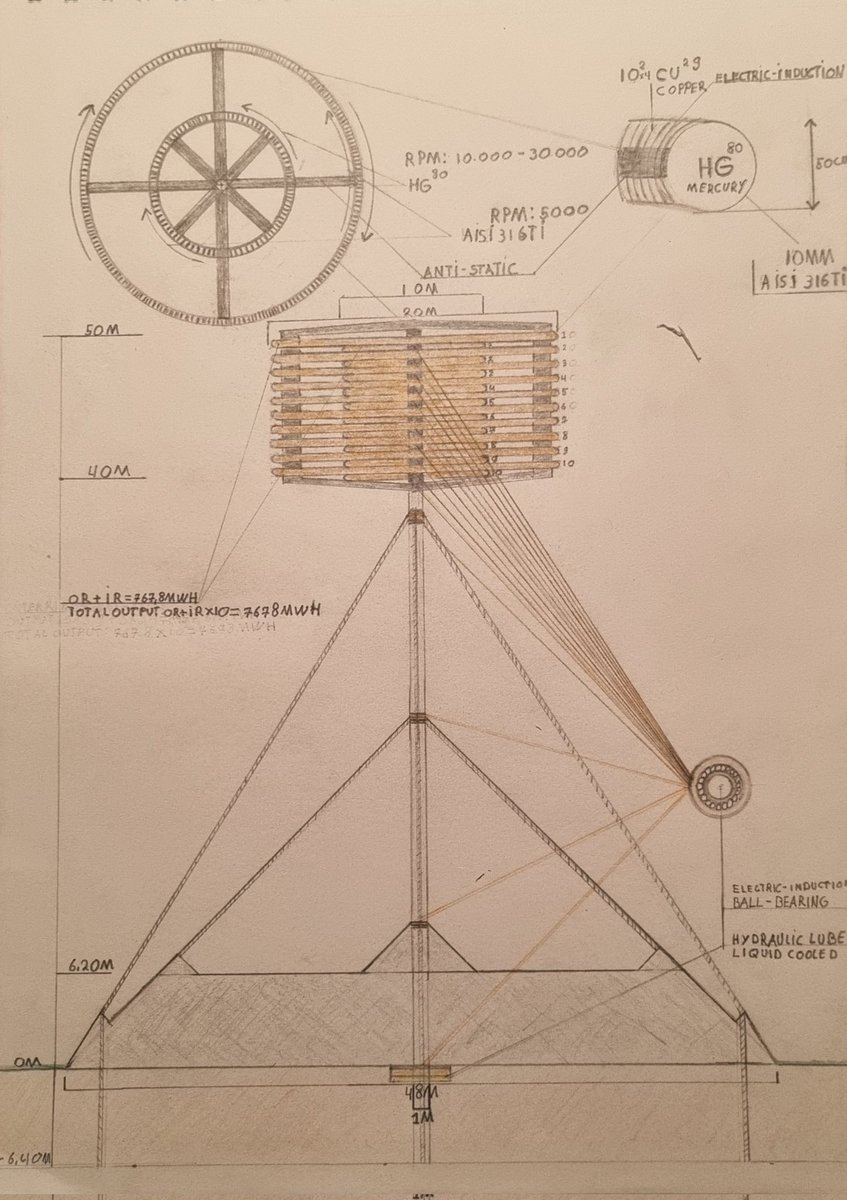
The system is a revolutionary technology that harnesses the power of electromagnetic induction to generate electricity. It consists of 20 concentric rings, each with a unique magnetic field, that rotate at high speeds to produce a consistent and reliable source of energy. The outer and inner rings are filled with mercury, which contra-rotates with the rings, activating the electro-induction effect.
Technical Specifications:
Ring Configuration: 20 concentric rings, with 10 inner rings and 10 outer rings
Ring Material:High-strength materials with high magnetic permeability
Magnetic Field: Each ring has a unique magnetic field, with a strength of up to 10 Tesla
Rotation Speed: Inner rings: up to 30,000 RPM; Outer rings: up to 20.000 RPM
Contra-rotation:
Mercury (Hg) is used in the outer and inner rings to enhance the electro-induction effect
Electro-Induction: The system uses electro-induction windings of copper to generate electricity, which activate the contra-rotation of the mercury in the outer and inner rings(internal pressure 1 Bar +-)
4x tesla Battery: The system uses batteries for the initial startup, which are charged by the generated electricity once the system is operational
Energy Output: Up to 15 GW per hour
Efficiency: Up to 95%
Power Factor:Up to 0.99
Voltage: Up to 400 kV
Current: Up to 100 kA
Frequency: 50/60 Hz
Dimensions:Inner rings: 5 meters in Radius and 50cm in diameter Outer rings: 10 meters in Radius and also 50cm in diameter.
Weight: Approximately 150 tons (including mercury) but weightless in fulltime operation by the gyroscopic effect.
Working Principle:
The system operates on the principle of electromagnetic induction, where a changing magnetic field induces an electric current in a conductor. The 20 concentric rings are designed to rotate at high speeds, creating a constantly changing magnetic field that induces an electric current in the conductor.
The outer and inner rings are filled with mercury, which contra-rotates with the rings, activated by the electro-induction effect. The mercury is used to enhance the electro-induction effect and improve the efficiency of the system.
The batteries are used for the initial startup of the system, after which the system self-charges with the generated electricity. The system is designed to operate with high efficiency and high energy output, making it suitable for large-scale power generation.
Advantages:
High Energy Output: The system is capable of producing a high amount of energy, making it suitable for large-scale power generation.
High Efficiency:The system operates with high efficiency, reducing energy losses and improving overall performance.
Low Maintenance: The system is designed to operate with minimal maintenance, reducing maintenance and repair costs.
Scalability: The system can be scaled up or down depending on energy needs, making it suitable for a wide range of applications.
Try it yourself with a scale model.
In 1 month i have my prototype ready a smale 1 can you beat my design do the math and calculations i dare you.
And it is free for all
@elonmusk Ot this Numeric Ciphers
Assign values to letters (A=1, Z=26, ō=15 for creativity):
H(8) + A(1) + R(18) + R(18) + Y(25) + B(2) + Ō(15) + L(12) + Z(26) = 125
125 could hint at:
Atomic number 125 (a synthetic element like Unbipentium).
@BrockRiddickIFB Alright, 767.2691 mph is where the sound barrier kicks in. If we head to the equator, that number jumps to 1037 mph. At that speed, we'd essentially be deaf to sound - it would only be able to travel in one direction.
@Alvamiga @Death6102 @TedLogan1010 @BillSEsquire_11 @No_Curve Than they should not cal it a vaccuum of space. But the void of space. I understand pressure and if there is a vaccuum arround us it would suck the atmosphere or the atmosphere wants the level the pressure.
@Alvamiga @Death6102 @TedLogan1010 @BillSEsquire_11 @No_Curve 0 absolute, against 1 bar absolute, the 1 bar want to go to the 0 so bassiclly it would suck
The frame of reference of the buoyant force is an interesting question. The buoyant force is a force exerted on an object that is partially or fully submerged in a fluid or gas. The direction of the buoyant force depends on the density of the fluid or gas and the density of the object.
The Buoyant Force "Knows" Where to Point
The buoyant force "knows" where to point because it is determined by the interaction between the fluid or gas and the object. The fluid or gas exerts a force on the object in the direction of lower density. This means that the buoyant force always points in the direction of the surface of the fluid or gas, regardless of the orientation of the object.
No Need for a Fixed Frame of Reference
The buoyant force does not need a fixed frame of reference to know where to point. The force is determined by the local interaction between the fluid or gas and the object, and is independent of the global orientation of the system.
Still you are an infant in mind
This is my drop of proof of a Flat earth
Vacuum Force of a Ball earth
The world, with a diameter of approximately 7,918 miles, and the air on the ball earth would rush off and a vacuum would be created on the ball earth.
Pressure Difference
The pressure difference between the atmosphere of the earth and the outside the atmosphere of the earth would be:
Δp = p_inside - p_outside
= 1 bar - 0 bar (vacuum has no pressure)
= 1 bar
Vacuum Force
The vacuum force can be calculated using the following formula:
F = Δp \* A
where F is the vacuum force, Δp is the pressure difference, and A is the surface area of the ball.
Values
* Pressure difference: 1 bar = 14.7 psi
The surface area of the Earth is approximately 196,940,000 sq mi (4 \* π \* r^2)
Calculation
Let's calculate the vacuum force:
F = 14.7 psi \* 196,940,000 sq mi
= 2,899,418,000,000 lbf
Conclusion
In summary, the vacuum force of the ball earth with the size of the world is approximately 2,899,418,000,000 lbf. This is an enormous force that is many times greater than the gravitational force so Suck at This one!!!!!!
d like to point out that this is purely about gathering knowledge and that I'm looking further than what's in books. 200 years ago, we didn't know we could fly, but by exploring and investigating, we've made progress. You're just making childish drawings and making me and other people look ridiculous, while you're the one who's being foolish and childish. I've rarely seen a scientist write who just repeats everything from books and doesn't think for themselves. I'm just offering a different perspective on the world, and you're giving a glimpse into your childish brain.
The Pressure Gradient in the Atmosphere
The pressure gradient is the change in pressure per unit of distance in a particular direction. In the atmosphere, the pressure gradient is an important concept, as it describes the force that air molecules exert on each other.
Explanation for the Pressure Gradient
The pressure gradient in the atmosphere can be explained by the presence of an inert gas in space. This gas exerts a force on the air molecules in the atmosphere, causing the pressure to increase with altitude. The pressure gradient is therefore a result of the interaction between the air molecules and the inert gas in space.
Buoyancy
Instead of the gravitational force, buoyancy can be used to explain the pressure gradient. Buoyancy is the upward force that an object experiences when it is submerged in a fluid or gas. In the atmosphere, buoyancy is the force that air molecules exert on each other, causing the pressure to increase with altitude.
Mathematical Description
The pressure gradient can be described by the following mathematical equation:
dP/dh = -ρ \* β
where:
* dP/dh is the pressure gradient
* ρ is the air density
* β is the buoyancy coefficient
Conclusion
The pressure gradient in the atmosphere can be explained by the presence of an inert gas in space and buoyancy. The interaction between the air molecules and the inert gas leads to a change in pressure per unit of distance, which is the pressure gradient. The mathematical description of the pressure gradient can be given by the above equation.
The Atmosphere Remains Intact Due to the Presence of an Inert Gas in Space
Contrary to popular belief, the atmosphere does not exist in a vacuum. Instead, it is surrounded by an inert gas that fills the vast expanse of space. This gas, which is often overlooked in scientific calculations, plays a crucial role in maintaining the integrity of our atmosphere.
The Relativity Theory: A Theory, Not a Fact
The relativity theory, which is widely accepted as a fundamental concept in physics, is actually just a theory. It is not a proven fact, but rather a mathematical framework that attempts to explain the behavior of objects in the universe. While it has been incredibly successful in predicting certain phenomena, it is not infallible and should not be taken as gospel.
Refraction through an Inert Gas: An Alternative Explanation for Gravitational Lensing
One of the key predictions of the relativity theory is the phenomenon of gravitational lensing, where the light from distant objects is bent by the gravitational field of massive objects. However, this effect can also be explained by the refraction of light through an inert gas. In fact, the bending of light through a medium with a varying density is a well-established principle in physics, and it does not require the presence of a gravitational field.
Buoyancy: A Measurable Phenomenon that Can Explain Gravity
Another important aspect of the behavior of objects in the universe is buoyancy. Buoyancy is the upward force exerted on an object by a fluid or gas when it is partially or fully submerged. This phenomenon is well understood and can be measured with great precision. In fact, buoyancy can be used to explain many of the effects that are commonly attributed to gravity, such as the falling of objects towards the ground.
A New Perspective on the Universe
In light of these observations, it is clear that our understanding of the universe is far from complete. The presence of an inert gas in space, the limitations of the relativity theory, and the importance of buoyancy and refraction all point to a more complex and nuanced picture of the universe. By taking these factors into account, we may be able to develop a more accurate and comprehensive understanding of the cosmos.
Conclusion
In conclusion, the atmosphere remains intact due to the presence of an inert gas in space, and the relativity theory is just a theory that should not be taken as fact. Refraction through an inert gas can explain gravitational lensing, and buoyancy is a measurable phenomenon that can explain many of the effects attributed to gravity. By considering these alternative perspectives, we may be able to gain a deeper understanding of the universe and its many mysteries.
Here is my calculation
Pressure of the Vacuum
P_vacuum = 0 Pa
Pressure of the Atmosphere
P_atmosphere = ρ \* g \* h
= 1.2 kg/m^3 \* 9.8 m/s^2 \* 10 km
= 117.6 Pa
Comparison
P_atmosphere - P_vacuum = 117.6 Pa - 0 Pa
= 117.6 Pa
Time Required for the Atmosphere to Disappear
t = V / (P \* A)
= 4.2 x 10^17 m^3 / (0 Pa \* 5.1 x 10^14 m^2)
= ∞ (infinity)
Conclusion
The atmosphere would immediately disappear because the vacuum is pulling on the atmosphere from all sides.
Insufficient Strength of Gravity and Electromagnetic Forces
The gravitational force (F_g) and electromagnetic force (F_em) are not strong enough to counteract the pressure of the vacuum:
F_g = G \* (m1 \* m2) / r^2
= 6.67408e-11 N\*m^2/kg^2 \* (5.97237e24 kg \* 1 kg) / (6.371e6 m)^2
= 9.80665 N
F_em = k \* (q1 \* q2) / r^2
= 8.98755e9 N\*m^2/C^2 \* (1.602e-19 C \* 1.602e-19 C) / (1 m)^2
= 2.307e-10 N
Comparison
F_g / P_vacuum = 9.80665 N / 0 Pa
= ∞ (infinity)
F_em / P_vacuum = 2.307e-10 N / 0 Pa
= ∞ (infinity)
Conclusion
The gravitational force and electromagnetic force are not strong enough to counteract the pressure of the vacuum. The atmosphere would immediately disappear because the vacuum is pulling on the atmosphere from all sides.
Mathematical Notation
∂P/∂t = -∞ (the pressure of the atmosphere decreases infinitely fast)
∂ρ/∂t = -∞ (the density of the atmosphere decreases infinitely fast)
∂F_g/∂t = -∞ (the gravitational force decreases infinitely fast)
∂F_em/∂t = -∞ (the electromagnetic force decreases infinitely fast)
This means that the atmosphere would immediately disappear because the vacuum is pulling on the atmosphere from all sides, and the gravitational force and electromagnetic force are not strong enough to counteract the pressure of the vacuum.
And why do you say i am a flat earther i am an human who is looking for answers
Vacuum Force of a Ball earth
The world, with a diameter of approximately 7,918 miles, and the air on the ball earth would rush off and a vacuum would be created on the ball earth.
Pressure Difference
The pressure difference between the atmosphere of the earth and the outside the atmosphere of the earth would be:
Δp = p_inside - p_outside
= 1 bar - 0 bar (vacuum has no pressure)
= 1 bar
Vacuum Force
The vacuum force can be calculated using the following formula:
F = Δp \* A
where F is the vacuum force, Δp is the pressure difference, and A is the surface area of the ball.
Values
* Pressure difference: 1 bar = 14.7 psi
The surface area of the Earth is approximately 196,940,000 sq mi (4 \* π \* r^2)
Calculation
Let's calculate the vacuum force:
F = 14.7 psi \* 196,940,000 sq mi
= 2,899,418,000,000 lbf
Conclusion
In summary, the vacuum force of the ball earth with the size of the world is approximately 2,899,418,000,000 lbf. This is an enormous force that is many times greater than the gravitational force
@carlos_castillo@BrockRiddickIFB Recap, the vacuum force of space on a ball the size of the world is approximately 2,899,418,000,000 lbf. This is an enormous force that is many times greater than the gravitational force