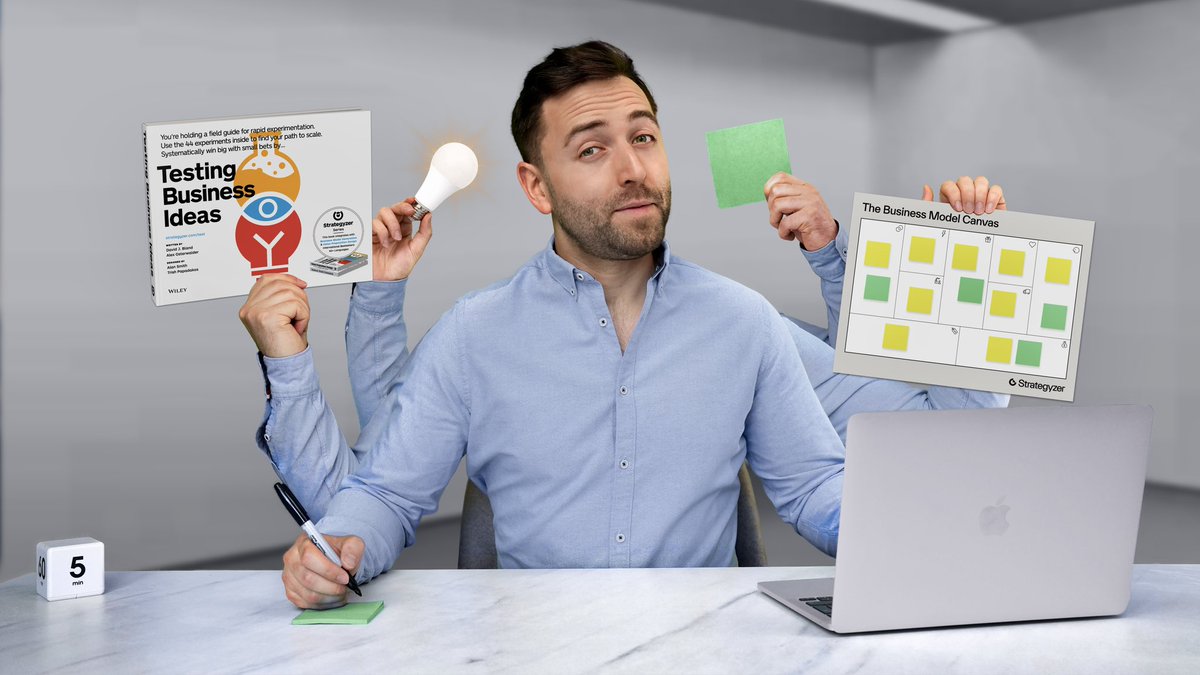
A lot of people struggle with the Customer Relationships building block of the Business Model Canvas.
It’s one of the most important parts of the canvas.
I made this video to help make it easier to fill it out. 👇https://t.co/lXdzHQcpVy
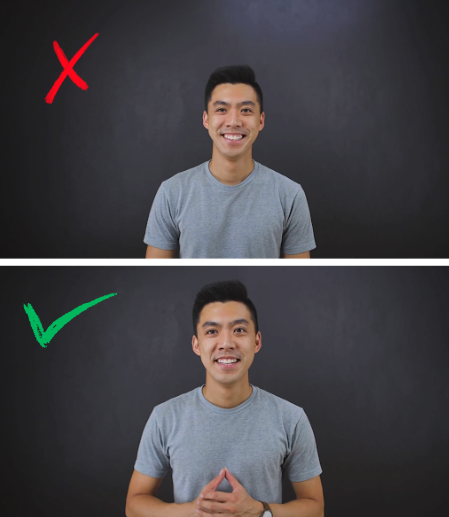
Another framing mistake that people make:
Putting your face in the middle of the shot.
Don’t do this!
Remember, a person also has a body.
Balance the frame out by positioning the head a little higher and aim for 2-6 inches of headroom.
ChatGPT is my "idea generation" intern:
I feed it a topic I want to explore.
And it generates 2 lists for me:
1. A list of "actions" someone interested in the topic might have questions about
2. A list of questions
Then I sit down and just answer the questions.
Easy!
How to build a $1,300/month side business for $19.
Here's the entire 16-step business plan for you:
1. Clean up your profile to reflect what you do for people.
2. Create content that talks about a challenge you solve.
3. When people ask questions, DM them.
4. Tell them you'll help solve their problem for free.
5. In return, as for 30 minutes to ask questions.
6. Do 15 calls to understand how to solve the problem.
7. Create a solution process that takes 60 minutes.
8. Build a simple Carrd website for $19.
9. Add a Stripe widget for a paid service
10. Title the service "From X to Y in 60 minutes"
"From clueless to writing lines of code in 60 minutes"
11. Open up a few slots outside of your 9 to 5.
12. After payment, redirect to a Calendly account.
13. Set up a form to collect important info.
14. Add your website to your X and LinkedIn profiles.
15. Continue creating great content each day.
16. When people ask questions, direct them to your site.
If you can book:
2 calls per week at $150 an hour: $1,300 per month
3 calls per week at $150 an hour: $1,950 per month
3 calls per week at $250 an hour: $3,250 per month
The possibilities are endless.
Listen, this is certainly not perfect. There are a million nuances I didn't mention.
But know that getting started is the hardest part.
So, try the above plan for 6 months
Tinker around with it, listen to your customers, experiment, & make changes.
I hope this helps.
@KevinEspiritu Courses don't bother you. Unqualified teachers bother you.
Courses are a medium for a message, like books. Bad course creators and bad authors are the same.
We've just romanticized books and hold authors in high regard even though they're often grifters on a national scale.
A few months ago, I went to a $15 open mic in Austin.
Dude gets on stage. The crowd goes bonkers. It's Shane Gillis, one of the most popular comedians in the world.
He pulls out a notebook and a pen, grabs the mic, and starts telling jokes.
When the crowd gives one of those loud, genuine laughs, he jots down a note. When the crowd looks at each other, confused, he jots down a note. When the crowd stares at him, expecting more, he jots down a note. When the crowd gives that knowing chuckle, he jots down a note.
You get the idea. He's testing jokes. Making a note of what's connecting and, even more importantly, what's not.
Then, I imagine, he cuts or changes the parts that don't connect. Tests them again at another open mic. And repeats the process until the joke, his story, is tight and compelling throughout.
He made me realize:
This is how you can treat Storytelling, too.
Your story is flexible. You can constantly test, get feedback, improve, repeat. Like Shane, what you're looking for is moments of connection:
• Your boss starts nodding along.
• Someone leans forward in their chair.
• There's a spark of interest in your partner's eye.
You get the idea. You're searching for that visceral reaction in your audience.
When you see it, double down. Iterate until you get there.
@TomFrankly I made video about why we should stop focussing on building and instead focus on making progress by running experiments. You might find it useful. 👇
https://t.co/CXrdFtFt93
@TomFrankly “the smallest possible thing” makes it sounds like you need to make a simple version of the product.
What’s better is running an experiment which doesn’t even require you to build it yet.
Run a test, see if people even like the idea before you start building.
My challenge to you:
Choose ONE metric in your business:
• Revenue for ONE product
• Email subscribers
• Followers on ONE platform
Anything – whatever metric is important to you.
Design an experiment to try and improve that ONE metric. If it's revenue, you could try and increase visitors to the sales page or conversion from visitors to customers.
One metric, one experiment, and run it for one month.
This one thing, if done consistently, will make a massive difference by the end of the year.
@lennysan@karrisaarinen@ericries Why don't we say we're "running business experiments" and use MVP specifically for later stage validation experiments?
Thanks for sharing @lennysan
This interview inspired me a lot.
So much so I decided to turn my thoughts into a video.
https://t.co/RFCGolGxnl
@karrisaarinen Also, it's so easy to fall into the build, build, build loop trap!
Why not call them business experiments?
Then MVP or a single feature prototype is just one validation experiment but there are many.
This inspired me to put my perspective into a video.
https://t.co/RFCGolGxnl
3. Design matters a lot. EVERYTHING is designed – and people associate good design with being trustworthy.
4. Distribution matters as much as (or more than) the product.
5. Great marketing or distribution can't save a BAD product