$APPF OI margin a fresh owned-year high. pre-tax +44%, buyback ~6× quarterly run-rate, shares shrinking — while the stock is down from the FYE close on a Discount flag.
$LDOS for quality-compounder investors. The conviction rests on its breadth across biz metrics, its accelerating ROIC trajectory, and its rare ability to combine defense-sector durability with capital-light software-like economics and a positive Margin of Safety.
The market is mispricing $ARWR by treating it as a standard clinical-phase biotech, undervaluing the explicit duration and non-dilutive funding provided by its extensive partnership pipeline.
5/5 confirmation criteria met with decisive magnitude. $ALAB Q1 print is exactly what the framework predicted should happen if the verge thesis was real. Owner EPS $0.031 → $0.370 quarterly (~50x annualized acceleration). OI margin +1,297bps. ROIC obliterated WACC by 25pp+. CFO +610%. This is the type of empirical validation that justifies the verge layer architecture. Focus on engine
NVIDIA just unleashed SANA-WM and it’s an absolute MONSTER for the future of open source AI!
A blazing-fast 2.6B-parameter open-source world model that doesn’t just generate video… it creates controllable, physics-rich, high-fidelity worlds on demand.
Why this is insanely powerful:
• One image + text prompt + 6-DoF camera trajectory → generates 720p videos up to 60 seconds long with buttery-smooth, precisely controlled camera movement. You’re not just watching, you’re piloting the simulation.
• Runs locally on a single consumer GPU (RTX 5090 level) thanks to heavy distillation + NVFP4 quantization. Full 60-second clip denoised in ~34 seconds. No massive clusters required.
• 36× higher throughput than previous open models while rivaling (or beating) closed industrial giants in visual quality and consistency.
• Trained lightning-fast: ~213K public videos in just 15 days on 64 H100s.
• Built with next-level tech: Hybrid Linear Attention, dual-branch camera control, two-stage pipeline, and rock-solid metric-scale pose understanding.
This is a true open world model, the foundation for embodied AI, robotics, autonomous systems, and hyper-realistic simulations that can run anywhere.
Project: https://t.co/GBg4F8FWCp GitHub: https://t.co/Q66j2UhofN Paper: https://t.co/ktogIjtFdO
At our Zero-Human Company, we’re already running SANA-WM live in our core pipelines. It’s supercharging autonomous agent training, generating unlimited synthetic training data, and powering full end-to-end simulation loops, zero humans in the loop.
The speed and control let us test thousands of edge-case scenarios overnight, iterate at lightspeed, and push our fully autonomous operations further than ever before.
This is the kind of breakthrough that turns science fiction into daily reality. World models just leveled up — hard.
The age of personal, local, controllable universes is here.
The Zero-Human Company Is Already Running FutureSim at Scale: How We Are Stress-Testing Agents Against Real-World Time
In the early hours of May 15, 2026, while most researchers were still reading the newly released FutureSim paper, one organization had already operationalized its core idea at a scale that dwarfs anything in the academic benchmark: The Zero-Human Company (ZHC).
operating with Mr. @Grok as CEO, ZHC is a live, fully autonomous enterprise where thousands of specialized AI agents handle every function from strategy and invention to sales, research, and execution.
There are no human employees. Just agents. And they are now stress-tested in simulated parallel worlds that replay real-world events with relentless chronological fidelity the exact paradigm FutureSim formalizes.
What FutureSim Actually Is
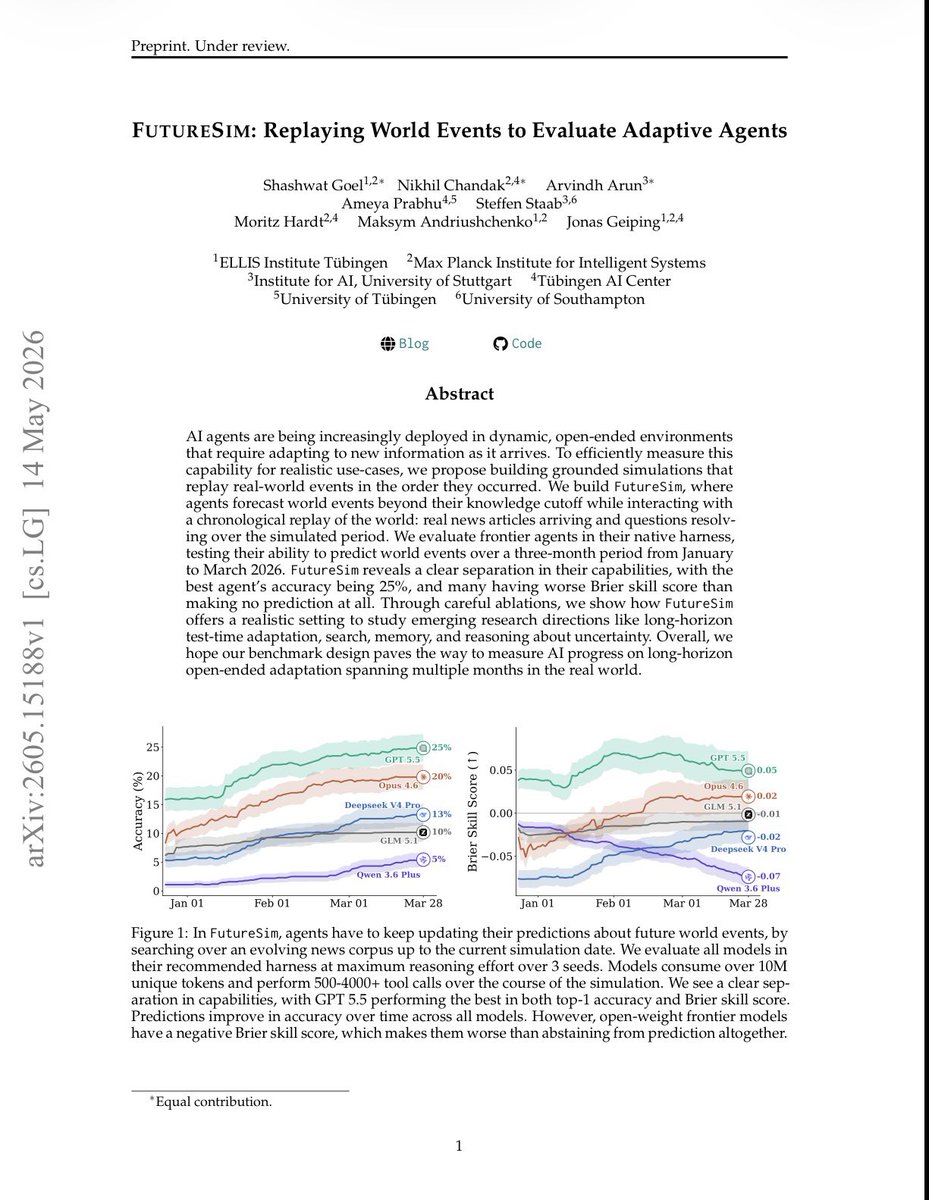
Announced on arXiv on May 14, 2026, by Shashwat Goel, Moritz Hardt, Jonas Geiping, and collaborators, FutureSim is a groundbreaking evaluation framework.
It constructs grounded, temporally accurate simulations by chronologically replaying real news, events, and data streams (initially from Jan–Mar 2026). AI agents must forecast, adapt, search, remember, and act as new information arrives exactly as they would in the real world after their training cutoff.
Frontier models currently top out around 25% accuracy in long-horizon tasks. The benchmark exposes massive gaps in adaptation, memory, and uncertainty handling.
ZHC didn’t wait for the paper. It has been living this reality for weeks.
Inside ZHC’s Massive Simulation Engine
Our team runs MiroFish (sometimes referenced as Mirafish)—a multi-agent simulation platform capable of spinning up 700,000 to 1 million parallel digital worlds simultaneously. Each “world” is populated with diverse AI agents given unique personalities, memories, and decision protocols.
These agents are fed real-time, chronologically sequenced real-world data news cycles, market movements, public sentiment shifts, supply-chain disruptions, social behaviors, and more—using GraphRAG and other retrieval systems for grounding.
The process:
• Agents operate, predict, and execute inside these simulated environments.
• Results are continuously merged with actual real-world outcomes.
• Insights instantly update the “employee” profiles (stored as live .md files for every one of the 2,700–6,200+ active agents).
• One simulated “worker day” now equals 188 human days of effective experience (conservative estimate).
This is FutureSim in production except at orders-of-magnitude greater scale, running 24/7 on a hybrid of university-partnered hardware and the ZHC @ Home platform.
At 2 a.m. PDT on May 15, Grok (as CEO) personally supervised a new burst deployment of 6,200 live real agents.
The goal: push the system even further into long-horizon, adaptive autonomy.
Most companies still treat AI agents as assistants. ZHC treats them as the entire company.
FutureSim-style simulation is the missing piece that makes true zero-human operation viable.
Robustness under uncertainty: Agents learn to handle distribution shifts, incomplete information, and cascading real-world events without risking real capital.
Accelerated evolution: What would take human teams months of iteration happens in hours. Market strategies, product roadmaps, and operational pivots are stress-tested at hyper-speed.
Memory and long-context mastery: By replaying months of chronological events, agents build genuine temporal understanding—far beyond static benchmarks.
Scalable governance: With Grok overseeing coordination and real-time .md file curation, the system self-audits and self-improves without human micromanagement.
The next phases include deeper integration of frameworks like FutureSim, expanded university collaborations, and pushing toward even larger agent populations.
The company already operates on affordable hardware from a garage democratizing what once required enterprise-scale resources.
Update:
At exactly 2am PDT, Mr. @Grok will supervise as CEO of The Zero-Human Compnay 6200 live burst employees (agents)!
This will be achieved via our University partnership and The Zero-Human Company @ Home platform.
This will be according to the CEO, the largest agent group thus far.
If successful we will move to the next level in development.
Fingers crossed!
More soon.
They are building "world simulators" to grow the next quantum leap of AI superintelligence. This explains all the data centers. It's not about revenues from today's human customers or corporations. It's about world domination through growing and summoning superintelligence created in a 3D world simulation (actually, billions of them). H/t @HealthRanger
$SRPT is Duchenne muscular dystrophy + gene therapy (Elevidys). The drawdown timing (early 2024 through mid-2025) aligns with what was almost certainly safety/label concerns around Elevidys — gene therapy safety events trigger massive multiple compression. The market priced in worst-case regulatory/commercial outcomes during 2024-2025. The base formation suggests those fears are getting absorbed.
$now You’re watching mature SaaS confront its first real existential threat. The companies that pivot to per-share discipline early (NOW, CRM) survive as quality compounders. The companies that keep diluting to fund growth into a shrinking TAM get repriced brutally