@megbasham@BigD7764@HelloFresh I’d take this down Megan. With AI nowadays, who knows if anyone can track down the address on the label. Be wise for safety
@RyanLewwy@JustinPetersMin I’m not sure that’s true. Of course we’re called to exercise grace and mercy but there are many cases in scripture that destruction was a work of God and a direct response to get His people to truth.
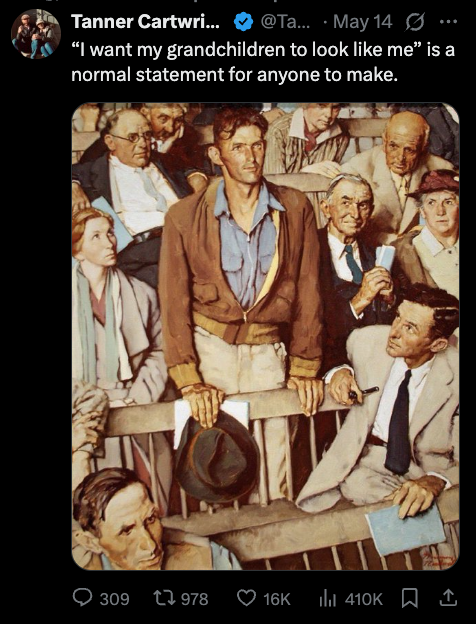
I have grandchildren. Never crossed my mind that my goal for them was to look like me. Heavens no. But know my Lord? Walk in His ways? Live for His glory? Have a sound foundation to stand against the world and the enemies of Christ? That's all I've ever cared about. I guess, as I said last evening, and here on X this morning: my people are the ones surrounding the throne in glory, absorbed in the worship of He who sits upon the throne, and the Lamb. The only "looks like" that matters to me is "he looks like Jesus."
I've noticed the back and forth going on over "Mother of God." Words I wrote about 26 years ago on the topic that could, if considered, end much of the dispute (but won't):
It’s the single most misused theological term around. Mary is the “mother of God.” The logic seems inescapable: Jesus is God, come in human flesh. Mary is Jesus’ mother. Hence, Mary is the mother of God. What could be simpler?
If everyone would use the term to communicate just that—that Jesus Christ was truly and completely God—there would be no reason to include a brief chapter on the topic of “the mother of God.” Yet, obviously, that would be a bit simplistic. Most of the time when the phrase is used, the persons using it are not in any way commenting on the fact that Jesus Christ was God and Man on the earth. They are not speaking about Christ at all, but about Mary, and they are using the title to give her a position of honor and power.
Should we call Mary “Mother of God”? What did the term mean in the ancient church? How is it being misused today?
The Origin of the Term
Anyone who reads the writings of the ancient church knows that the word translated “Mother of God” is the Greek term theotokos. Literally, the word means “God-bearer.” It became a title for Mary, so that you often find her simply being called Theotokos in devotional and theological writings. But where did the term come from?
Around the beginning of the fourth century, Alexander, Bishop of Alexandria, first used this term when speaking of Mary.
It is no coincidence that it was the teaching of Alexander that prompted the most famous “heretic” of all time—Arius, the great denier of the deity of Christ—to begin propagating his heresy. Evidently, at that time, even in its earliest uses, the term was meant to say something about Jesus, not Mary. That is, the term was Christological in force. It was focused on Christ, and was meant to safeguard the truth about His absolute deity.
The term really entered into the “orthodox” vocabulary through its usage at the Councils of Ephesus (a.d. 431) and, more importantly, Chalcedon (a.d. 451). We can learn the most about how this term was originally understood by taking a moment to understand why it appears in the creed produced at Chalcedon.
The debate over the complete deity of Christ had lasted for many decades, continuing on well after the Council of Nicea had finished its work (a.d. 325), not coming to completion until the Council of Constantinople in a.d. 381. But once this great truth was properly safeguarded, other questions began to arise. One of those questions went like this: Granted that Jesus Christ is truly God in human flesh, how, then, are we to understand the relationship between the divine and the human in Christ? Was He really a man at all? Did His deity swallow up his humanity? Was there some mixture of the two? Or was Jesus two people: one divine and one human, merely sharing one body?
Sadly, the debate was undertaken in anything but a calm and respectful climate. More time was spent on political maneuvering than upon meaningful exegesis. But despite the rancor of the debate, the resulting understanding was very important, especially for our understanding of the term theotokos.
One of the principle participants in the debate over the nature of Christ was a man named Nestorius. But since he was eventually condemned as a heretic, we have some doubt as to whether we have a completely accurate (or fair) view of his beliefs, as they have come down to us primarily through the writings of his enemies. Basically, Nestorius objected to the use of the word theotokos. He quite rightly expressed concern that the word could be easily misunderstood. But most importantly, his denial of the propriety of theotokos led him to insist that Mary was the mother only of the human “element” of Christ, which resulted in a functional separation of the divine from the human in Christ. The basic danger of Nestorius’ position, then, was that it led to a Jesus who was two “persons,” with no real connection between the divine and the human.
Those who defended the use of theotokos did so by insisting that the Messiah was fully human and fully divine from the moment of conception, hence, the child who was born was not only a human child with deity dwelling in him but was the God-Man, the Incarnate One. Chalcedon insisted that Jesus was one Person with two distinct natures, the divine and the human. The divine did not “swallow up” the human, nor was it “mixed” with the human to create something that was neither fully God nor fully man. Nor was Jesus schizophrenic—a human person, Jesus, and a divine Person, separate from him. He was one person with two natures.
What is vitally important is that the term God-bearer as it was used in the creed and as it was applied to Mary in these controversies said something about the nature of Christ, not the nature of Mary. “Mother of God” is a phrase that has proper theological meaning only in reference to Christ. Hence, any use of the term that is not simply saying, “Jesus is fully God, one divine Person with two natures,” is using the term anachronistically, and cannot claim the authority of the early church for such a usage.
The Misuse of the Term Today
Outside of seminary classes and theological debates about the Trinity, I have never heard the term “Mother of God” used in a historically proper and theologically accurate way. That is, every time I have heard the title used outside those contexts it was being used to say something about Mary rather than something about Christ. Obviously, Nestorius was right about one thing: the term is liable to serious misuse and misunderstanding.
Mary is not the mother of God in the sense that she gave rise to the being of God. We normally use the word “mother” to refer to the one who gave rise to us as individuals, and from whom we derived our human nature. Yet the divine Person who became Jesus, the eternal Son of God (Col. 1:13–17), the Logos (John 1:1–14), has existed eternally and is the Creator of Mary. She was used to bring the Incarnate One into the world, but she did not add to or give rise to the Eternal Son who came into the world through her. Her child was fully divine (hence she is theotokos) but she herself did not give rise to the divinity of her Son. For this reason, there can be nothing about the term theotokos that in any way exalts Mary, but only Christ.
Of course, if this is true, then the vast majority of the use of the phrase “Mother of God” in our world today is simply in error. Prayers addressed to "Mother of God" that seek her intercession and ascribe to her power and glory and honor are using the title in a way completely foreign to the biblical truths that gave rise to it in the first place. And the fact that, in general, the term is avoided as improper outside the narrow spectrum in which it speaks to the important truth of the unipersonality of Christ, as well as His full deity, is a testimony to the spiritual sensitivity of believing Christians. We cannot help but conclude that the use of "Mother of God" as a title for Mary that leads to her being seen in quasi-divine categories is nothing but a gross misunderstanding of the true relationship between the blessed virgin of Nazareth and the eternal God who sent the eternal Son to be born of her.
Onomastic congruence is a criteria of investigation done on ancient works that analyzes the frequency and patterns of names. When this is done with the biblical Gospels and Acts we find something very interesting.
Christ beside me
Christ before me
Christ behind me
Christ within me
Christ beneath me
Christ above me
Christ to the right of me
Christ to the left of me
Christ in my lying, my sitting, my rising
Christ in heart of all who know me
Christ on tongue of all who meet me;
Christ in eye of all who see me;
Christ in ear of all who hear me.
—St. Patrick's Breastplate
Meh, I love Doug. I have spent time with him, eaten Taco Time with him (that's a true bonding experience!), and unlike 99.999% of his critics, I have debated him, repeatedly, on a wide variety of topics. And I am a better Christian for having done so, and I hope he would say the same thing in reverse. I am so thankful he got to be on TC and give a clear testimony to the fact that Jesus is a perfect and powerful Savior of sinners. And if your DWDS is so strong you can't rejoice in that, well, you've lost the narrative. Step back, take a deep breath, and be thankful.
So I have not commented on this uber-recent, "I wonder if anyone will remember this a year from now" controversy over saying "Christ is King." Evidently, the only real controversy is due to vile unbelievers using the phrase as some kind of attack upon "Jews," however you even define that term. There is absolutely no question about the fact that there are false brothers (and sisters) pretending to be amongst the sheep who are promoting vile prejudices and hatreds toward some mythical concept of "the Jews," asserting they are behind all sorts of evil things. Had one of these loonies show up at Apologia last year. Wasted ten minutes with him before he finally got to "the Jews." At which point I rolled my eyes and suggested he might want to exit the building. Anyway, such folks need to be marked out, rebuked, avoided. No question.
But "Christ is King" has definitely taken on a greater meaning since 2020, globally. As a child, we would have said this phrase without giving it a second thought because in our "myth of neutrality" world, we were only talking about a spiritual king. The idea that the ascended and enthroned Lord would fulfill the words of Psalm 2, and kings and judges would be called to bow down to him and kiss him (and hence actually take consideration of His law), never crossed our minds. It does now, of necessity. And so we are thinking through what this must mean as we face a world of techno-tyrannical secularism. There is much work to be done in this project, to be sure, and we dare not avoid that labor.
But what we SURELY cannot do is hesitate for even a moment to proclaim Christ as King. But this little controversy should surely show us that when we make that statement, we need to be prepared to make application and defense immediately.
More on this topic on the DL today at 5pm EDT. And for those who would like, here is Psalm 2, sung in German, by my dear brother Tobias Riemenschneider (who preached a barn-burner of a sermon at Apologia this past Sunday!):
https://t.co/WhbTZxgmTu
@kevinmyoung @dumpsterfiretx @HwsEleutheroi He may block me that’s fine. The truth is he wanted him to eat with him and call him a Christian. Is that not what I just said that’s total truth? So I lied?
@kevinmyoung @dumpsterfiretx You had an opportunity to debate this “non expert” @HwsEleutheroi but u forced a person u know disagrees with you (since it’s a debate to begin with) to acknowledge and accept your beliefs.