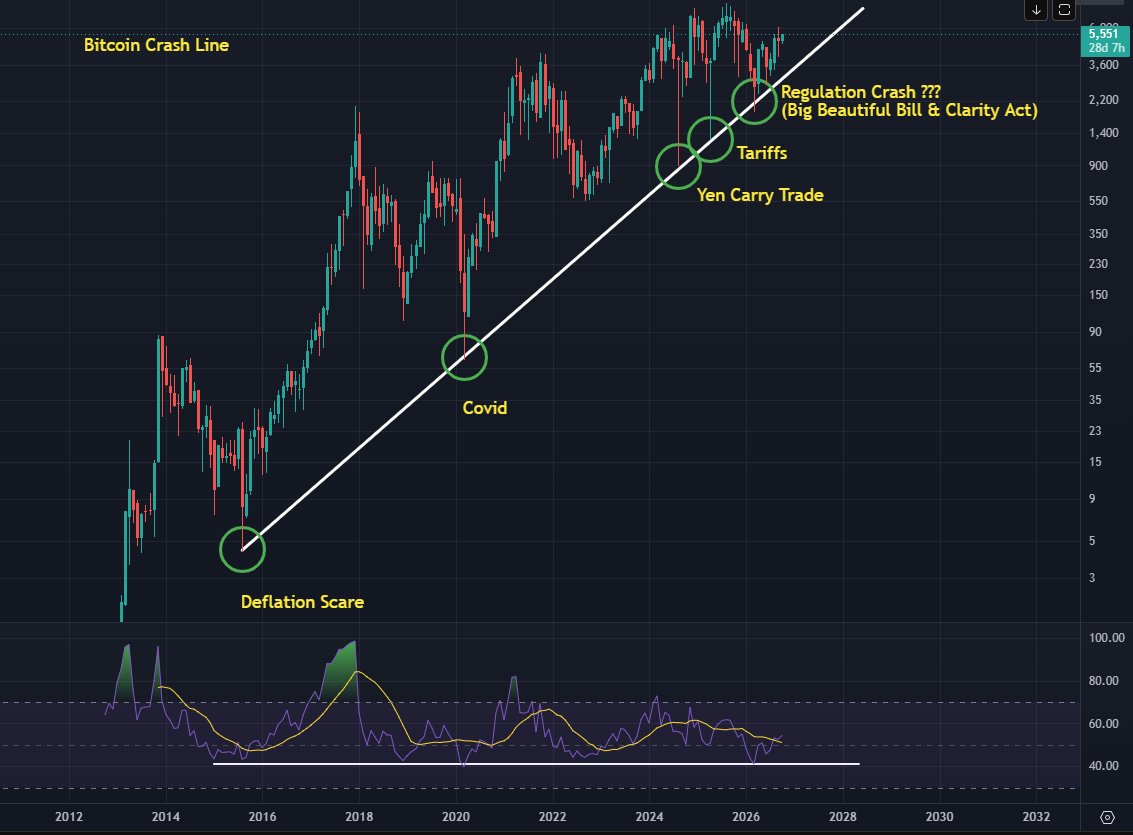
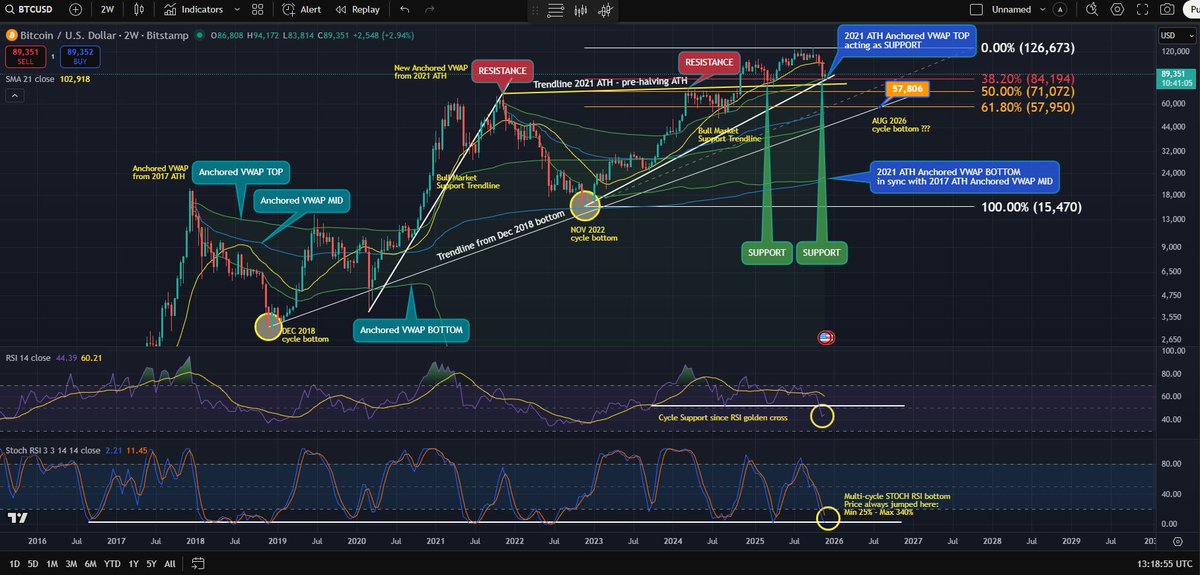
Grok The Great has given just a tip of the iceberg kinda reply. The chart points to a major confluence of "support" signals that would favor an upcoming price action probabilistically and technically bullish. It isn't clear if strong enough to break a new ATH or just a "dead cat bounce". Anyway I'm expecting 5-6 weeks of good uptrend.
I'm long, so I'm inclined towards a good uptrend for next 5-6 weeks before the usual weakness the markets encounter among Feb OPEX and Mar OPEX (Quad Witching Day). Planning to swap my ETH into BTC at approx 0.042-0.053 and in that window many quality/narrative Alts will also pump
Don’t get trapped in the moment, my friend. The drop in active addresses is mostly large holders migrating to ETFs for custody safety, regulation, and insurance. If you hold 50+ BTC, shifting part of it to a regulated vehicle isn’t "losing interest", it’s risk management.
The real power of ETFs comes when the $50–$100/week retail DCA crowd starts flowing in through their brokers automatically. ETF inflows don’t show up as on-chain activity, but they’re relentless.
Bitcoin won’t die because some holders choose safer custody. It simply moves from early-adopter infrastructure to mainstream infrastructure, exactly how every major asset class grows.
Take your time to unpack the info in here and you'll find out that despite I agree on a Q3/Q4 2026 bear bottom, the chart hasn't signaled yet a 100% bull end.
We are in for a last hurrah, just can't say if it's gonna be a dead cat bounce or new ATH before our rendez-vous with destiny...
(#TOTAL3-#USDT-#USDC)/#BTC on October 10th Flash Crash some could argue that it's reached the historical 0.25 "support" level that previously marked a good oscillating point for TOTAL3 against BTC.
IMHO The AI/Gold rush will provide some juicy "window dressing" activity before EoY and #FederalReserve ending QT on Dec. 1st will ignite the Santa rally.
Aside from BTC & ETH, what's the best Alt to hold in such a setup?
I'll get started: #TAO
@NewsAsset#TAO technical double bottom at 165-166 across it's lifespan and now trading at 390 after recent peak at 490 and ATH 6 months ago at 750.
#TAO is a no brainer and the AI narrative will support the rise
#ETH#BTC all time chart tells a story everybody dreams about hearing once in a lifetime, but nobody really wants to experience it first hand.
At 0.01788 BTC my personal "monetary policy" will pivot from QT or #CashIsKing to QE or #WelcomeBackETH
By no mean this is financial advice! #NFA #DYOR
And just to be clear, the name of the game is #AccumulateBitcoin so when ETH is gonna be valued at 0.06 BTC, half of the bag will flip back to THE ACTUAL KING.
LFG 🚀
@benjamincowen ETH is only at the gateway, home is around 1096...but knowing the rascal it'll flee the scene before even entering the door...ain't it?!
MY OPEN LETTER TO PRESIDENT TRUMP
The frustrating part is that I was on board for a reset. Truly. I’ve said it publicly. I’ve written about it in this very feed. I understood the need for a detox. For decades, the U.S. economy played the part of the rich guy at the table -- picking up the check for a global order that no longer worked in our favor. We hollowed out our industrial base. We enabled unfair trade imbalances under the illusion of diplomacy. We subsidized demand for cheap imports while outsourcing the hard questions about how our domestic workforce would adapt.
Eventually, that had to stop. It was unsustainable -- financially, politically, and morally. We couldn’t keep pretending that a consumption-led economy held together by zero-interest rates and global fragility was a long-term solution. I wanted a rebalancing. I welcomed the idea of a harder, smarter America-first policy that pushed for fair treatment, reciprocal agreements, and a real industrial strategy rooted in technological superiority, national security, and capital formation. That would’ve been leadership.
But that’s not what this is.
What you’ve rolled out isn’t detox -- it’s whiplash. This isn’t strategic decoupling. It’s scattershot retaliation dressed up as reform. There’s no roadmap. No operational playbook. No clear articulation of where this ends or what the metrics of success even are. It’s not an attempt to responsibly unwind America’s role as the global shock absorber -- it’s a brute-force attempt to disorder the existing system with no viable alternative in place.
You can’t replace a fragile supply chain with chaos and call it resilience. You can’t build American industry by torching the scaffolding that underpins capital flows, labor mobility, and global coordination -- especially when the U.S. itself no longer has the domestic capacity to meet its own industrial needs. You talk about bringing jobs home, but the U.S. doesn’t have the labor force, permitting structure, or wage flexibility to stand up full-scale manufacturing at speed. And now -- after years of deportation policies and underinvestment in vocational training -- you’ve made the labor gap even wider.
Capital isn’t going to rush to fill that void just because you raised tariffs. It’s going to wait. It’s going to sit on the sidelines and preserve optionality. Because right now, no CEO can confidently model a five-year capex plan. No board can greenlight supply chain onshoring when they don’t know whether a tariff rate will double next quarter based on your Twitter account or some arbitrary trade deficit formula.
That’s the issue. This wasn’t rolled out as part of a comprehensive American renewal strategy. It wasn’t coordinated with the Fed. It wasn’t communicated clearly to Treasury. It wasn’t backed by a labor reskilling program or any form of public-private manufacturing incentive beyond empty slogans. It was dropped like a bomb -- seemingly designed more to shock than to build.
And in the absence of credible structure, capital is retreating -- not realigning.
I was ready to endure the pain of a thoughtful, structured reset. Most long-term investors were. We’ve lived through tightening cycles. We understood that globalization, as it stood, had reached a breaking point. But this isn’t a correction of imbalances. This is a rupture without scaffolding.
What you’ve created isn’t reindustrialization. It’s an intentional sabotage of capital planning. No executive is going to build a factory with four-year political horizon risk, a floating tariff regime, and no labor certainty. No investor is going to fund expansion in a market where the basic cost of imports can change weekly based on what country has a current account surplus that week. The system you’ve launched isn’t designed for certainty. It’s designed for control.
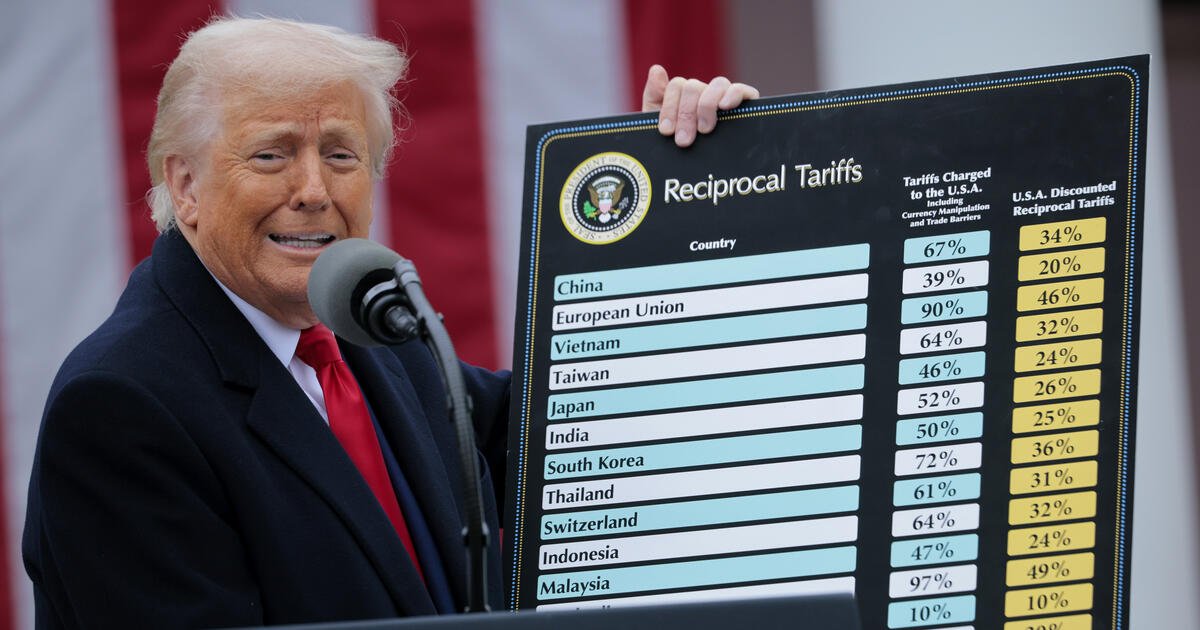
And the irony is -- we’re not even punishing bad actors. We’re punishing everyone. Allies. Poor countries. Longstanding partners. Israel gets slapped with 17% tariffs while dismantling their own to support American imports. Vietnam gets hit with 46% because it’s become too productive. Lesotho, one of the poorest countries on Earth, faces a 50% tariff because it doesn’t buy enough U.S. goods -- as if that were a sign of unfairness rather than poverty. It’s incoherent. It’s cruel. And it undermines any claim to moral high ground.
You say this is about protecting American workers. But no worker is helped by policy so erratic that no employer wants to hire. No consumer is helped when import costs rise and domestic capacity doesn’t exist to replace them. No investor is helped when the cost of capital spikes in the face of weaponized uncertainty.
This is not a plan to make America stronger. It’s a gamble that markets and allies will blink first. It’s brinkmanship with no floor.
And the most maddening part? There was a path. A real one. A version of this policy that could’ve worked -- not in headlines or soundbites, but in practice. A path that applied pressure with purpose, that aligned economic force with long-term national interest, that sent a clear message to adversaries and partners alike without destabilizing global commerce or blindsiding capital allocators.
You could’ve gone after China -- hard -- and had the backing of nearly every serious investor and strategist on the Street. Not just because of trade deficits or currency suppression, but because China has been actively undermining our economy and our people. I would’ve supported a four-year plan to end all dependence on Chinese manufacturing unless they stopped stealing American IP (DeepSeek). No more games. Make it explicit: if they don’t comply, we’ll back Taiwanese independence and bring the entire global semiconductor economy with us. No ambiguity. No half-threats. As I see it, China is at war with us -- and our policy should reflect that.
With the EU, you could’ve played it clean. Match auto tariffs percent-for-percent. That’s fair. And then leave the rest alone -- especially goods and services. We run a huge surplus on services with the EU. It props up some of our biggest competitive advantages -- enterprise software, consulting, cloud, defense tech, streaming, media IP. Tariffing the EU outside of autos would be like shooting your own foot for balance. We’re not in a trade war with Europe. We're in a competition for global enterprise dominance -- and right now, the U.S. is winning.
That’s what real strength would’ve looked like. That’s what an America-first trade doctrine could’ve achieved. You’d be rebuilding the system from the inside out -- not just throwing bricks through the windows and calling it a redesign.
Investors would’ve backed it. CEOs would’ve planned around it. Global partners would’ve respected it -- even if they didn’t like it. And capital would’ve flowed toward American resilience instead of retreating from American unpredictability.
But instead of that, you went with chaos. And now, confidence is shattered. Not because the numbers are bad -- but because no one knows what the numbers mean anymore.
That’s the cost of burning down the rules without building new ones.
So no, this is not the detox we needed. It’s not strategic decoupling. It’s not a path to renewal. It’s a slow, loud dismantling of the very foundation that has allowed American capital, innovation, and enterprise to dominate for decades. And it didn’t have to be this way.
But now we’re here. And the market is reacting accordingly -- not to the fundamentals, but to the sense that the future may no longer be modelable. That’s not a trade. That’s an exit.
I don’t want this post to be hyper-political. This isn’t about red or blue. It’s not about the 2024 election cycle. It’s not about ideology. It’s about strategy. It’s about execution.
It’s about understanding that when you're the United States -- when you sit at the helm of the global economic engine -- every policy you roll out reverberates through capital markets, supply chains, boardrooms, and governments. Words become signals. Signals become pricing. Pricing becomes pain -- or progress.
And I hope -- for the sake of the markets, for the sake of businesses trying to plan, and for the future we’re all investing into -- that it’s not too late to recalibrate.
Because we don’t need more noise.
We need a plan.
UX/UI Suggestions
1. Interactive Watch Configurator
- Add a tool where users can customize a watch (e.g., straps, dials, engravings) and see a real-time 3D preview. Even if not all options are purchasable, this engages users and collectors who crave personalization. Include a "Save Your Design" feature to email themselves a link, driving return visits. You can later run a “Bremont Challenge” and the design with more votes will be produced in a Limited Edition, with the creator of the design receiving the watch #1 (or any number of their choice) and a “all-inclusive vacation for 2 in some exotic place”.
2. Community Feedback Portal
- As you just invited X feedback—mirror this on the site with a "Share Your Ideas" section. Users could submit design or feature suggestions, with top ideas showcased (and winners awarded watches). This builds a participatory community feel.
3. Seamless Checkout
- For e-commerce, reduce friction with a one-page checkout, guest purchase option, and clear warranty info (highlighting the 5-year upgrade). Add trust signals like "Handcrafted in Henley" or "Trusted by 500+ Squadrons" near the buy button.
Marketing Strategy Suggestions
1. Leverage X Presence
- Since you plan periodic X updates, amplify these with a branded hashtag like #BremontJourney or #BremontTime. Encourage followers to share watch photos or stories, offering a chance to win exclusive merchandise (e.g., a strap or tour invite). This turns your posts into a viral campaign.
2. Collector-Focused Content Series
- Launch a YouTube or X series called maybe "Behind the Wing," featuring short episodes on watchmaking, military partnerships, and yours & Davide Cerrato’s vision. Target collectors with deep dives into movements and materials, cross-promoting on watch forums like Hodinkee or Watchuseek.
3. Influencer Partnerships
- Partner with micro-influencers in the watch community (e.g., YouTubers or niche Instagrammers) to review Bremont’s new lines. Gift them limited-edition pieces to showcase, emphasizing rarity and value-for-money versus Rolex/Patek.
4. Experiential Events
- Host "Bremont Adventure Days" at boutiques or The Wing, blending watch showcases with military/aviation-themed activities (e.g., flight simulators, guest talks by pilots). Invite collectors and X followers, livestreaming highlights to broaden reach.
5. Scarcity Marketing
- Emphasize limited production (10,000 watches/year) in campaigns: "Fewer than 1% of Rolex’s output, built for the bold." Pair this with waitlists for new releases to drive urgency and prestige.
Do you remember the audacity with Tommy Hilfiger’s 1985 billboard campaign in NYC? You can do the same and immediately register in the brains of people the brand Bermont at par with Rolex AP and PP.
https://t.co/qOLbloYGPS
6. Cross-Industry Collaborations
- Partner with British brands in adjacent luxury/adventure spaces (e.g., Land Rover, Barbour) for co-branded watches or gear bundles. This taps into a patriotic lifestyle appeal and widens the audience.
Bremont’s strengths (its British identity, military cred, and quality at a fair price) position it as a compelling alternative to Swiss giants. By enhancing product storytelling, making the website a narrative hub, improving UX for engagement, and amplifying brand awareness, Bremont can build a cult following among collectors and adventure enthusiasts. The goal is to shift perception from "underrated gem" to "must-have independent icon" leveraging scarcity and heritage to stand out in a crowded market.
Just in case, I personally love the Supermarine Tundra 🫡
Best of Luck with your new passion!
Hi Bill, you are a great storyteller so I want to share with you some food for thought about your passion’s current positioning.
Here are some tailored suggestions across design, web design, UX/UI, and marketing strategy to boost public awareness and attract collectors. These recommendations aim to leverage Bremont’s unique heritage, quality, and niche appeal while addressing potential areas for growth.
Design (Product) Suggestions:
1. Lean into British Heritage with Subtle Modern Twists
- Bremont’s British roots and military connections are a key differentiator. Consider a limited-edition "Heritage Series" that pays homage to British watchmaking history (e.g., 17th-19th century innovations) with design cues like vintage-inspired dials, Breguet hands, or engraved casebacks featuring historical motifs. Pair these with modern materials like 904L steel or sapphire crystals to appeal to collectors who value both tradition and innovation.
- Example: A watch inspired by the 1942 Harvard trainer crash, with a dial subtly mimicking cockpit gauges and a numbered edition tied to the aircraft’s serial number.
2. Expand Complications with Storytelling
- The new tourbillon and perpetual calendar launches are a great start. To attract collectors, tie each complication to a narrative—e.g., a perpetual calendar inspired by British naval exploration or a tourbillon reflecting precision engineering from the Industrial Revolution. Limited runs (like the 12-piece tourbillon) with certificates of authenticity and engraved stories enhance exclusivity; maybe the number of watches produced with a 17th Century Limited Edition Theme can iconically be 1700.
3. Custom Military Editions
- Since 25% of sales come from military clients, offer squadron-specific customization options (e.g., engravings, unique straps, or dial accents). Market these as "bespoke battlefield heirlooms" to collectors and military enthusiasts, emphasizing durability and legacy. RAF is a well-known “brand” among military and history enthusiasts worldwide.
4. Sustainable Innovation
- Introduce a line using recycled materials from aviation or maritime relics (e.g., salvaged plane parts or ship steel), aligning with modern luxury trends and reinforcing the Land, Sea, Air theme. This could appeal to environmentally conscious collectors and emphasize “authenticity”.
Web Design Suggestions
1. Showcase "The Wing" Virtually
- The Henley-on-Thames facility is a unique asset. Add a high-quality virtual tour on the website (beyond just emailing for tours). Use 360-degree video or interactive 3D renders to let users explore the manufacturing process, reinforcing transparency and craftsmanship.
2. Hero Section with Narrative
- Revamp the homepage with a cinematic hero video or animated timeline tying the English brothers’ story to the brand’s evolution. Highlight key moments (e.g., the crash, military partnerships, and so on) to hook visitors emotionally.
3. Collector-Focused Product Pages
- For limited editions, create dedicated microsites or sections with rich media—detailed photos, movement animations, and designer interviews. Include a "Notify Me" feature for sold-out pieces to build anticipation for future releases.
4. Simplify Navigation
- The current site is functional but could streamline its menu. Group products clearly under "Land, Sea, Air" with filters for complications, materials, and price. Add a "Collections" tab spotlighting military and heritage lines.
Behold, a sonnet crafted with rhyme’s sweet art,
For Bitcoin’s journey, bold and wild to trace,
From fifteen thousand’s humble, shadowed start,
To tenfold glory in a boundless race.
Through pre-halving peaks at seventy-three,
Where golden ATHs once kissed the starry skies,
A beacon calls to those with eyes to see,
Yet moving roadblocks block the dreamer’s prize.
These obstacles, like shadows thick with dread,
Shall clog the path till Quadruple Witching Day,
No upward surge till markets turn their head,
When fates align in cryptic, mystic play.
So wait, ye holders, with your hearts so true,
For Bitcoin’s rise shall break the dawn anew.