Postdoctoral Researcher at UPenn, PhD from IIT KANPUR Department of Chemistry, MSc from IIT Guwahati, Quantum thermodynamics 🔥⚛️❄️ Open Quantum System ⚛️
Another stop. More stories. The IITK community keeps growing. 🇺🇸
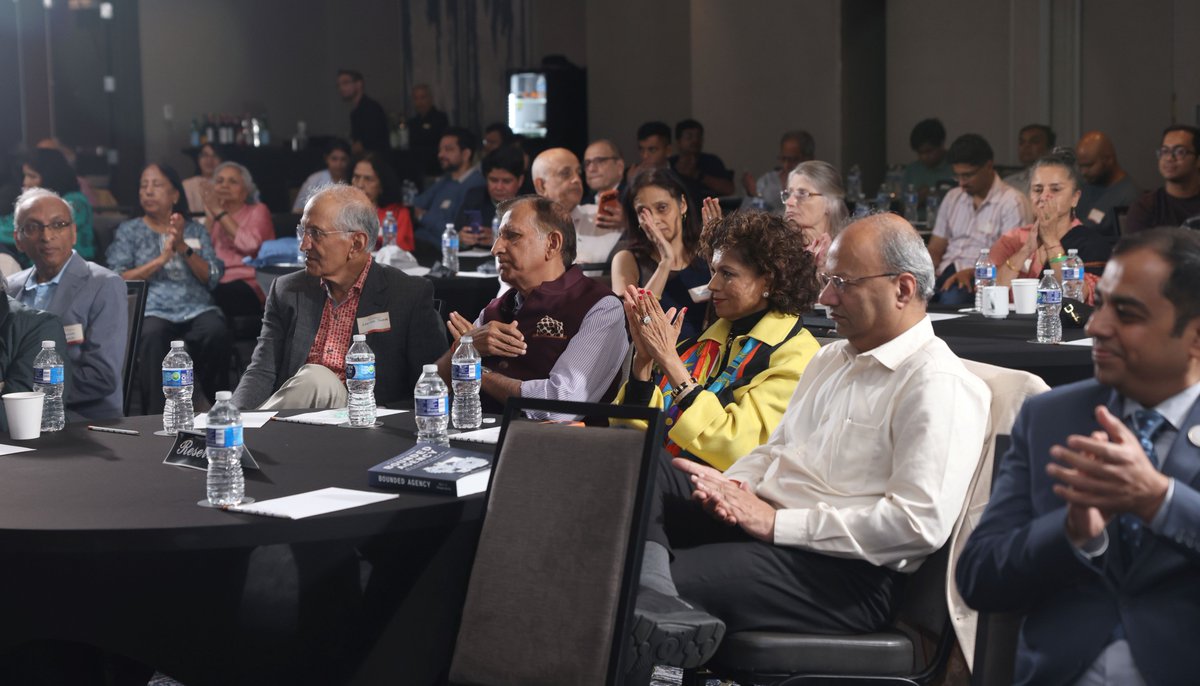
From Washington, D.C., the IITKarvaan travelled north to New York and New Jersey, bringing together alumni for an evening filled with conversations, memories and the unmistakable IITK spirit.
With the IIT Kanpur leadership and alumni community coming together, the evening was a celebration of the connections that continue to bring IITK alumni closer, wherever their journeys may take them.
From catching up with old friends to meeting fellow alumni and exchanging new ideas, every conversation added another chapter to the Karvaan.
A special highlight was the keynote by Ms. Chandrika Krishnamurthy Tandon, whose journey and perspectives added to an inspiring evening for the IITK community.
Two more stops. Countless connections. One IITK community.
And now, the Karvaan moves on to Chicago.
#IITKarvaan #IITKarvaan2026 #IITKanpur #IITKAlumni #IITKCommunity #IITKUSA #NewYork #NewJersey #AlumniNetwork #TheKarvaanContinues
When you throw a ball at a wall, you can be sure it will bounce back at you.
You would be extremely surprised if the ball suddenly appeared on the other side of the wall. In quantum mechanics this type of phenomenon is called tunnelling and is exactly the type of phenomenon that has given it a reputation for being bizarre and unintuitive.
The 2025 #NobelPrize laureates in physics John Clarke, Michel H. Devoret and John M. Martinis, used a series of experiments to demonstrate that the bizarre properties of the quantum world can be made concrete in a system big enough to be held in the hand. Their superconducting electrical system could tunnel from one state to another, as if it were passing straight through a wall. They also showed that the system absorbed and emitted energy in doses of specific sizes, just as predicted by quantum mechanics.
BREAKING NEWS
The Royal Swedish Academy of Sciences has decided to award the 2025 #NobelPrize in Physics to John Clarke, Michel H. Devoret and John M. Martinis “for the discovery of macroscopic quantum mechanical tunnelling and energy quantisation in an electric circuit.”
Our recent paper on Graph theory of spin-thermoelectric effects gets published in PRB. Congratulations to @NikhilGupt3 for this wonderful work🥳
https://t.co/465OegJyDY
Happy to share our recent work, where we implement a novel network analysis scheme to decipher unconventional electron tranfer pathways in molecular solar cells @NikhilGupt3@IITKanpur
https://t.co/20AvIympFm