🚨 What if we're about to relive 1979?
Back then, inflation didn’t just come from money printing.
It came from geopolitics:
👉 Iranian Revolution
👉 Oil shock
👉 War in the Middle East
Now fast forward to 2025...
👇👇
🧠 Investing Principle
The best investors?
They do less, not more.
Here are 5 hard-earned lessons that turned my investing around — from costly mistakes to consistent compounding:
👇 A thread for long-term thinkers:
$NVDA was the obvious AI winner.
But the next wave of compounders will come from lesser-known names.
Here’s one that’s building the infrastructure behind AI infrastructure: $AMD
🧵 A thread:
If you won $5 million today, how would you invest?
$2 million in S&P500
$1 million in stocks like $AMD, $NBIS, $NKE, $AMZN, $GOOGL, $MYTIL, $KRI, $RKLB
$1 million to sell options and generate income
$1 million in high yield savings account.
Let me know what you think 🤔
I still don't understand why $MSTR is trading 2x its NAV. I mean its a managed bitcoin etf at this point where saylor and the other executives are selling their shares and leverage up the company. What if this thing explodes? What happens then?
Please let me know what you think
$AMD has 10x potential from here
They have 10 years of hypergrowth ahead
GPUs, CPUs, FPGAs, APUs, NPUs, DPUs, model deployment, photonics, gaming, VR...
This company will be at the core of the AI era
Let’s dive deep into it 🧵
Over the past few weeks, $SOFI has consistently shown up on my radar, so I took a deep dive into the company. Here’s my investment thesis and why I believe $SOFI is a no-brainer buy at current levels:
$LMND train is taking off.
The market finally saw the investment case — declining loss ratio, cheaper prices, and accelerating growth.
Here is my $LMND investment thesis: 🧵
Top 6 stocks that will be a multibagger this year coz of data center play -
1) $TSSI - Designing and building data centers. Most of its revenue is from Dell who is the prefered partner for Nvidia. Jenson Hwang gave a shout out to Michael Dell saying if anyone wants AI server, they should go to Dell in the latest GTC conference
2) $PSIX - Portable generators. The only way for USA to keep up with growing power demand for data centers
3) $FIP - Multiple biz. including a 500MW of power plant coming online which will be used to power data center within the campus
4) $TGEN - Enable liquid cool to pack in more GPU in small data centers (1-2 MW)
5) $HNRG - Coal power generation + ongoing deal to power a data center
6) $IREN - they have ~1.4 GW of power coming online next April and 0.6 MW shortly after. The market values it as a bitcoin miner, they are pivoting to AI. AI deal should be a quick 100% jump in stock price
$TMDX
Some of my favorite quotes from Waleed at today’s conference.
- Next Gen OCS Timeline
“We expect that approval will be in hand sometime in late Q2, early Q3 to put us right on track to launch these clinical programs late this year as we anticipated in the beginning of the year.”
- Getting Beyond 10k Transplants
“We’re not stopping here. We're already investing in Gen 3 technology that would be highly optimized for more NOP to go from the 10,000 transplant target by 2028 to 20k or 30k transplant target over the following three to five years.”
- NOP App Capability & Timeline
“The NOP Connect, this is one area that we're very, very excited about. This is what we're calling the Uber of organ transplant. Everything we talked about NOP will be launched and run in full transparency and full visibility to the clinical surgeon, to the administrator of the transplant program, at the third party OPO staff and TransMedics NOP staff, managing the entire procedure as if they're launching or requesting an Uber ride with full transparency and security that they keep the record with the patient. This is already launched for the NOP component. We're deploying it at the transplant program at the beginning of Q3.”
- $TMDX Is a True Partner (Moat)
“No other company, technology, or logistics partner gives the transplant program zero, zero cost if the organ is not transplanted. TransMedics does. We don't charge the transplant program a dime if the organ is not transplanted when it's on our device.”
“The second thing with the integration of the logistics, because we control the logistics, when we go to a DCD run today, third party charges the transplant program the full cost of a round trip to the donor and back. We eliminate 50% of the cost, and that's across the United States. Every center gets the same deal. We do that because we are delivering the most cost effective and efficient way, and we want to share the cost efficiency of running our network with the transplant program, because we're in this for the long term. We're not in this to make a quick buck like the charter operators do.”
Why $NBIS is a compelling business:
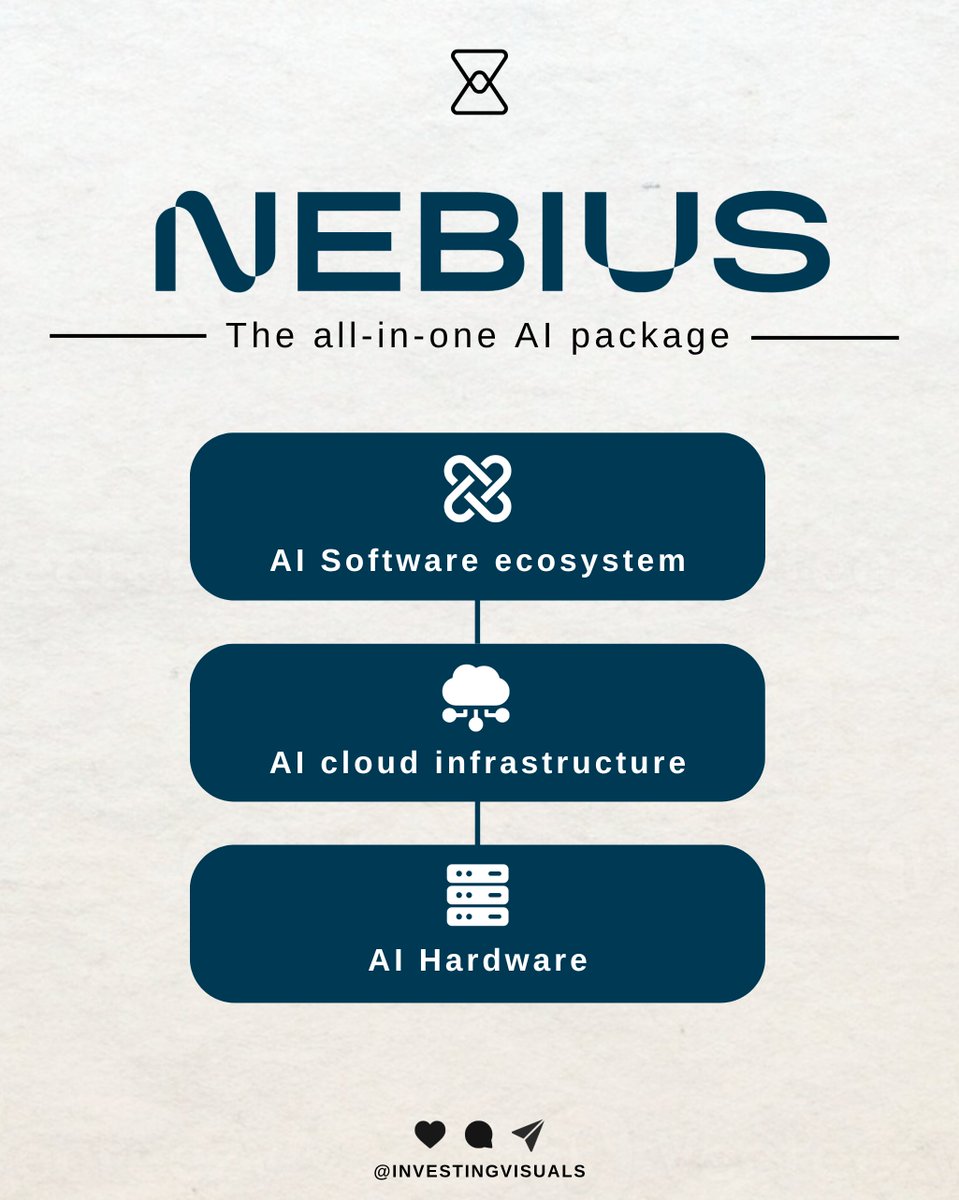
🔹 All-in-one AI stack
🔹 Strong balance sheet to fuel future growth
🔹 Portfolio of high-quality subsidiaries
🔹 Deeply experienced workforce
🔹 Massive global TAM
🔹 Founder-led
Big milestone for AMD Instinct GPUs in MLPerf Training!
✅ First training submission
✅ Competitive vs. NVIDIA H200 & H100
✅ 30% uplift from MI300X to MI325X
✅ First Instinct multi-node training by MangoBoost
✅ First liquid-cooled training run by Supermicro
✅ Partner results from Dell, Oracle, Gigabyte & OCT
All on Llama 2-70B-LoRA—one of today’s most relevant GenAI workloads.
Powered by ROCm 6.5 with Flash Attention + Transformer Engine optimizations.
The future of open, scalable AI is here.
Read more: https://t.co/RW6mRIL16y
🚨 $AMD acquires Brium to strengthen its AI software ecosystem
Brium’s AI software expertise will enhance $AMD ability to deliver highly optimized AI solutions
They are misunderstood because they are investing heavily now for the future. It makes now look worse.
They are investing in an "autonomous organization" that runs with a little human input as possible. This takes upfront engineering cost, but will payoff as they scale.
They are investing in new products and geographies, offering multiple products across geographies. Takes more upfront cost to build and establish these products, work through data and improve underwriting of each.
They are investing in customers. They are ramping up growth spend to acquire new customers. This makes the existing quarters look worse, as the payback and profit for these customers takes place over years.
They are getting an LTV/CAC ratio of 3:1 or better. We know this because
1) We can calculate it ourselves
2) Management has told us
3) General catalyst sees detailed cohort data and continues to invest heavily in providing funding for customer acquisition via "Synthetic Agent" loan
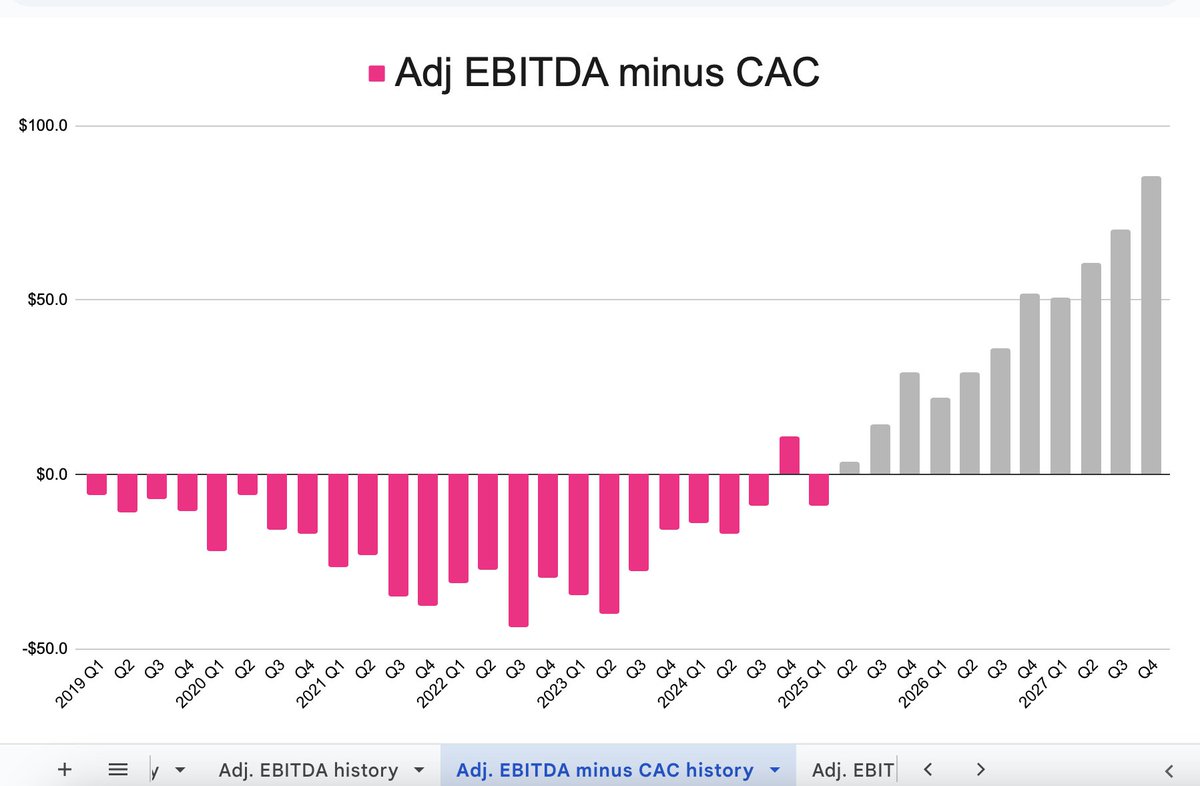
Their fixed costs outside of growth spend have been flat as the business has gone from ~$600M IFP to $1B+. Of course, you could say they just overbuilt capacity and are still growing into it, but I would argue the costs are due to the above investments. If they stopped doing any growth investment, they would be adjusted EBITDA profitable already.
In summary, things look bad right *now* because they are making heavy investments for the future. We could get into the numbers in more detail, but I strongly believe and model that they'll be adjusted EBITDA profitable next year, 2026, and then net income profitable in 2027.
The most asked question about $NBIS
How will they compete with the hyperscalers?
Here's my response:
The first reason why they can outperform hyperscalers is their convenience, great UI, and excellent support. That really sets them apart, particularly for small and mid-sized companies. In my deep dive, you can find examples of AI labs describing their frustrations with AWS and how much easier it is to use Nebius instead.
Another reason is that, while Nebius doesn’t have the scale of the hyperscalers, their data centers are just as efficient. There is a limit to economies of scale, and Nebius does not fall short in that regard. In fact, they have an edge. They design every part of their infrastructure, from the motherboard to the server, the rack, and even the overall building. Their experienced team reduces costs by avoiding dependence on providers like Supermicro, Dell, or ASUS.
A data center operator like DataOne is building a 300MW facility based on Nebius’ design, which speaks volumes about the quality of their engineering. In the coming months, we’ll see exact figures on the efficiency of their data centers, which should help clear up any remaining doubts.
If economies of scale are not enough to create a decisive advantage, hyperscalers can’t just outspend them either. There is immense unmet demand for compute, and it wouldn’t make sense for a hyperscaler to cut prices just to try to push Nebius out of the market.
In terms of innovation, there's only so much progress that can be made in a short time. Although hyperscalers have more money to pour into R&D, the reality is that, right now, major cloud providers like AWS and Azure are arguably behind Nebius in AI cloud usability. And when you consider the overall ecosystem, Toloka provides an edge that few, if any, can match.
This superior usability and software stack compared to the hyperscalers is backed by customer reviews and the independent report by SemiAnalysis, both of which are thoroughly covered in my $NBIS article.
Former $AMD employee shares his view on the positioning of $AMD and $NVDA in the robotics industry:
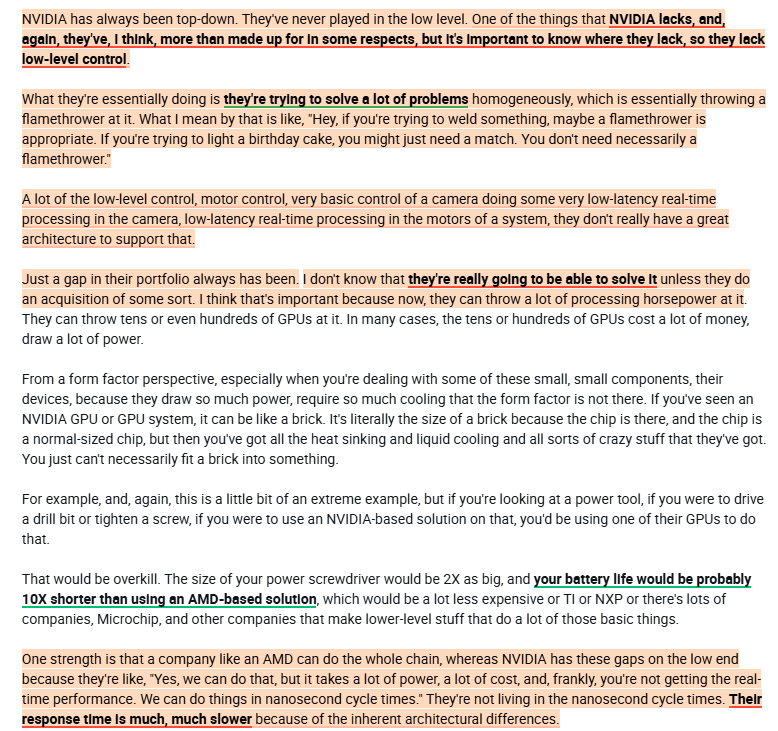
- According to the expert, AMD is heavily involved in many subsystems that make up robotics systems. $AMD grew from the bottom up, in contrast to $NVDA, which, according to the expert, has never been utilized in many of those subsystems. $NVDA has approached it from the other way, from the top down.
- In his view, one of the things that $NVDA lacks is low-level control. They are trying to solve problems in a homogeneous and less low-level manner. He doesn't know how $NVDA will solve that gap in their portfolio, but hints at a possible acquisition in that space for $NVDA to fill the gap.
- The strength of $AMD is that it can do the whole chain. Because of this, their response time is faster and less costly in terms of power.
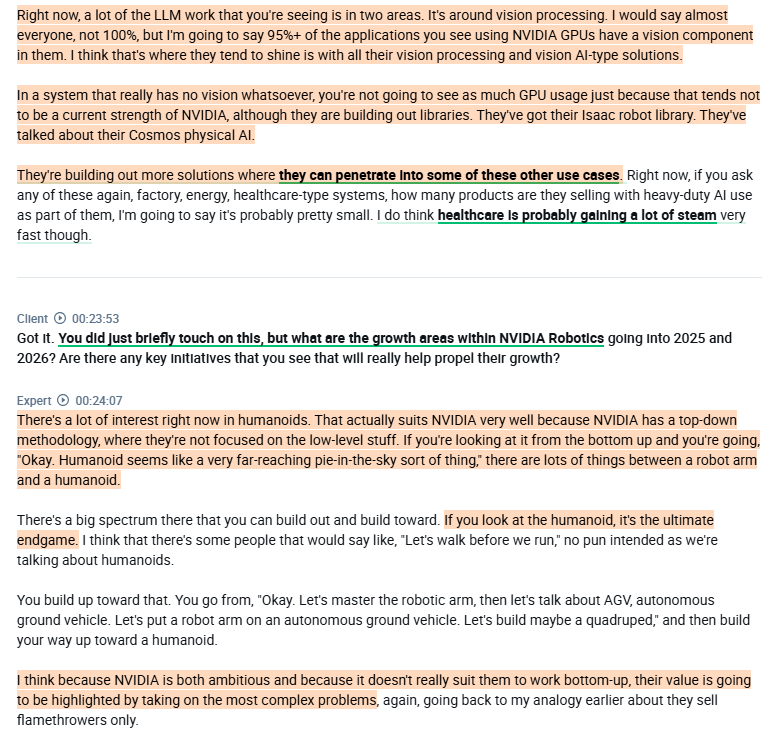
- Almost everyone working in the LLM and vision processing space uses $NVDA GPUs, as vision processing and vision AI-type solutions are where $NVDA shines.
- The interest in humanoid robots also suits $NVDA because it is a top-down methodology and not a bottom-up approach, starting from a robot arm, for example. Humanoids are the ultimate endgame.
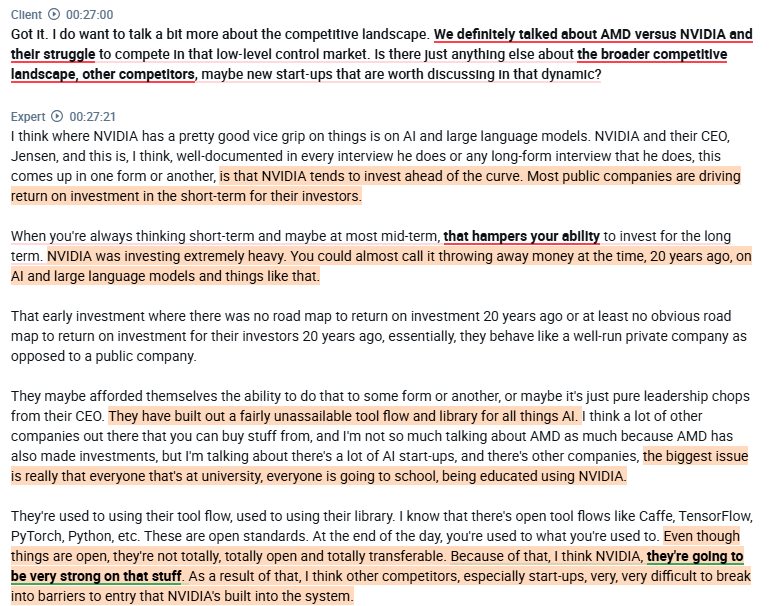
- He mentions that $NVDA invested aggressively in AI and LLMs 20 years ago, when many thought they were throwing away money, but they can do that because they are investing ahead of the curve. Because of these investments, they build up their unique AI tool flow and libraries. For competitors, the biggest problem is that $NVDA's software is now being taught in universities, and $NVDA has firm control over it.