Honored to win the ACJR award for Best Crypto Op-Ed for my piece on Ethereum security problems and the proposed recovery fund debate.
Big thanks to @ACJRnetwork and everyone involved. Very good company to be in.
Bitcoin has the lowest DeFi adoption of any major asset relative to its market cap. But I wouldn't call the rest useless.
For most holders, store of value is the use. Gold in a vault isn't idle.
And a few examples of where it works:
Babylon has around $3.2 billion of BTC staked natively, securing PoS chains.
Lombard's LBTC sits near $1.5 billion live in 70+ protocols.
Stacks ran a 30x capacity upgrade and opened sBTC to 1,800+ institutions through Fireblocks.
Spot ETFs hold more than 1.2 million BTC as a regulated product.
Public companies hold over $80 billion of BTC in treasury, used as reserve and borrowed against.
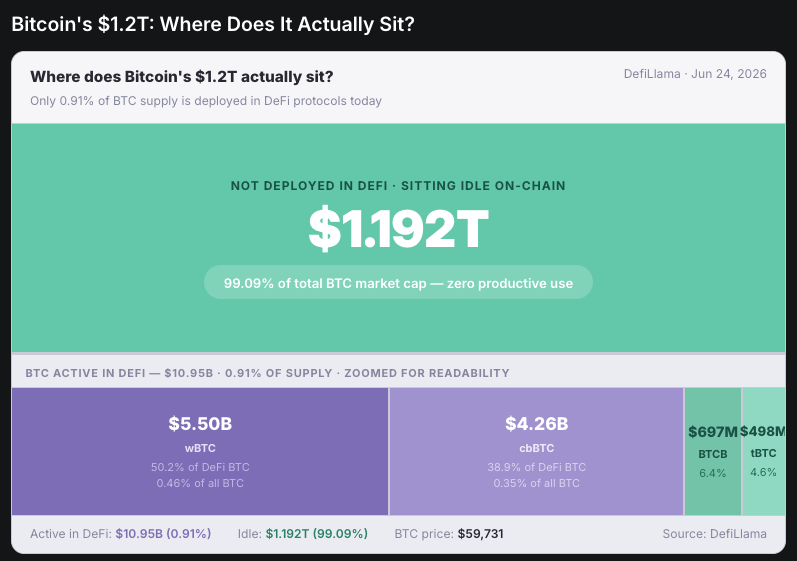
Only 0.91% of Bitcoin's $1.2T market cap is actively deployed in DeFi protocols
The entire wrapped BTC market across all chains, including wBTC, cbBTC, tBTC, BTCB, adds up to $10.95B
That's it
The other 99%+ sits idle on the Bitcoin network with zero productive use
For context: wBTC alone has been around since 2019
Seven years later, less than 1% of BTC supply has found its way into DeFi
The largest asset in crypto is also one of the least deployed in DeFi
Data: @DefiLlama
Shayne Coplan (@shayne_coplan), one decision right now can override every credibility hit Polymarket has taken. Airdrop the token to the people who lost money, proportional to their losses.
They funded everything @Polymarket have, and the only way to keep them is to reward them.
https://t.co/0oQR5CloTn
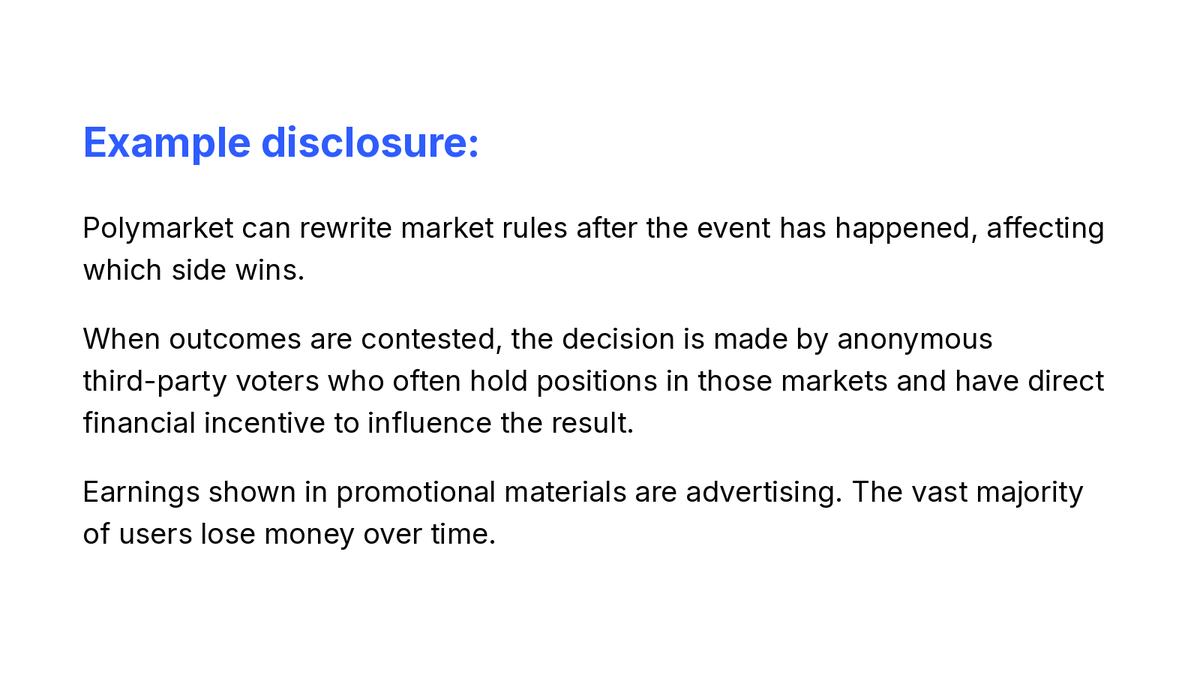
If you publish promotional content about @Polymarket, please consider attaching a disclosure to avoid misleading your audience about the platform's gambling-like nature.
Example disclosure:
Polymarket can rewrite market rules after the event has happened, affecting which side wins.
When outcomes are contested, the decision is made by anonymous third-party voters who often hold positions in those markets and have direct financial incentive to influence the result.
Earnings shown in promotional materials are advertising. The vast majority of users lose money over time.
Aren't PR experts hired precisely to get the coverage a founder can't land on their own? Otherwise, why hire PR at all, if not to turn their announcements into news?
The way I see it, the filter for what is or isn't news is the journalist. They're the one judging the pitch from the PR who framed the announcement into a story.
So filtering isn't what you hire a PR's expertise for in the first place, which means that hardest part is one you can just let go of.
Interesting that The Block writes about @Polymarket changing rules after the event and right below this article they advertise Polymarket
https://t.co/rFWXRMgxdT
@mroliverpt Vault leader doesn't control when depositors exit. a whale at 30% AUM pulls out mid-swing and 30% of positions get force-closed at market. Also you have to keep 5% of AUM in the vault at all times. as TVL grows you're forced to lock more of your own capital, can't redeploy it.
🏆 Best Crypto Op-Ed
@Nikopolos, "Will TheDAO's $220M Security Fund Actually Make Ethereum Safer?"
Pointed, principled commentary on governance and security: https://t.co/qmOVxcenyQ
The original post used Musk as proof of capitalism's efficiency. My point is that this specific example fails, because a large share of Musk's wealth came not from paying customers but from the government taking money from other people.
In that sense Musk doesn't fit the model of an entrepreneur tested by the market. He's closer to what the original post itself called a Cantillon first receiver, just a private one instead of a public one.
My post wasn't about socialism vs capitalism. Is it clearer now?