My latest for @latimes: I travelled to southern India to document the rise of the AI "arm farms" — where young engineers strap GoPros to their foreheads and fold laundry or pack boxes to teach humanoid robots how to do chores.
https://t.co/o6dgEtbuEN
Alphabet generated over $160b in operating cash flow last year… yet it’s still issuing $40b+ in equity to fund AI compute (including a private placement to berkshire)
One of the biggest cash generators in tech is diluting to keep up
I've been closely following the labor, business, & capital flows shaping the humanoid robotics industry
reach out if you want to chat or have tips for what I should look into next. DMs open.
https://t.co/atHhGHP2EG
My latest for @latimes: Meet the "robot puppeteers" of Silicon Valley
I spent a day inside a teleoperation data facility in California — where human pilots train robots to do the basic tasks like pouring coffee and plugging cabes using $40,000 robot arms
https://t.co/atHhGHP2EG
9/ Humanoids are being trained using a mix of: human demonstration, robot demonstration & simulation
The dilemma: "Our fellow human beings are selling their bodies to train robots to replace the functions of human beings"
@tristanharris called it "the coffin builder" industry
The polarization of the discourse on the speed of AI progress & impacts is unhelpful. AI as Normal Technology is a project that advocates a strong view in this debate while also trying to improve mutual understanding between people who disagree. We don’t think those goals are contradictory.
In our latest, we included a "Why we could be wrong" section. We stand by our empirical findings, but we acknowledge that choices about what to measure and how to interpret the results inevitably involve judgment. We welcome other views on the state of AI reliability. My ideal state of AI discourse would be quick convergence on facts paired with robust, good-faith debate on matters of interpretation. https://t.co/FI5kuBkdRZ
Whether these semiskilled robot wrangler jobs will see an in-step increase as these companies scale up operations remains to be seen.
Cos don't share their human-to-robot ratios
https://t.co/YDXXc2TeYN
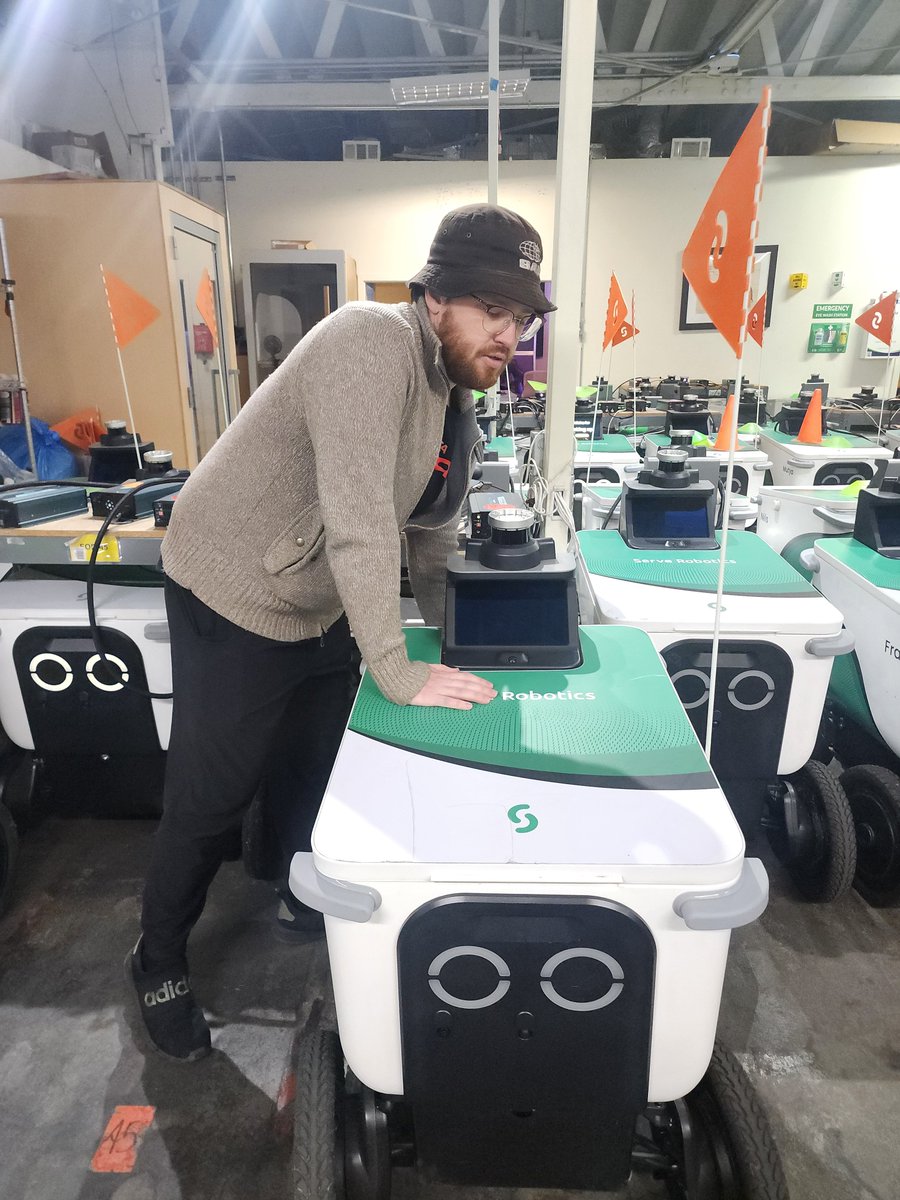
For years, Charlie Snodgrass delivered for Uber Eats. Now, he spends his mornings "wrangling" the very robots that replaced his old job.
Inside the West Hollywood depot where autonomous robot still needs humans to give it a bath, for @latimes
https://t.co/YDXXc2TeYN
Job postings for "Robot Technicians" jumped 75% last year
While robot engineers make $123k, wranglers earn about $26/hr. It’s a new blue-collar tech class
https://t.co/YDXXc2TeYN


![JeffLadish's tweet photo. "Draw me a highly detailed where’s Waldo Image, but of [Anthropic] [OpenAI] at their office. Make sure it search to make it funny with in-crowd jokes" https://t.co/Je7odeYaD7](https://pbs.twimg.com/media/HGi_umAaUAAWOiG.jpg)













![JeffLadish's tweet photo. "Draw me a highly detailed where’s Waldo Image, but of [Anthropic] [OpenAI] at their office. Make sure it search to make it funny with in-crowd jokes" https://t.co/Je7odeYaD7](https://pbs.twimg.com/media/HGi_wGiaYAASC6Y.jpg)


