Rainmatter started in 2016, with a few of us doubling up on our day jobs and trying to help startups that were trying to expand India’s capital markets ecosystem. Nine years later, it has grown into something far bigger than we ever imagined.
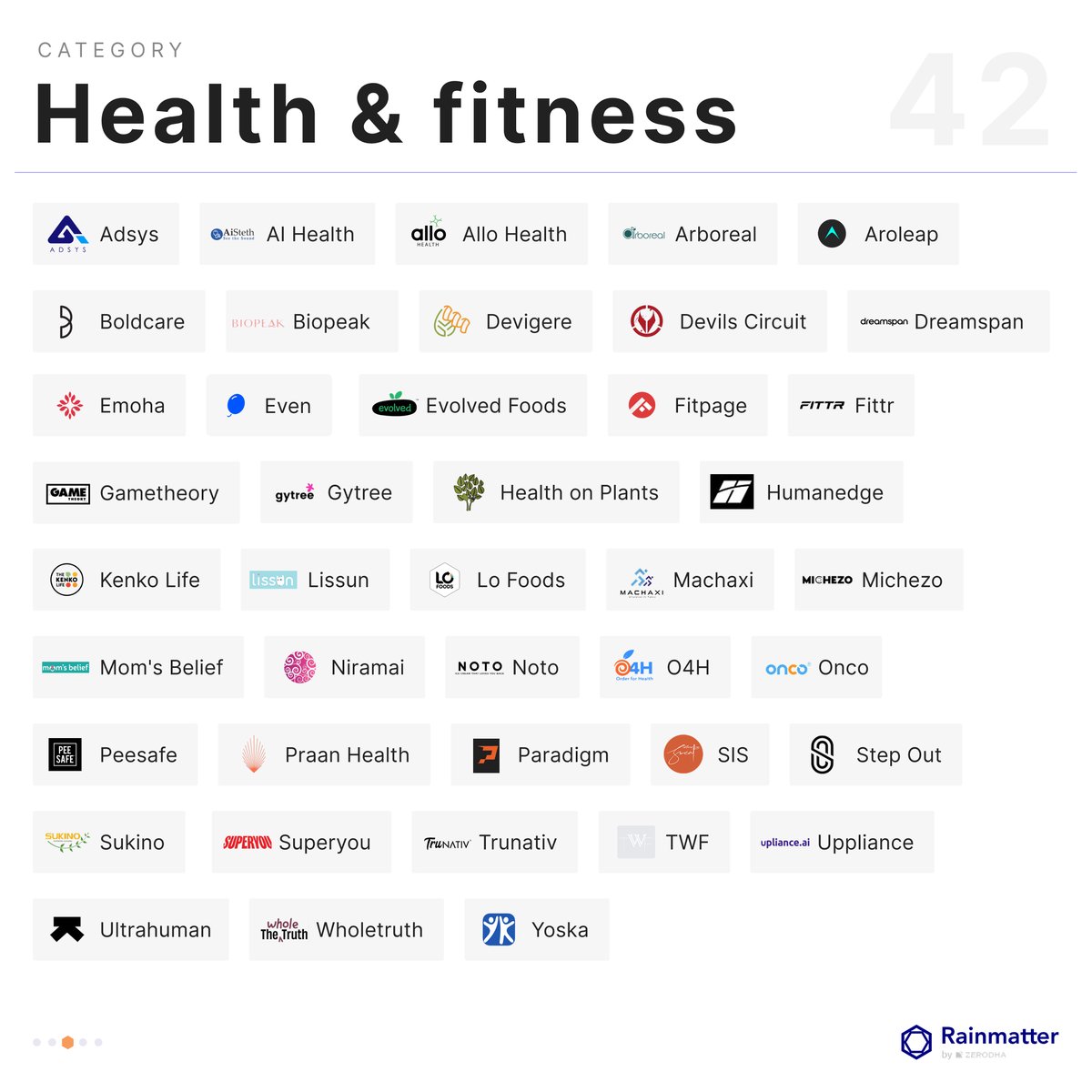
So far, we’ve invested over ₹1,500 crore across 160+ startups spanning fintech, climate, health, media, and deep tech. We’ve also earmarked 10% of everything Zerodha earns to invest in startups, and another 10% for the social sector through the @RainmatterOrg.
The thesis has evolved from just expanding the capital markets, but the thread running through it is simple. As a country, we need to own more of what we consume. Sovereignty, in the truest sense.
We’re not a typical VC. We don’t take board seats, and we’re not in this for quick exits. We’re not interested in forcing founders into short-term decisions just so we can make money in five or six years.
The simple reality is that building a good business is hard. Building one that is genuinely useful, scalable, and profitable is even harder when investors are pushing you to speedrun success and sustainability.
That kind of pressure usually leads to shortcuts. And shortcuts, more often than not, come at the consumer’s expense.
So our approach has been simple: be patient, back founders for the long term, and help them build the business the right way.
That, more than anything else, is the heart of @Rainmatterin.
A lot of Zerodha customers don't know that you can set up SIPs for stocks and ETFs, just like mutual funds. SIPs are probably the easiest way to bring some discipline to investing.
We’ve had Stock SIPs on Kite for a while, but the process of setting one up could have been better.
We've now introduced an all-new Stock SIP flow on Kite web. You can add stocks or ETFs while creating an SIP, choose between quantity-based and amount-based SIPs, and allocate the investment amount across multiple stocks or ETFs.
For example, say you want to invest ₹10,000 every month in the Nifty TOP100CASE ETF. You can simply create an amount-based SIP for ₹10,000 and set the schedule. Or, if you want to invest across multiple stocks or ETFs, you can add them to the same SIP and decide how the ₹10,000 should be split between them.
For amount-based SIPs, you can also automate funding using UPI Autopay.
Coming to the Kite app soon.
This year, India finished 4th in the medal rankings at the Commonwealth Games, winning 39 medals. That's a big deal. But what's even more inspiring are the life stories of the athletes who won those medals.
@arshi_yasin from @the_bridge_in sent me some of their stories, and they are incredible. Reading about the backgrounds these athletes come from, the adversity they had to face to get to where they are, is incredible. The fact that they never gave up when most would have and went on to win a medal is inspiring.
A few stories:
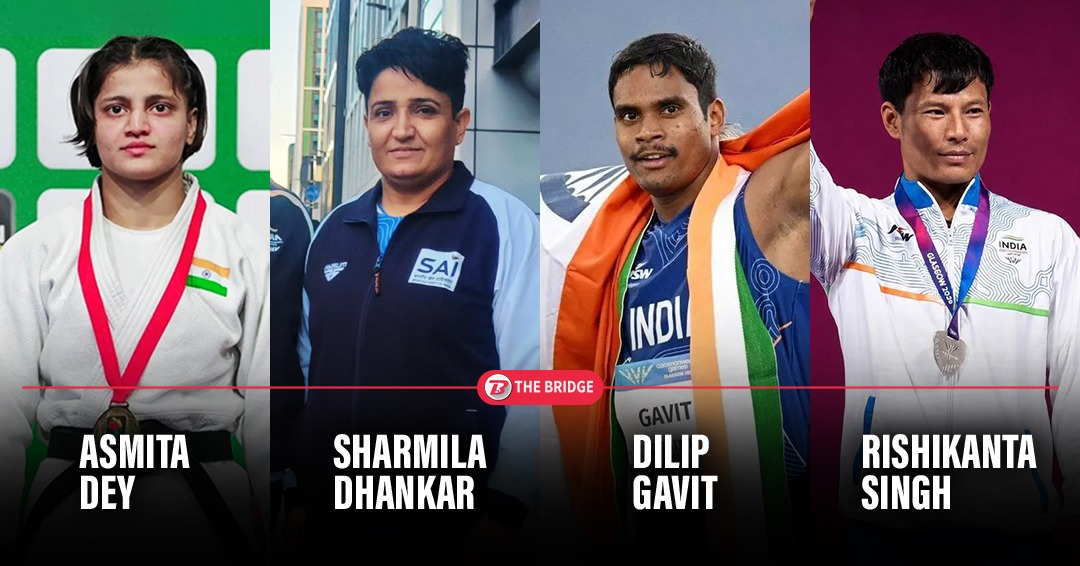
Asmita Dey: Her father ran a bicycle repair shop and was her biggest cheerleader. He passed away in December 2025. Just a few months later, she won gold in the women's 48 kg judo event, India's first-ever Commonwealth Games medal in the sport.
Sharmila Dhankar: She was left disabled by a wrong injection from a quack when she was two. She was married off at 19 into an abusive marriage and was once stripped naked in her village by her husband. At 26, she was thrown out of the house with her two children. It was her second husband who introduced her to para athletics. She has now won gold in the women's F57 shot put, ending India's 20-year wait for a Commonwealth Games medal in para athletics.
Dilip Gavit: He lost his arm as a child after a fall from a tree went untreated. His coach, Vaijnath Kale, spotted him in his village, adopted him, and trained him. Today, he is the first Indian to win Commonwealth Games gold in para track, in the men's 100 m T47.
Rishikanta Singh: He worked as a daily wage labourer, earning just ₹150–200 a day, using that money to fund his weightlifting dream before eventually joining the Indian Army. He went on to win silver in the men's 60 kg event.
And there are many more stories like these, whether they won a medal or not. These are stories that aren't told today.
We often look to people who are popular on social media and elsewhere for inspiration. But I think these are the people we should really be looking up to. People who kept going despite unimaginable odds, with little support or recognition, in our cricket-obsessed nation.
This is also why we invested in @the_bridge_in to bring stories like these to the forefront. There's no shortage of such inspiring stories, and we need more people to tell them.
There has been a lot of discussion about the sharp closing moves since the new Closing Auction Session went live.
CAS itself is not a bad idea. Most large global markets have some form of closing auction. A large amount of institutional activity, especially from passive funds and other benchmark-tracking investors, happens near the close. Instead of the closing price being determined based on the average traded price during the final 30 minutes, CAS brings these orders together in an auction to discover one closing price.
The goal of CAS is to enable better price discovery and make it easier to execute large orders without moving prices abruptly. But the price dislocations we have seen over the last few days highlight some of the structural problems that are specific to the Indian markets.
Closing auctions work well when there is deep liquidity and a large and diverse ecosystem of market participants, including market makers and arbitrageurs. Whenever prices diverge between the cash market, futures, ETFs, or different exchanges, participants step in and arbitrage the differences away.
This ability to arbitrage is much more limited in India.
For one, it is impossible to express a short view in the cash market. We have a securities lending and borrowing mechanism, but it isn’t deep or easy enough to use. Unless borrowing stocks and shorting them becomes easy, there is bound to be structural upward pressure in the markets.
Then there is the difference in the cost of trading an option versus a futures contract. In April 2026, STT on futures was increased to 0.05% of the entire contract value, while STT on options is charged on the premium. So even though the STT rate on options is higher, trading futures is more expensive.
Once you add STT, exchange charges, spreads, and impact costs, the trading opportunity has to be quite attractive before a futures arbitrage trade is worth doing. The same directional view can often be expressed more cheaply through options. This leads to traders preferring options over futures.
India has over 13 crore registered investors, but only about 20–30 lakh traders trade actively on any given day. That’s it. We don’t have a large enough committed ecosystem providing two-sided liquidity across the cash market, futures, ETFs, and closing auctions.
CAS is not the reason for these structural limitations, but it makes them more apparent. The timing of its rollout is also unfortunate, because the RBI’s new norms on capital-market exposure, which limit banks’ exposure to capital-market activities, are going live at the same time.
When one instrument is more attractive than another, or when participants cannot express both bullish and bearish views easily, distortions are inevitable.
There might be tweaks required in how CAS itself works. But the larger issue of our markets being shallow is a complicated problem to solve. It requires building an ecosystem that encourages all kinds of traders and investors, with different time horizons, to participate easily.
Making shorting and securities lending easier, reducing distortions between instruments, and encouraging genuine market-making would be a good place to start.
For the last 45–60 minutes of every day, my unwinding routine has been sitting with Seema and Kiaan while they read. I still can't seem to read a physical book myself. There's some kind of mental block, so I usually listen to an audiobook or a podcast instead.
That said, I do think reading a physical book is probably better. It demands your full attention in a way that very little else does.
One thing that's made a surprisingly big difference to my sleep is having a proper wind-down routine. An hour before bed, all screens go off (other than the audiobook or podcast), and I try to get to bed at the same time every night.
It's amazing how much consistency and a simple routine can improve sleep. Maybe the next challenge is finally getting myself to finish a physical book.
Seema and Kiaan recently took part in the @indiareadsaloud initiative by @turningpages_in, which is trying to get more children to discover the joy of reading. Full video link in comments.
India has so many athletes who, with the right support, can bring home so much glory for the country. But there's often a big gap between the kind of training and support an athlete needs and what they actually get. A better coach, a good diet, a proper rehab routine can take someone who is already extraordinary and make them even better.
This kept coming up in our discussions at @Rainmatterin. That's when we found the good folks at @OGQ_India (Olympic Gold Quest). What they've built is incredible. They support athletes with everything: coaching, sports science, nutrition, rehab, equipment, and even a monthly stipend so athletes can train without worrying about money.
And the results show. 13 of India's 21 medals in the last four Olympics were won by athletes supported by OGQ.
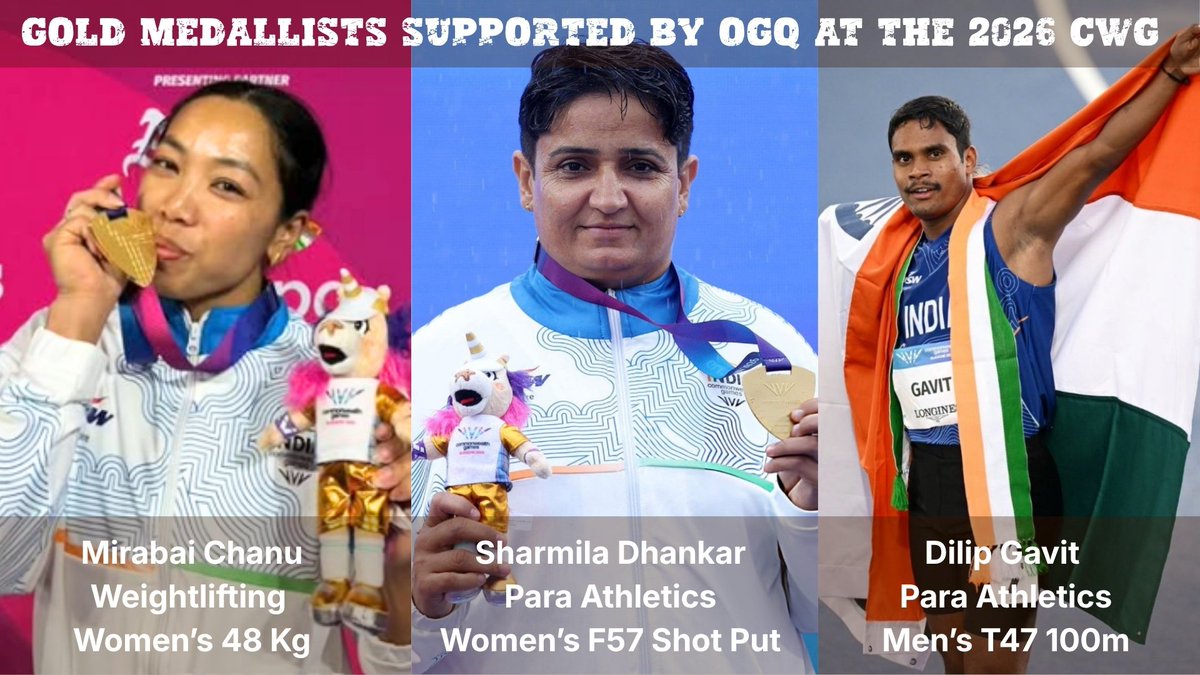
At the ongoing Commonwealth Games, three of India’s six gold medallists so far are OGQ-supported athletes. 10 Indian boxers have reached the finals, guaranteeing India 10 medals, each silver or better, and seven of the finalists are supported by OGQ.
All the credit goes to the athletes and the OGQ team. Makes me super happy that we get to support them in a small way.
The most exciting thing about @ZerodhaVarsity Tribe is that it's building a community of young people who are curious about money, saving, investing, trading, and building wealth. Financial literacy is one of the most important life skills, yet it's rarely taught. If more youngsters understand how money works early in life, they're far better equipped to make smarter decisions, build wealth, and even take the leap into entrepreneurship.
8 years back, I spoke to @jackschwager, the man behind the Market Wizards series. @mysandz spoke to him again recently on In The Money, and it was an interesting conversation. Market Wizards is probably the only book I've read multiple times when I was trading actively.
The one thing that stood out to me from the video was the debate between systematic vs. discretionary trading. There's a common assumption that the best traders are rules-based, meaning they follow a fixed set of rules. The logic is that this helps them keep their emotions in check so they can follow the signals dispassionately.
But what Jack found among the traders he interviewed was that almost all of them were discretionary traders. They had rules, but they knew when not to follow them. Meaning, they knew when their approach wasn't working and when they had to change the "rules" they were following.
The one purely systematic trader he ever profiled kept changing his systems. He once showed Jack the equity curve of the original system he made his first money on. It went straight up while he traded it, and straight down after he abandoned it. If he had stuck to it with blind discipline, he would have been wiped out.
At the very least, what this shows is that there isn't just one way to make money. There are numerous approaches that work, and you ultimately have to figure out what works for you and stick with that approach until it stops working, because nothing works all the time. People change, the markets change, and so do the strategies.
Full episode link in comments.
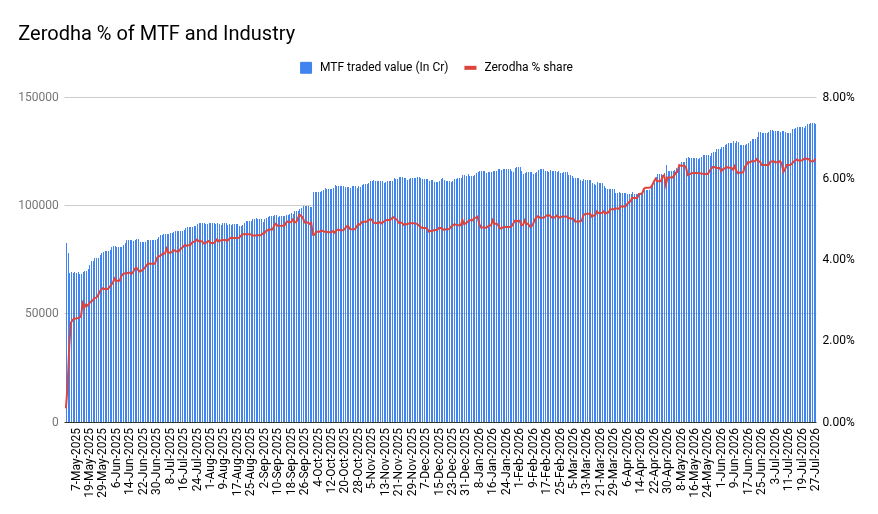
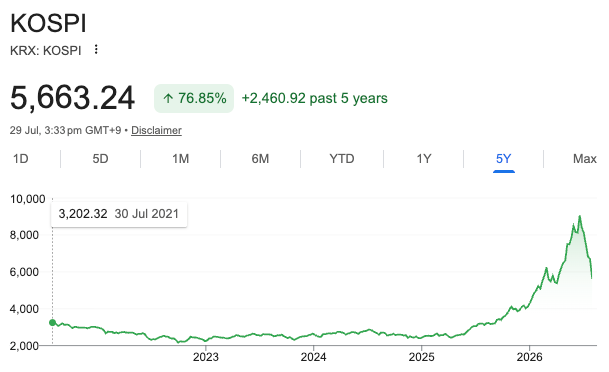
My biggest nightmare as a broker is what’s happening in the Korean markets right now. The source of my nightmare is the way our MTF book has been growing along with the industry as a whole. In terms of pure risk, MTF is by far the biggest risk we have taken since we started in 2010.
More specifically, the risk lies in our ₹9,000-crore book: at least half of it is in non-F&O stocks, which can hit lower circuits every day without offering an exit.
The problem with Korea is the one-way rally. When markets go up so sharply, leverage builds up because collateral values increase, leading to more borrowing and so on. The second layer of risk comes from the derivatives complex and leveraged ETFs, which further exacerbate moves on both the upside and downside.
When the markets fall, things get really ugly. The first leg of selling tends to be small, but as collateral and margin values drop, margin calls increase, leading to forced selling. Forced unwinding from leveraged ETFs makes this worse, and this downside move becomes a self-reinforcing loop until things stabilize.
Btw, MTF became popular only in the last 3–4 years, and we really haven’t seen a sharp market crash similar to the KOSPI since COVID. Even though MTF as a percentage of market cap is small, if the Indian markets were to fall sharply, it would cause severe sell-offs across many small- and mid-cap stocks. Brokers today typically provide MTF on ~1,500 stocks. 😬
Luckily, thanks to SEBI, we've avoided the worst excesses that typically arise from unchecked leverage.
Btw, my colleague @prayagverma maintains a site with really good market stats, including MTF, here: https://t.co/uRJrvOvbHK
Things get a little more complicated from Monday, August 3.
Exchanges are introducing a Closing Auction Session, or CAS, for stocks with F&O contracts. This isn’t a new concept globally. Major exchanges such as the New York Stock Exchange (NYSE) and London Stock Exchange (LSE) already use versions of a closing auction to determine closing prices.
Today, the closing price of a stock in India is based on the volume-weighted average price of trades during the last 30 minutes. Under CAS, buy and sell orders will instead be collected and matched at a single equilibrium price.
The change is meant to address two issues.
First, passive funds tracking indices need to execute large orders near the end of the day to match the closing price. These orders can move prices while they are being executed, increasing tracking error.
Second, large orders placed in the final few minutes can disproportionately influence the closing prices of stocks and, in turn, the indices they are part of. There have been concerns that this can be used to push indices towards certain closing levels. Since CAS pools all orders and matches them at a single price, influencing the close becomes harder.
It also means we’ll now have three different market end times depending on what you’re trading.
- Stocks with F&O contracts will stop continuous trading at 3:15 PM and move into CAS.
- All other stocks will continue trading until 3:30 PM.
- Index and stock F&O contracts will trade until 3:40 PM.
Now that broking is listed and people are looking more closely at the business, the honest bit: this will probably knock off some revenue, perhaps around 1–5% of brokerage income.
The more immediate challenge, though, will be explaining why different parts of the market now appear to close at different times. We’re braced for the flood of questions.
More detail on the blog, link in comments.
One of the reasons filing takes time is the constant back-and-forth with your accountant. @zerodha’s Tax P&L reports were already largely tax-ready, but over the last few months, we’ve spent quite a bit of time making them even better.
Btw, historically, brokers didn’t really provide good tax statements, which made filing taxes on trading and investing a pain in the ***. Around 2013, we realised that this could be a significant value-add for customers, and we became the first broker to offer a dedicated Tax P&L statement.
We also created a dedicated @ZerodhaVarsity module on taxation related to trading and investing to make customers’ lives a little easier.
Taxation on market activity has changed significantly since then and has only become more complicated. Our tax reports account for these changes, so you don’t have to worry about figuring everything out yourself.
Some new things we’ve added recently:
1. The Trade-wise Entry/Exit and Equity sheets now classify investments as equity, non-equity, and debt ETFs.
2. Short-term and long-term capital gains from non-equity transactions are now shown separately.
3. Dividend income now comes with a quarter-wise breakup, while interest received from debt securities is available in a dedicated Debt Interest Statement along with dividends.
4. You can now download quarterly Tax P&L reports aligned with advance-tax due dates.
5. The Tax P&L page now also includes a summary of profits and losses from non-equity transactions.
So, you can now pretty much download the reports and send them directly to your CA without worrying that something important might be missing.
You can also check out @Quicko_official in case you need help.
One of the biggest challenges of the broking industry is that retaining users is really, really hard. The reason is that most users eventually end up blowing up their accounts. And this isn’t limited to F&O; it happens in equities as well.
So, you have to keep running just to stand still, to maintain the number of users on the platform and ensure that the business remains steady.
We were looking at some statistics, and one of the surprising things we found was that roughly 55-60% of our users are still active. By active, I mean people who have holdings in their accounts.
The best proxy we have for the broader industry suggests that this number is much, much lower elsewhere.
This may be partly due to the fact that we have never advertised and don't have a lot of new users who typically don't trade and invest much.
This is my first long conversation in a very, very long time.
The idea was to talk about all the things that make Zerodha what it is today, because a lot of people don’t really know how differently Zerodha has been built compared to most other companies.
We’ve never raised external capital. We don’t advertise. We don’t have a sales team with sales targets. We don’t do much marketing. We don’t push people to trade or invest. And we have a relatively small team that has remained at roughly 1,000 people since around 2018–19, even though the business has grown five or six times since then.
In this conversation, I spoke about all these things and more: how we think about growth, risk, competition, and the future of Zerodha.
This is also the beginning of a new series where we want to shine a spotlight on the people who have made @zerodha what it is today. A lot of them aren’t very well known, so the idea is to put them on the spot and tell their stories.
Check out the full conversation on the Zerodha YouTube channel. The link is in the comments.
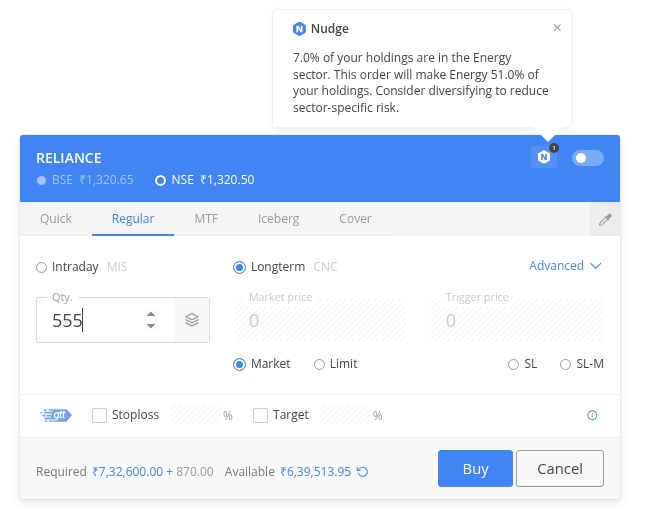
Saw a tweet of some guy losing all his savings because he invested all his money in 2 stocks. We recently added a nudge on Kite to help investors avoid exactly this scenario. You will now see an alert if a single stock or sector exceeds 50% of your portfolio. While “getting rich” with a concentrated portfolio sounds nice in theory, it’s often a recipe for disaster unless you are a genius stock picker.
The 50% is just a starting point. We will eventually give users the option to configure it.
This is just one nudge. We have more intelligent and contextual ones in the works, including the ability to customize them.