Interesting: Amber, a programming language for Bash scripts.
"Amber is a programming language compiled into Bash Script. It was designed with a modern syntax, safety features, type safety and practical functionalities that Bash could not offer."
The Fable model has been terrific for me in a very specific way: I'm using it to fix my Claude setup [CLAUDE.md, settings.json/local, etc.] to avoid most of the annoying user approvals needed by the dev thread, while staying safe.
Meanwhile Opus 4.8 for coding is just fine.
"Fair question. I reached for it reflexively because your question names Anthropic, but it's the wrong tool here — that skill is a reference for the Claude API's own .., but your question refers to ..."
Makes me a bit skeptical about AI agent loops, but going to give it a shot.
In many ways, this is the golden age of LLM usage: access to the latest models at very low prices, like $5 Uber rides when it was subsidized by VCs.
In future, cutting-edge models may be out of reach for personal coding. But open source models may become good enough by then!
People think too simplistically about AI, in terms of the individual tasks it can do. To understand the impact of AI on knowledge work, we need to think in workflows.
Imagine we have an assembly line process composed of 100 different small steps.
Now imagine we receive a magical technology that speeds up a random 50% of the tasks by 100x, while the other 50% stay exactly the same.
Does this mean the whole factory will run 100x faster? No.
What we end up with instead is massive misalignment in production rates, with logjams at dozens of points in our process. The whole line ends up slower than it was before, if not broken entirely.
Sure, if we're lucky, we have a lot of processes that only have 1 or 2 steps end-to-end, and they will be sped up miraculously, but anything that's intricate and detailed will very likely get much worse before it gets better.
This, in my opinion, is where we're at with AI.
Someone is going to build a worldclass “Brain” for enterprises & make a stupid amount of money.
Why? As @da_fant said, “coding w ai is solved bc all context is in the git repo. knowledge work is difficult bc context is spread out. an ai system that creates a git repo w all context for a knowledge worker will be able to 100% automate the work.”
When companies talk about being data ready for AI, this is what they’re implicitly saying.
Engineering has been prepared for this moment for a long time because of the deterministic nature of code, the centralization/versioning of data (read: GitHub), and AI tools that are largely build by engineers for engineers.
But for the rest of white collar work, there’s a TON of catching up to do to properly harness the power of the technology.
The big challenge here, and why no one has truly cracked the code for "an ai system that creates a git repo w all context for a knowledge worker" is because unlike code, most knowledge is 1) distributed, 2) unstructured, and 3) unverifiable.
It's distributed: transcripts live in Granola. Documents in Notion. Customer Data in Hubspot. ERP. Emails. Slack messages. Random spreadsheets. SOP docs. Etc. Etc.
Building an ingestion engine that connects to all of your disparate data sources and auto-updates based on the shelf-life of the data is the first, and frankly, easiest step of the process.
Next, it's unstructured: let's say I want to create a proposal for a potential client. To nail the proposal, I want it to pull important information from a variety of sources. The specific asks & background from our initial sales call. Previous proposals to anchor ourselves to a proven format. And completed sprint boards from Linear, so the pricing & timeline in the document is grounded in truth.
Whether it's a thoughtful filesystem (a la Obsidian) or an OpenClaw-esque memory structure, the brain needs to be great at self-organizing in a thoughtful schema. This is very hard, especially if you want to build a generalizable brain that can be shaped to an array of different enterprises.
And finally, most knowledge is unverifiable: writing a function, running a unit test, and seeing if the code works is easy. It works or it doesn't. Using AI to accelerate your content creation process is highly subjective. What is a good/bad idea? Is the content in your voice or not? Does it feel like slop or novel? Answering these questions are both difficult and non-verifiable.
That same system described above doesn't just have to be great at organizing & forming coherent relationships, but it also has to be great at self-improving based on feedback from the user. Memory systems (like those introduced by OpenClaw) are great to a point, but as you scale the corpus of data within your company's brain, things like compaction and cleaning become wildly important to avoid the needle in the haystack problem.
Someone is going to figure out how to solve this problem, and when they do, not only will they make a shit ton of money, but they'll be robinhood for knowledge workers, enabling non-engineers to enjoy the sort of leverage that only technical folks have felt for the last few years.
“The fix wasn't fixing 10 skills individually. That's whack-a-mole. You fix one, another drifts. The fix was a shared filing rules document …”
Functions! We’re rediscovering software from first principles. Truly, English is the programming language of the future.
Here a controversial take: most of the authority that exists in any organization was never formally granted to anyone. It was assumed, exercised, and then retroactively legitimized by the fact that it worked.
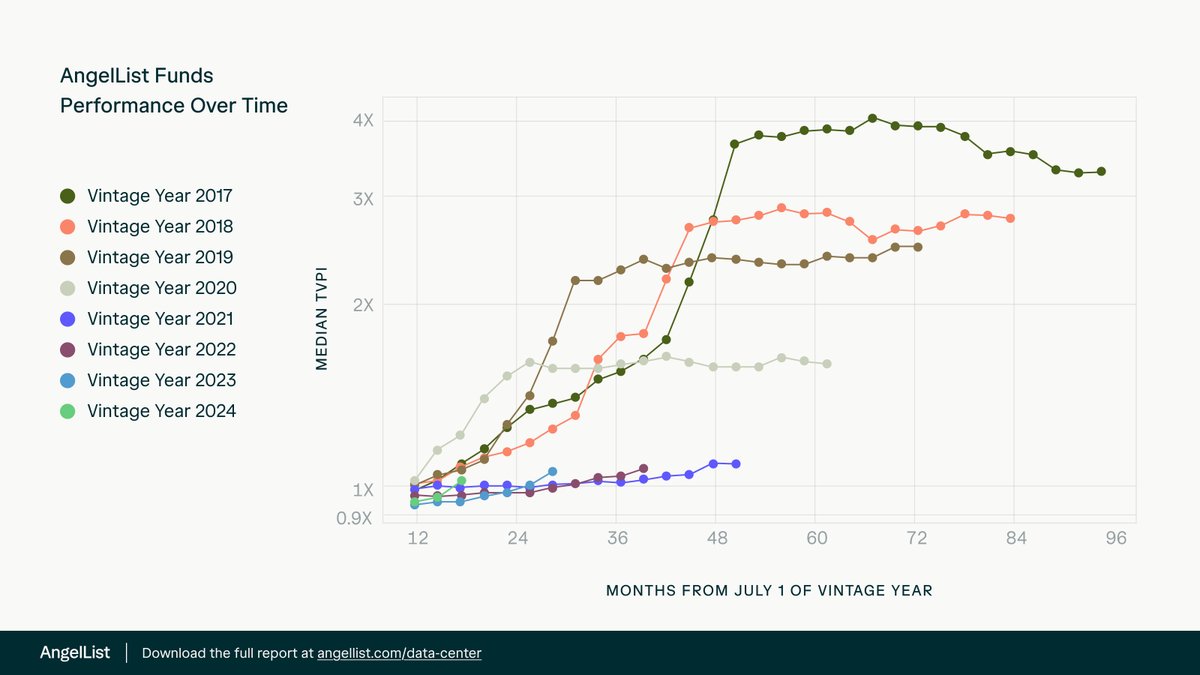
This chart explains a lot of quiet tension in venture right now.
Early-stage performance over the last decade breaks into three distinct vintage regimes, driven more by macro conditions than manager behavior.
If you’re still thinking about recent vintages on a single curve, this is worth a closer look.
Full context in our 2025 Fund Benchmarks Report 2025: https://t.co/KtypzoIyOc
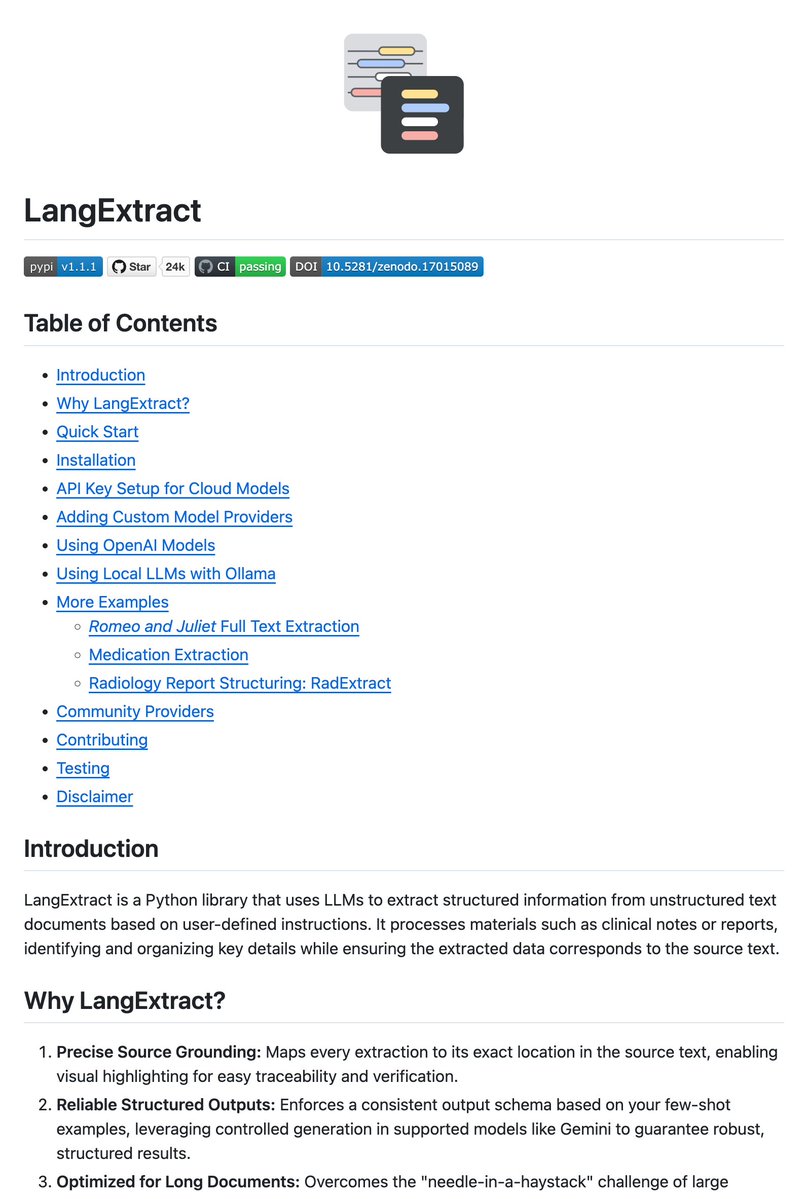
Google just killed the document extraction industry.
LangExtract: Open-source. Free. Better than $50K enterprise tools.
What it does:
→ Extracts structured data from unstructured text
→ Maps EVERY entity to its exact source location
→ Handles 100+ page documents with high recall
→ Generates interactive HTML for verification
→ Works with Gemini, Ollama, local models
What it replaces:
→ Regex pattern matching
→ Custom NER pipelines
→ Expensive extraction APIs
→ Manual data entry
Define your task with a few examples.
Point it at any document.
Get structured, verifiable results.
No fine-tuning. No complex setup.
Clinical notes, legal docs, financial reports, same library.
This is what open-source from Google looks like.
It's not going to happen overnight but I'm now convinced that the cost of sw dev is headed close to zero.
And AI-forward startups will have a serious advantage in terms of greater speed, smaller teams and lower cost. They can focus on the solution, not the technology.
How to build a context graph
A follow-up to the recent piece on context graphs, the layer that captures decision traces rather than just data.
The argument: the next trillion-dollar platforms won't be built by adding AI to existing systems of record, but by capturing the reasoning that connects data to action.
But how do you actually build one? @akoratana, founder and CEO of PlayerZero has a go at an answer.
The answer isn’t “add memory to your agent” or wire up MCP. In fact, the word graph itself is a little misleading. What you’re really trying to model is far more dynamic and probabilistic than a static graph suggests.
The honest answer is that this is structurally hard. Not "scale up compute" hard, but "rethink your assumptions" hard. Context graphs don’t exist today because building them forces us to confront problems we’ve spent decades ignoring.
Every organization pays a fragmentation tax: the cost of manually stitching together context that was never captured in the first place. Different functions use different tools, each with its own partial view of the same underlying reality.
A context graph is infrastructure to stop paying that tax. But to build one, you first have to understand why the tax exists.
Koratana outlines three ideas that shape how he thinks about this.
1. The Two Clocks Problem
CRMs store the final deal value, not the negotiation. Ticket systems stores "resolved," not the reasoning. Codebases store current state, not the two architectural debates that produced it.
We've built trillion-dollar infrastructure for what's true now. Almost nothing for why it became true.
2. Agents As Informed Walkers
The ontology problem looks unsolvable at first. Every organization is different. Every system has unique structure. You can't standardize "how decisions work" any more than you can standardize "how companies work."
But there's something that navigates arbitrary systems by definition: agents.
3. Context Graphs Are Organizational World Models
There's a concept worth taking seriously because it reframes what context graphs actually are: world models.
A context graph with enough accumulated structure becomes a world model for organizational physics. It encodes how decisions unfold, how state changes propagate, how entities interact. Once you have that, you can simulate.
https://t.co/tX9PlevVqF
--
📩 The Year of the Graph Winter 2025-2026 newsletter issue is out!
The Ontology issue: From knowledge to graphs and back again 👇
https://t.co/sviXFOwPPj
All things #KnowledgeGraph, #GraphDB, Graph #Analytics / #DataScience / #AI and #SemTech.
Subscribe and follow to be in the know. Reach out if you'd like to be featured
6/7 But the real magic comes in 2026 and beyond: what happens when you *combine* these two technologies? Can stablecoins provide AI agents with a practical wallet enabling AI to execute financial transactions autonomously?