@barberaf84 I was also wondering myself about that yesterday. Less landscape occupied and the opportunity to have a great pov of our valley from the city.
@mattpocockuk That's a very competent solution for development, and a pragmatic one considering the occasional quirks of running a full Linux distro. If you can tolerate Windows as an operating system, which is fine. I suggest to have all the scripts/workspace on the remote linux filesystem.
4 years after Deno 1.0, the next generation of JavaScript is ready for production at scale.
Deno 2 is out today:
🐢 Fully backwards compatible with Node and npm 📦 Package management and node_modules and package.json
📅 Long term support
https://t.co/LsV4D4Too8
It’s always nice starting the day with great announcements!
Module Federation & Vite
Module Federation & Webpack
Module Federation & RSpack
Module Federation without any bundler
Now you don’t have any more excuses… #microfrontends are improving the ecosystem and tools
A huge congrats to @giorgio_boa@ScriptedAlchemy and the entire team behind module federation for this incredible milestone 👏
There is a lot of commitment and hard work for achieving a rich ecosystem like this one and I am pleased to see so much innovation on micro-frontends this year.
On top of module federation, let’s not forget what Vercel is doing and the new version of Piral with Picard library 🙏
I will have a ton of work to document everything in my second edition of “Building Micro-Frontends” 😅
In the meantime enjoy Giorgio’s post on Vite with Module Federation: https://t.co/O4Ly0WsLe3
Please share this far and wide. As far and wide as you can. NIST Password Guidelines for 2024 are in the process of being updated.
This is a HUGE pet-peeve of mine (when vendors in particular are still operating like its 2017 and keep changing passwords every 60 days, STOP DOING THIS, it's outdated and has been shown to put you MORE at risk than less -- NIST explains why it does in this document, meticulously outlining user behavior**) so I'm sharing this in the hopes all of you will pass it along to your bosses.
The Special Publication series governing passwords is SP 800-63 "Digital Identity Guidelines".
The 2024 version is 800-63-4.
Here: https://t.co/oX8YEJHxXg
The companion docs are also on that link. They are 800-63A, 800-63B and 800-63C. These are different documents for different scenarios in play at your org.
The previous update was in2020.
The changes in the 2020 version from the 2017 version were numerous but one of them was that the password verification method should NO LONGER require passwords be changed at specific intervals (i.e. every 60 days) but in the following circumstances instead:
1. After a breach/compromise
2. User request
2024 repeats this and adds a bunch more guidlines but here is a screenshot of page 13 of the new 800-63-4 (note the # 4 after it) which outlines how your systems should now and moving forward, be handling passwords.
This goes for Active Directory, too. All your systems which have passwords should align with these guidelines provided there isn't another standard or framework you must adhere to which overrules this.
Most frameworks, however, have moved away from arbitrary password resets and complexity rules.
**We cybersec researchers and hackers use wordlists from breaches in a variety of different ways. Hackers use them in tooling to crack passwords whereas researchers use breach dumps to see the kinds of passwords users are creating and the psychology behind them.
Using complexity rules gets you the user psychology of:
Password1
Password2
and so on
Use phrasing instead and allow for spaces, which is important. Humans type phrases with spaces. They also mention phish-resistant methods and most vendors are on-board with MS going to be turning off all Legacy Auth next month, across all free accounts and tenancies.
I'm so excited for the new changes!
Ok I'm off my soapbox.
Share the love! Thank you!
The agenda for #DaprDay is now published! Come and join us online to celebrate 5 years of Dapr! 🎂🥳
🗓️ Oct 16th
🕣 8am-1:30pm PST / 5pm-10:30pm CET
🎥 Online
Free registration: https://t.co/IwNURvdUsB
Here’s the thing folks. I’ve been coding 32 years. When something like this happens it’s an organizational failure. Yes, some human wrote a bad line. Someone can ��git blame” and point to a human and it’s awful. But it’s the testing, the Cl/CD, the A/B testing, the metered rollouts, an oh shit button to roll it back, the code coverage, the static analysis tools, the code reviews, the organizational health, and on and on. It’s always one line of code but it’s NEVER one person. Implying inclusion policies caused a bug is simplistic, reductive, and racist. Engineering is a team sport. Inclusion makes for good teams. Good engineering practices makes for good software. Engineering practices failed to find a bug multiple times, regardless of the seniority of the human who checked that code in. Solving the larger system thinking SDLC matters more than the null pointer check. This isn’t a “git gud C++ is hard” issue and it damn well isn’t an DEI one.
@mattpocockuk Can we then agree that a pre-commit hook that can potentially save the dev a failed CI and a subsequent commit + build (and wait) workflow (and is reasonably quick) can be considered beneficial?
To address extreme levels of data scraping & system manipulation, we’ve applied the following temporary limits:
- Verified accounts are limited to reading 6000 posts/day
- Unverified accounts to 600 posts/day
- New unverified accounts to 300/day
Ecco le ultime 24h di generazione elettrica in GER e FR.
Il sole sta per tramontare e il vento è calato molto rispetto a 24 ore fa. Così in GER, nelle prox 14 ore la generazione solare sarà zero, quella eolica quasi zero, ~40 GW saranno generati in media a carbone e a gas 1/n
@barberaf84 I tend to agree on this one. That's a pattern I used to love when working on JavaScript projects but types (maybe unions in this case) are safer to use and have a nice bonus to better communicate the expected or possible behavior.
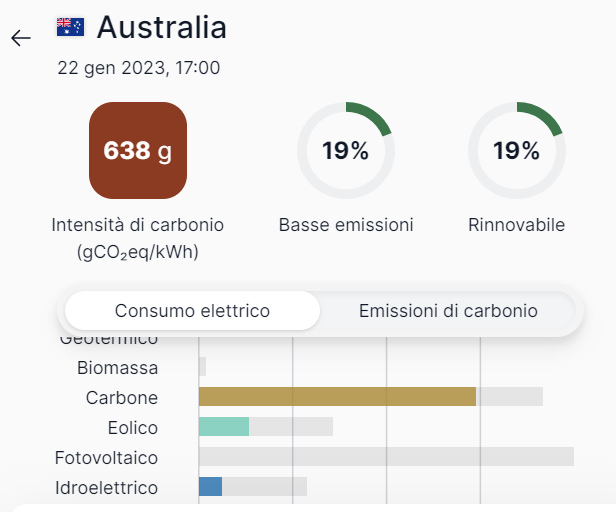
Nuovo record per la #Germania: la chiusura del #nucleare e i grandi investimenti nelle #rinnovabili sono riusciti a renderla oggi più inquinata dell'Australia, il Paese del #carbone! L'ambiente ringrazia.