College athletics is terrible at seeing problems around the corner. The 24-team playoff is the latest example.
A lot of schools that supported this will regret it because in the end it won't be about the playoff or even the now diminished regular season.
Notre Dame now has the best situation in all of football - almost 100 percent guarantee to make the playoff, freedom to schedule as it wishes, maximization of its own media value.
To use the Big Ten as an example, why wouldn't Ohio State, Michigan and Penn State follow? If you can, be independent. That's the future.
The 18-team Big Ten is bloated, distant and winning it carries little intrinsic or competitive value for the biggest brands.
Those three schools can create a scheduling agreement that would increase their media revenue 2-3x and give the same control over everything. No sharing money. No forced TV times. Eight or even nine home games. Select your own schedule.
Staying in the Big Ten now makes little and perhaps no economic sense. And yes, I do understand the league-wide research grants and so on, but there is always a way around everything.
In terms of athletics, for those schools (and maybe a few more) it's lost revenue for the sake of loyalty and we know how that usually gets settled.
All these middle and lower schools -- even in the P2 -- that supported this because they'll get in the "participation playoff" with an 8-4 record are facing significant risk in the future.
There will come a day when they will now get a share of the Ohio State-Michigan windfall; only Ohio State and Michigan will.
Maybe not tomorrow, but I believe a 24-team playoff makes it closer than ever.
Thoughts?
The Real Energy Shock Isn’t Oil. It’s Diesel.
Everyone watches Brent.
They may be watching the wrong number.
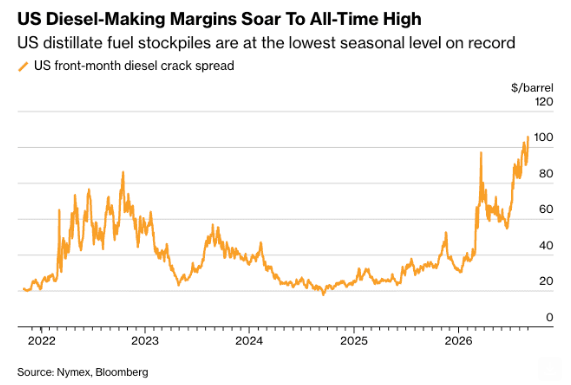
US diesel futures have surged to the equivalent of more than $216 per barrel, while Brent crude is trading near $105. The national US pump price for diesel has already broken $6 per gallon for the first time.
That gap matters.
Diesel inventories are around 13% below their five-year average, while the diesel crack spread — essentially the premium for turning crude oil into diesel — has hit a record $112 per barrel.
This is no longer simply an oil shortage.
It is becoming a refined-products crisis.
And diesel is different from gasoline.
Gasoline hurts the consumer directly.
Diesel moves the economy.
Trucks.
Agriculture.
Construction.
Mining.
Rail.
Heavy industry.
Backup power.
Shipping logistics.
Almost everything sitting on a supermarket shelf has diesel embedded somewhere in its cost.
The inflationary impact is already visible. US producer prices rose 5.4% year-on-year in August, with diesel prices jumping 24.1% in a single month and accounting for more than a third of the rise in producer goods prices.
And now Saudi Arabia has another problem.
Its East–West pipeline — the strategic route designed to bypass the Strait of Hormuz — has been shut following attacks.
That matters because the entire purpose of the pipeline is redundancy.
If Hormuz becomes unreliable, Saudi crude goes west.
But if the bypass itself becomes vulnerable, the market loses something far more important than barrels:
it loses confidence in the backup plan.
Meanwhile, attacks on tankers, disruptions around Hormuz and pressure on Saudi energy infrastructure have already helped push Brent back above $100. Saudi crude supply fell to around 6 million barrels per day in August, its lowest in more than three decades.
The chain reaction now looks like this:
Middle East war
→ crude supply disruption
→ refinery/feedstock stress
→ diesel shortage
→ freight costs
→ food and manufactured goods
→ inflation
→ higher interest rates
And that final arrow may prove politically explosive.
US inflation accelerated again in August, while markets are now pricing a high probability that the Federal Reserve will raise rates, rather than cut them.
So while politicians debate whether Brent reaches $120 or $150, the more important question may be:
What happens if crude stays near $110 — but the fuel that actually moves the economy trades at $220–250 per barrel?
That could be a far more damaging shock.
Because an oil crisis is visible at the petrol station.
A diesel crisis eventually appears almost everywhere.
Och där har vi även en väldigt bra slutkläm kopplad till Trump:
Trump promised cheaper energy.
Instead, the fuel that moves the American economy has just reached the highest price in history.
The World is Focused on the Price of a Barrel of Oil. They should be looking at the refinery charge, or the “crack spread” to produce the refined products of diesel and gas.
The Diesel Anomaly: In a standard market (like 2016), a barrel of refined product yields a fraction of the cost of the crude input. Today, the diesel crack spread ($106/bbl) exceeds the actual cost of the crude oil itself ($100.25/bbl). Refiners are earning more pure profit on every barrel of diesel produced than they pay to buy the oil in the first place.
Refining Bottleneck: While crude oil has slightly more than doubled since 2016 (~$43 vs ~$100), the benchmark 3-2-1 refining margin has surged nearly five-fold (~$13.50 vs ~$65). This underscores that current pump shocks are heavily driven by refinery infrastructure limitations.
Bottom line: Refined product supply is low due to refinery infrastructure limitations. Demand is unchanged.
This is one of my new favorite maps. It shows the real America and the immense power that flows through the Heartland. Physical commerce. Not the office jobs, the insurance companies, the vast number of urban consumers on welfare. This is where the real is produced. 1/
If I were trying to build a data center in rural America @ChrisBennettMS is the first person I would talk to about how to navigate the contention. Very balanced article.
@MarkRuffalo@elonmusk .@elonmusk is a 1 of 1. A true rainmaker. You, alas, are a relic of a time when celebrity corresponded with inflated influence. Your grip on reality has slipped past the point of redemption. Thanks for your bygone contributions to the cinema of the 2000’s.
@ChrisMWilliams Suggestion to target Nkrumah as a Grad Transfer for next season. Body type and mentality are there. Leadership and game IQ will be valuable.
An NVIDIA powered farming machine uses Al vision and precision lasers to eliminate weeds in milliseconds without herbicides and without harming crops, a potential shift toward chemical free agriculture
My dear American friends,
We British Christians would get excited when, once a year, Queen Elizabeth would make a mild but sincere reference to the love of Jesus Christ in her Christmas address.
In Charlie Kirks' Memorial service, watched by tens of millions, I just heard:
- Multiple clear presentations of the gospel from men like @robmccoyus and @DrFrankTurek with clear calls to repentance and faith
- Worship songs full of Scripture sung by tens of thousands live and millions at home
- Personal testimonies of lives transformed by the work of Christ and the witness of believers
- Demonstration and explanation of the value of marriage, child-rearing and family
- Calls to Romans 13 for the government to bear the sword for the protection of good and punishment of the wicked
- Declarations of spiritual warfare on the forces of evil and promises to endure no matter the cost
- Calls to be prophets and call the nation to repent
- More Scripture references and Bible readings than I can count
- And a widow publicly forgiving her husband's killer because Christ forgave his killers on the cross.
All of it done before, and by, the most powerful people in your nation and the world.
You guys should be on your knees thanking God for your country. It is a light to the world.
Never stop fighting for it.
To my fellow Christians: Something beautiful is happening because of Charlie Kirk. Both the non-believers and churchless are coming back to church. Be warm and loving to them. Many left church years ago because they saw hypocrisy or got hurt in them. Show them the love of Jesus.