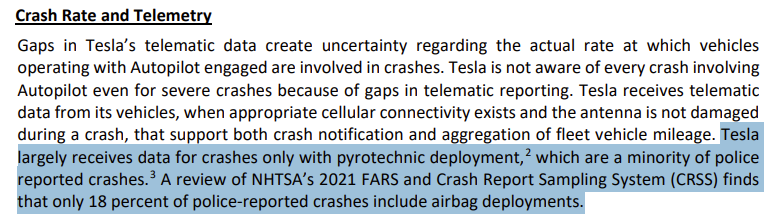
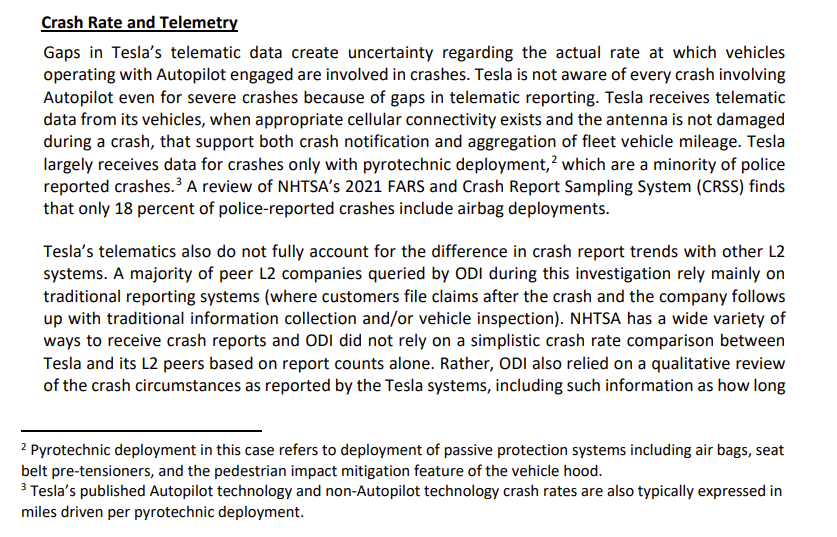
@technojawa This is correct. I can't determine the proportion of crashes with seat belt pretensioners, but NHTSA seems to think they are a "minority" of police reported crashes, which I interpreted as <50%. https://t.co/2OD2Sz4gMg
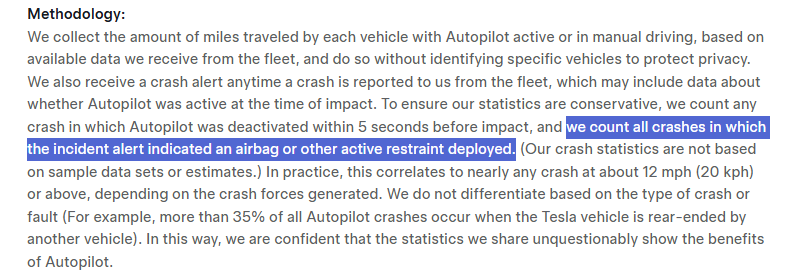
This is false. In the fine print, Tesla only counts their own crashes when it's an airbag or active safety restraint, whereas "US drivers" counts anything where at least one involved vehicle was towed. Many tow crashes don't deploy airbags. It's apples to oranges.
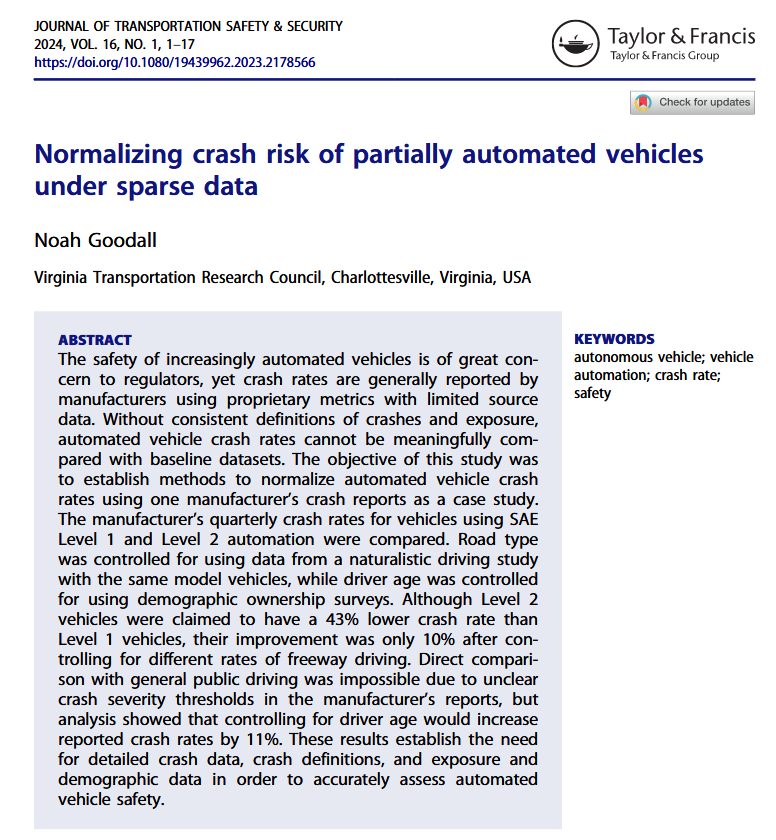
Tesla should be doing the work of coming up with appropriate benchmarks, not me. For comparison, Waymo has been writing entire peer-reviewed journal articles about benchmarking! https://t.co/oIGmx3rx5r
1. We have to assume these stats are accurate, which is hard when they fall apart upon inspection every time.
2. Autopilot is used on freeways, which is already 2x safer than non-freeways. Last I looked, AP was only 10% safer when controlling for road type.
@Tesla Does the quarterly safety report include FSD (supervised) data, or is the post text incorrect? The quarterly safety reports make no mention of FSD, and never have.
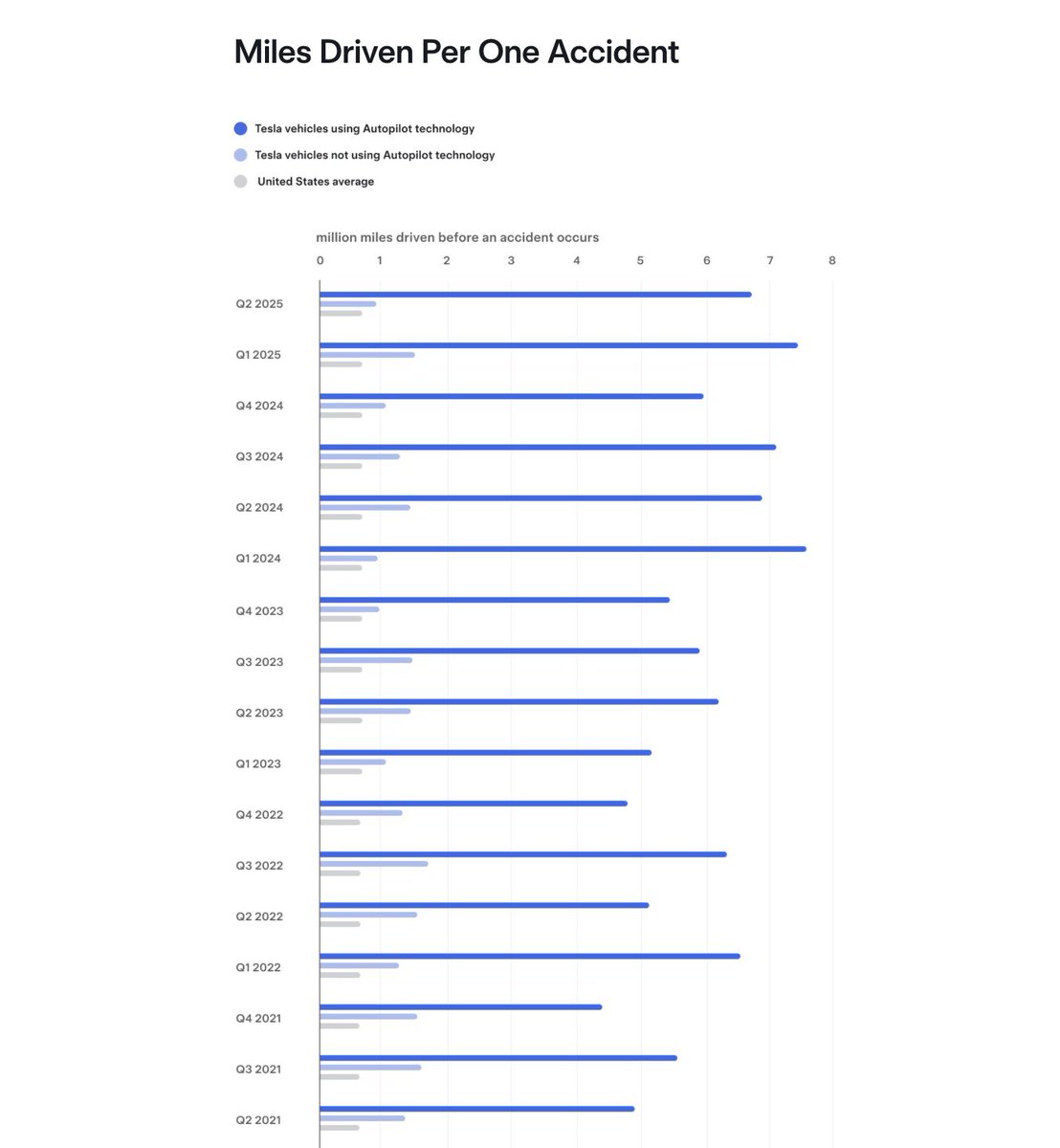
Autopilot & FSD Supervised safety data
In Q2 2025, we recorded one crash for every 6.69 million miles driven in which drivers were using Autopilot technology.
By comparison, the most recent data available from NHTSA & FHWA (from 2023) shows that in the United States there was an automobile crash approximately every 702,000 miles
I would love some clarification from Tesla, but I've been publishing on this for years and was an expert witness in Huang v. Tesla and still never got answers.
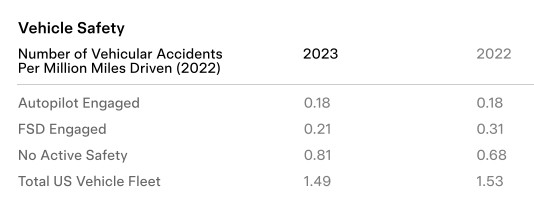
In Tesla's earnings call last night, CFO Vaibhav Taneja claimed their new safety report shows FSD is 10x safer than non-FSD. This is false. The new safety report covers AP, not FSD. FSD was only 4x safer than no active safety features at all (even AEB) from most recent 2023 data.
Even weirder, AEB is turned on every time the Tesla restarts. So I have to assume some weirdo is turning off AEB manually every time they start the car, and Tesla is using this person and other like them as a baseline. Talk about self-selection.
Most of the violations are fairly minor regarding labeling or lack of sun visors. The glazing may be an issue, but it could again just be labelling, I couldn't quite follow. It was purely a visual inspection, nothing destructive.
Exclusive: Negative findings by federal investigators examining a self-driving taxi made by Amazon-backed Zoox raise questions about plans for a new generation of autonomous vehicles. https://t.co/1uQV6vVDKX
The Virginia Transportation Research Council is hiring a scientist for the safety, operations, and traffic engineering team. VTRC is the research division of the Virginia Department of Transportation. https://t.co/tyMhTXXAno
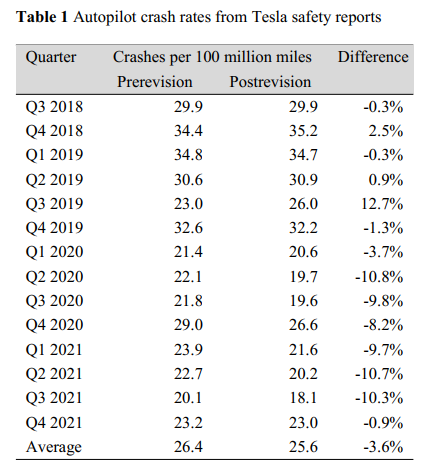
I later learned why the crash rates were revised: they appear to have removed records of Teslas running active safety features (like automatic emergency braking) but not AP. So we get a comparison of AP vs. some theoretical low-tech car from the 1990s. https://t.co/ajGxDqNsso
Back when NHSTA SGO required ADAS crash reporting, Tesla reclassified and revised their self-reported Autopilot crash rates. The revisions don't make statistical sense, and I suspect Tesla is miscounting crashes to make Autopilot look safer.
New peer-reviewed pub out, 🧵 1/
I testified for the plaintiffs re: Autopilot's safety in the Huang trial. Tesla's expert was a consultant who had only been given the high-level quarterly crash rates, which had been mysteriously revised in Tesla's favor just months before. It led to some fun exchanges.
HUBRIS MAXIMUS: The Shattering of Elon Musk is out April 22
Read the entire excerpt here:
Musk’s fury over a Tesla investigation foreshadowed his war on Washington
https://t.co/R1zTF7XZur
This went on for quite awhile. I was shocked. There was millions on the line for Tesla, so I assumed they'd break out the internal numbers and destroy my argument. Instead, they settled. I suspect the internal numbers were worse.