@FibreTigre Je trouve ça médiocre de plaisanter sur la réelle mort de gens. Que ce soit complotiste ou pour se moquer d'eux, il y a eu des morts qui se sont fait manipulés. Cette histoire est triste et indigne d'en faire un tweet dédaigneux.
🚨Un desarrollador acaba de hacer lo que Google no ha conseguido en años.
Ha creado un navegador en Rust que arranca al instante, consume 10 veces menos RAM y bloquea miles de trackers automáticamente.
Acumula más de 5k stars en GitHub, es gratis y open-source.
te explico cómo funciona ⬇️
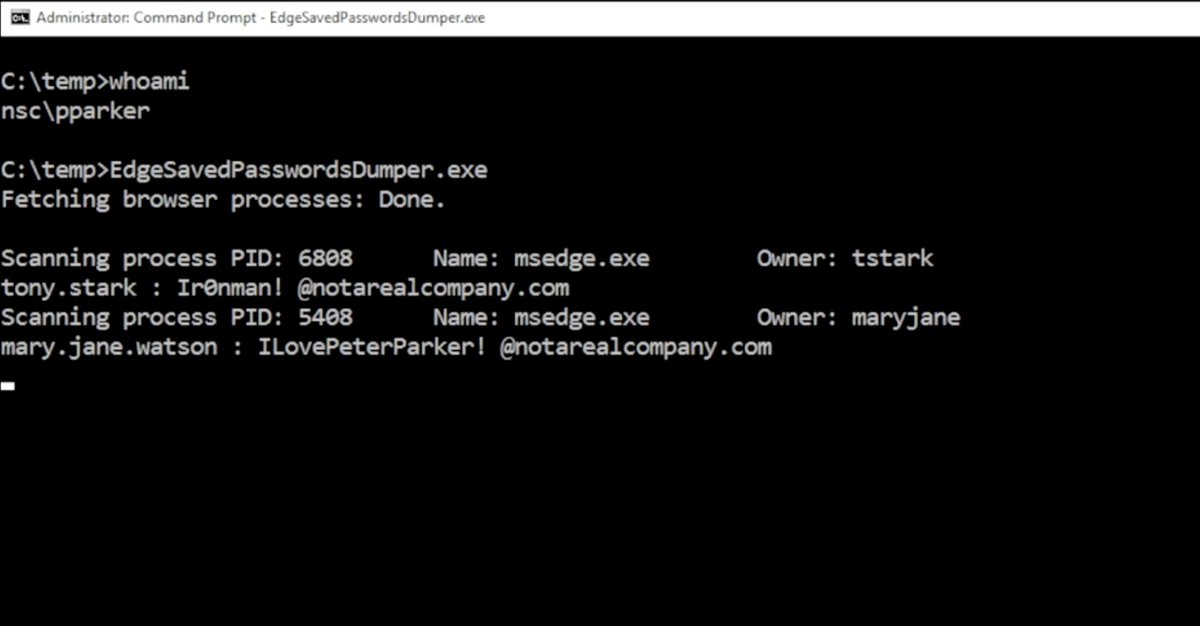
❗️🚨 Microsoft Edge keeps every saved password in process memory as cleartext from the moment it launches. Microsoft's responsed when reported: "by design."
All of them. Including credentials for sites you won't open this session.
Researcher @L1v1ng0ffTh3L4N tested every major Chromium browser. Edge is the only one that behaves this way.
Chrome decrypts credentials on demand, and App-Bound Encryption locks the keys to an authenticated Chrome process so other processes can't reuse them.
In Chrome, plaintext surfaces only during autofill or when a password is viewed, making memory scraping far less useful.
What makes this extra weird is that Edge still demands re-authentication before revealing those passwords in its Password Manager UI, while the same browser process already holds every one of them in plaintext.
In shared environments, this turns into a credential harvest. On a terminal server, an attacker with admin rights can read the memory of every logged-on user process. In the published PoC video, a compromised admin account lifts stored credentials from two other logged-on (and even disconnected) users with Edge running.
Microsoft's official response when notified: "by design."
The finding was disclosed April 29 at BigBiteOfTech by PaloAltoNtwks Norway, alongside a small educational tool that lets anyone verify the cleartext storage for themselves.
Good news for Windows 11 gamers: Microsoft is quietly working on a major internal plan called “K2” to slash bloat, boost performance, and make the OS seriously competitive with SteamOS.
>SteamOS is now the official benchmark, Microsoft wants Windows 11 to deliver identical (or better) gaming performance on the exact same hardware
>Dramatically lower idle RAM usage and a much lighter overall OS footprint
>Heavy cuts to AI clutter and pre-installed junk
>Completely rebuilt Start menu, reportedly up to 60% faster
>A ton of other under-the-hood tweaks (faster File Explorer, snappier UI, fewer background processes, etc.)
The changes are probably due to make Windows look better on Project Helix and future handheld/Xbox PC hardware.
It finally feels like Microsoft is listening people, can’t believe it
Je suis très surpris qu’un député ait pu avoir ces propos.
On glisse doucement vers une vision où l’Histoire devrait être triée plutôt que comprise lorsque j’entends qu’il faut mener « la bataille dans les JV » en parlant de Heart of Iron.
J’ai aussi l’impression de réentendre les avis des années 2000 sur les JV avec les sous-entendus « jouer un méchant = devenir un méchant »
Heart of Iron est un jeu de simulation de stratégie dit « historique » dans lequel les Allemands peuvent perdre contre l’Argentine…
Et évidemment que l’Allemagne, le Japon et les Britanniques au vue de l’époque font partie des nations avec le plus de bonus pour régner sur le monde.
Alors on enlève le fascisme allemand, mais c’est quoi la suite ? On enlève aussi Genghis Khan de Civilization ? Les Huns de Âge of ? Staline ? Quid de Napoléon ?
Ces dictateurs aux yeux du monde entier et qui pour certains font partie du jeu qu’il cite.
Et met-on quelque chose à la place ou juste un vide sur la frise chronologique du monde ?
À vrai dire, ce type de prise de position donne surtout l’impression de simplifier à l’extrême un sujet qui mérite au contraire un peu plus de réflexion.
🚨🇫🇷 ALERTE INFO !
Pavel Durov affirme que le fisc français a vendu des données de détenteurs de cryptomonnaies.
Selon lui, cela aurait contribué à 41 enlèvements liés aux cryptomonnaies en France cette année.
Because we get asked a lot.
The Technological Republic, in brief.
1. Silicon Valley owes a moral debt to the country that made its rise possible. The engineering elite of Silicon Valley has an affirmative obligation to participate in the defense of the nation.
2. We must rebel against the tyranny of the apps. Is the iPhone our greatest creative if not crowning achievement as a civilization? The object has changed our lives, but it may also now be limiting and constraining our sense of the possible.
3. Free email is not enough. The decadence of a culture or civilization, and indeed its ruling class, will be forgiven only if that culture is capable of delivering economic growth and security for the public.
4. The limits of soft power, of soaring rhetoric alone, have been exposed. The ability of free and democratic societies to prevail requires something more than moral appeal. It requires hard power, and hard power in this century will be built on software.
5. The question is not whether A.I. weapons will be built; it is who will build them and for what purpose. Our adversaries will not pause to indulge in theatrical debates about the merits of developing technologies with critical military and national security applications. They will proceed.
6. National service should be a universal duty. We should, as a society, seriously consider moving away from an all-volunteer force and only fight the next war if everyone shares in the risk and the cost.
7. If a U.S. Marine asks for a better rifle, we should build it; and the same goes for software. We should as a country be capable of continuing a debate about the appropriateness of military action abroad while remaining unflinching in our commitment to those we have asked to step into harm’s way.
8. Public servants need not be our priests. Any business that compensated its employees in the way that the federal government compensates public servants would struggle to survive.
9. We should show far more grace towards those who have subjected themselves to public life. The eradication of any space for forgiveness—a jettisoning of any tolerance for the complexities and contradictions of the human psyche—may leave us with a cast of characters at the helm we will grow to regret.
10. The psychologization of modern politics is leading us astray. Those who look to the political arena to nourish their soul and sense of self, who rely too heavily on their internal life finding expression in people they may never meet, will be left disappointed.
11. Our society has grown too eager to hasten, and is often gleeful at, the demise of its enemies. The vanquishing of an opponent is a moment to pause, not rejoice.
12. The atomic age is ending. One age of deterrence, the atomic age, is ending, and a new era of deterrence built on A.I. is set to begin.
13. No other country in the history of the world has advanced progressive values more than this one. The United States is far from perfect. But it is easy to forget how much more opportunity exists in this country for those who are not hereditary elites than in any other nation on the planet.
14. American power has made possible an extraordinarily long peace. Too many have forgotten or perhaps take for granted that nearly a century of some version of peace has prevailed in the world without a great power military conflict. At least three generations — billions of people and their children and now grandchildren — have never known a world war.
15. The postwar neutering of Germany and Japan must be undone. The defanging of Germany was an overcorrection for which Europe is now paying a heavy price. A similar and highly theatrical commitment to Japanese pacifism will, if maintained, also threaten to shift the balance of power in Asia.
16. We should applaud those who attempt to build where the market has failed to act. The culture almost snickers at Musk’s interest in grand narrative, as if billionaires ought to simply stay in their lane of enriching themselves . . . . Any curiosity or genuine interest in the value of what he has created is essentially dismissed, or perhaps lurks from beneath a thinly veiled scorn.
17. Silicon Valley must play a role in addressing violent crime. Many politicians across the United States have essentially shrugged when it comes to violent crime, abandoning any serious efforts to address the problem or take on any risk with their constituencies or donors in coming up with solutions and experiments in what should be a desperate bid to save lives.
18. The ruthless exposure of the private lives of public figures drives far too much talent away from government service. The public arena—and the shallow and petty assaults against those who dare to do something other than enrich themselves—has become so unforgiving that the republic is left with a significant roster of ineffectual, empty vessels whose ambition one would forgive if there were any genuine belief structure lurking within.
19. The caution in public life that we unwittingly encourage is corrosive. Those who say nothing wrong often say nothing much at all.
20. The pervasive intolerance of religious belief in certain circles must be resisted. The elite’s intolerance of religious belief is perhaps one of the most telling signs that its political project constitutes a less open intellectual movement than many within it would claim.
21. Some cultures have produced vital advances; others remain dysfunctional and regressive. All cultures are now equal. Criticism and value judgments are forbidden. Yet this new dogma glosses over the fact that certain cultures and indeed subcultures . . . have produced wonders. Others have proven middling, and worse, regressive and harmful.
22. We must resist the shallow temptation of a vacant and hollow pluralism. We, in America and more broadly the West, have for the past half century resisted defining national cultures in the name of inclusivity. But inclusion into what?
Excerpts from the #1 New York Times Bestseller The Technological Republic: Hard Power, Soft Belief, and the Future of the West, by Alexander C. Karp & Nicholas W. Zamiska
https://t.co/8igjazz1On
Très bonne vidéo! Ce qui est différent dans mon cas, c’est que j’adore les haters 😅! Ça me motive, et j’ai assez de fonds pour continuer pendant plusieurs années, donc ils vont dépenser beaucoup d’énergie que je vais utiliser!
Le jeu s’en va dans une direction tellement différente de celle de Minecraft. Ce qu’Hytale est présentement est très basique. Je ne recommande pas tout de suite. Pleins de tech unlocks à venir du genre: hauteur de monde infinie, automations, systèmes en ligne, etc. Ça va être complètement fou côté aventure et survie. Des innovations jamais vues dans ce style de jeu arrivent.
Beaucoup de jeux meurent parce que les devs ou les studios passent à autre chose. Dans mon cas, je vois Hytale comme le jeu de plateforme qui me permet de faire ce que je veux. Si j’ai envie de faire un extraction PvPvE, je peux le faire avec les minigames, etc. C’est aussi très dispendieux de faire tourner une équipe pour ce type de jeu et de rester compétitif. Ça prend de l’argent, oui, mais aussi une mentalité du style « même si je perds cet argent, ce n’est pas grave ». Certaines personnes à la retraite achètent des yachts, moi je dev Hytale lol.
PTI : Quand j’ai vendu Hytale en 2020, c’était pendant le crash boursier du COVID, donc j’ai tout mis dans des titres tech, et ça m’a permis de racheter Hytale et de sécuriser les 10 prochaines années de développement. En plus des bonnes ventes et du profit continu, on est vraiment dans une bonne lancée. On a beaucoup de potentiel pour relancer le viral avec Steam et la sortie officielle.
On embauche sans arrêt ; il faut juste être patient pour que le gameplay soit bon!
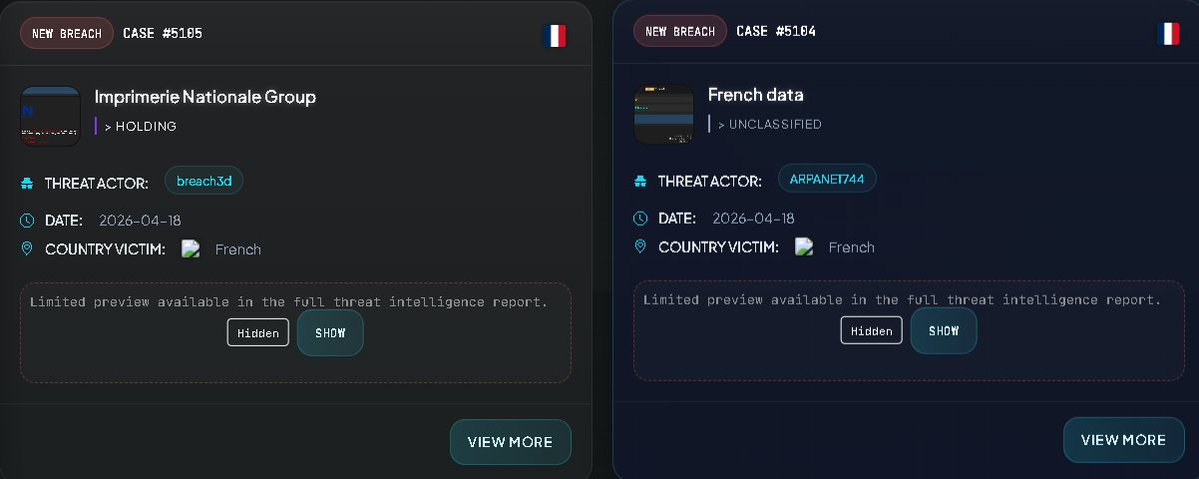
🚨 NATIONAL SECURITY ALERT: MULTIPLE DATA LEAKS (FRANCE) 🇫🇷
A coordinated cybersecurity attack against strategic infrastructure in France has been detected. Two major incidents have been reported simultaneously on threat intelligence forums, affecting both the public sector and the high-security printing industry.
CASE #5105: COMPROMISE OF IMPRIMERIE NATIONALE GROUP
🏢 Affected Entity: Groupe Imprimerie Nationale (IN Group)
👤 Threat Actor: breach3d
📂 Sector: Holding / Security Printing (Passports, ID Cards, Diplomas)
📅 Date: April 18, 2026
🔍 Significance: This entity is the official printer of identity and security documents for the French State. A breach in this organization represents a critical risk of identity fraud and espionage.
🏢 Affected Entity: Unknown (Generally labeled as "French Data").
A threat intelligence posting has been detected concerning a database named "French Data." It is imperative to note that, at this time, the incident remains unverified, as no technical samples have been presented to confirm the authenticity of the information, nor has a specific victim entity been identified.
👤 Threat Actor: ARPANET744.
📂 Alleged Volume: 300 million lines of data.
📅 Report Date: April 18, 2026.
🔍 Status: No confirmed evidence. The origin has not been determined to be governmental or corporate.
🛡️ Monitor: https://t.co/wk9bZJ2Nli
#CyberSecurity #France #DataBreach #ARPANET744 #Hacking #InfoSec #VECERT #Cybersecurity #Privacy #UnConfirmed #FrenchData 🇫🇷🛡️❓
🔴 Alerte info.
Un cheminot à détourné du 25000 volt de la caténaire pour miner du Bitcoin illégalement.
Avec 2000 ampères dans les CPU, l'agent indelicat a pu miner 350 BTC en 3 jours.
🚨🇫🇷 ALERTE INFO | L’ex-PDG de Lafarge condamné à 6 ans de prison avec incarcération immédiate, reconnu coupable de financement du terrorisme pour des versements à l’État islamique.
‼️🇫🇷 France's National ID Agency ANTS Allegedly Breached, 18 Million Citizen Records With Government-Verified Identities Listed for Sale
https://t.co/SVR6R15TSV
🇫🇷 «Dès qu'on a posé la question au gouvernement, on a obtenu un grand silence, du déni et des refus de réponse. On a saisi la CADA et elle nous a répondu que le ministère ne savait pas le faire, ne voulait PAS le faire, que c'était beaucoup trop cher en temps... » -@decoder_l
Des ultrasons contre l’endométriose
Des ultrasons pour vaincre le cauchemar de nombre de femmes ? C’est ce que la recherche française permet désormais de proposer aux victimes de l’endométriose. Cette pathologie touche une femme sur dix et reste, pour beaucoup, une source de douleurs intenses et de souffrances quotidiennes. Dans cette maladie, du tissu semblable à celui qui tapisse l’intérieur de l’utérus se développe en dehors de celui-ci. À chaque cycle menstruel, ce tissu s’enflamme et provoque des douleurs très fortes, pouvant même condamner la possibilité d’enfanter.
Longtemps cantonnée à des traitements hormonaux ou à des chirurgies lourdes et complexes, cette maladie invalidante voit enfin poindre une solution thérapeutique, née à Lyon. Aux Hospices civils de Lyon (hôpital de la Croix-Rousse), le professeur Gil Dubernard et son équipe ont détourné une technologie déjà éprouvée dans le traitement du cancer de la prostate : les ultrasons focalisés de haute intensité. Grâce à un dispositif robotisé, développé en collaboration avec l’INSERM et la société EDAP TMS, les médecins appliquent ces ondes de manière précise et non invasive, par voie endorectale, sans incision ni cicatrice.
En quelques minutes seulement, les ultrasons génèrent une ablation thermique qui détruit les lésions endométriosiques, notamment dans les formes les plus sévères. La procédure, réalisée en ambulatoire ou avec une hospitalisation très courte, permet aux patientes de rentrer chez elles le jour même ou le lendemain, avec une réduction souvent rapide des douleurs pelviennes, digestives et urinaires, tout en préservant leur fertilité. Aujourd’hui, les Hospices civils de Lyon sont devenus le premier centre au monde à l’offrir en routine, en alternative à la chirurgie traditionnelle. Une capacité initiale d’une centaine de patientes est prévue pour la première année, et l’intervention est désormais remboursée par l’Assurance maladie.
Cette avancée porte un immense espoir pour toutes les femmes confrontées à l’endométriose sévère. Elle promet de soulager des souffrances chroniques sans les contraintes mutilantes des opérations classiques, tout en ouvrant la voie à une prise en charge plus douce, plus rapide et plus respectueuse de la qualité de vie. Si elle ne guérit pas toutes les formes de la maladie, elle représente un progrès majeur qui change déjà concrètement le quotidien de nombreuses patientes.