Springsteen. The gift that keeps giving!
Thanks for this, let's share for and wide, and remember: it's about protecting people's rights and lives, rather than just protesting.
BREAKING: Music legend Bruce Springsteen just released this incredible song that will be sure to piss Trump off beyond belief.
“Streets of Minneapolis”.
He wrote this song about Alex Pretti and Renée Good Saturday and recorded it yesterday.
Share it far and wide and play it as loud as you can
Please, please, always keep your dog on a lead when walking in the countryside at this time of year. The fields and moors are full of babies and vulnerable nests. 🪺
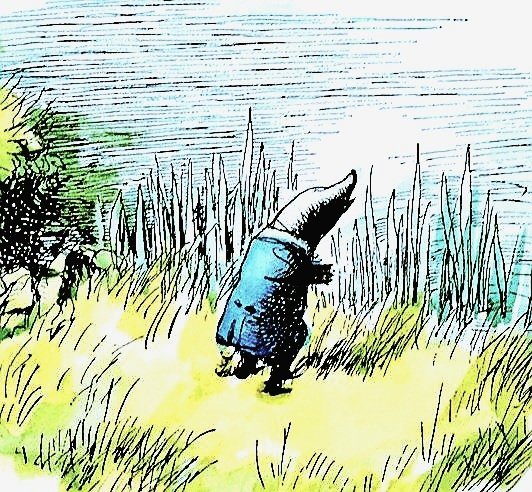
"He thought his happiness was complete when, as he meandered aimlessly along, suddenly he stood by the edge of a full-fed river. Never in his life had he seen a river before—this sleek, sinuous, full-bodied animal, chasing and chuckling, gripping things with a gurgle and leaving them with a laugh, to fling itself on fresh playmates that shook themselves free, and were caught and held again. All was a-shake and a-shiver—glints and gleams and sparkles, rustle and swirl, chatter and bubble. The Mole was bewitched, entranced, fascinated. By the side of the river he trotted as one trots, when very small, by the side of a man who holds one spellbound by exciting stories; and when tired at last, he sat on the bank, while the river still chattered on to him, a babbling procession of the best stories in the world, sent from the heart of the earth to be told at last to the insatiable sea."
~ Kenneth Grahame,
'The Wind in the Willows'
🔹️Illustration by E.H. Shepard 🔹️
'The LA verdict came a day after a jury in New Mexico found Meta liable for the way in which its platforms endangered children and exposed them to sexually explicit material and contact with sexual predators.'
https://t.co/XY10XvC6qr
'In March, juries found Meta and Google liable for intentionally building addictive platforms that cause mental health harms. The product liability framing now has peer-reviewed quantitative backing.'
The evidence is in. Social media is harming kids' mental health.
JAMA just completed the largest longitudinal meta-analysis ever assembled. 363,000 kids across 153 studies. Up to 22 years of follow-up.
The finding? Social media is bad for kids' mental health. Video gaming is not.
Samantha Teague's team at James Cook University screened nearly 19,000 papers to get to the 153 that met the bar for longitudinal evidence. They tracked 26 developmental outcomes across ages 2 to 19.
Video gaming was associated with higher aggression but better attention and executive function. Social media was associated with behavioral problems, self-injury, lower self-perception, lower academic achievement, and higher substance use. Across every domain measured.
The strongest relationship in the meta-analysis: social media use predicted media addiction later. Bigger than the link to depression. Bigger than every other outcome they tracked. The platform's primary product is the addiction. Everything else cascades from there.
Pediatricians like Jason Nagata at UCSF now see the same diagnostic profile used to identify substance use disorder showing up in young adolescents. Cravings. Withdrawal.
Look at the temporal cut. Effects got more intense in studies conducted after 2012, when smartphones became ubiquitous and platforms shifted to algorithmic feeds and infinite scroll. Same kids. Same screens. The product mechanic changed and the damage scaled.
Per-study effect sizes are small. Kate Blocker at Children and Screens does the population math: shifting the mental health score of 50 million teens by 3% means hundreds of thousands of additional kids crossing the threshold into clinical depression or anxiety.
In March, juries found Meta and Google liable for intentionally building addictive platforms that cause mental health harms. The product liability framing now has peer-reviewed quantitative backing.
Video games end. Feeds don't.
I’ve been reading up on the environmental impacts of LLMs and it’s not looking good. Roughly, data centres use as much drinking water as Denmark and as much energy as Japan, and all this impact is disproportionately borne by already marginalised people
A single 400-year-old ancient oak produces 234,000 litres of oxygen a year while soaking up carbon dioxide, and can support more than 2,000 species of bird, insect, fungus, and lichen.
📍my favourite oak #lakedistrict
@Meningioma_host Thanks so much! I was worried that the cold spring we have had here in Southern Ontario would mean the magnolia wouldn't bloom properly this year. So glad I was wrong!
Nvidia just admitted that "AI efficiency" is a LIE.
Every major tech company is doing the same thing right now:
Firing humans and replacing them with AI to "cut costs." 92,000 tech workers laid off in 2026 so far.
Every single earnings call sounds the same: "AI is driving efficiency."
But the VP of Applied Deep Learning at Nvidia, the company that literally SELLS the AI infrastructure, just told Axios:
"For my team, the cost of compute is far beyond the costs of the employees."
The man whose entire job is making AI work admitted that AI costs his company MORE than the humans it's supposed to replace. And he doesn't work at some struggling startup. We're talking about the most valuable company on Earth.
An MIT study backs this up too:
Researchers analyzed whether AI could actually replace human workers at a competitive cost and found that AI automation only makes financial sense in 23% of jobs. In the other 77%, humans are still cheaper.
So companies are firing cheap labor and replacing it with expensive labor, then telling shareholders it's "innovation."
But it gets even WORSE...
Uber just revealed that they burned through their ENTIRE 2026 AI budget in 4 months.
Their CTO said: "I'm back to the drawing board because the budget I thought I would need is blown away already."
What happened is that Uber gave their engineers access to AI coding tools and encouraged them to use them as much as possible. They even built internal leaderboards ranking engineers by how many AI tokens they consumed, basically gamifying their own budget crisis without realizing it.
By March, 95% of Uber's engineers were using AI tools monthly. 70% of all committed code was coming from AI. Monthly API costs per engineer hit $500 to $2,000.
One software engineer in Stockholm told the New York Times: "I probably spend more than my salary on Claude."
A human being now costs LESS than the AI tool they use to do their job.
And Uber isn't some edge case. Big Tech has announced $740 billion in AI capital expenditures this year alone, up 69% from 2025, according to Morgan Stanley.
Meanwhile the Yale Budget Lab says there is NO widespread data showing AI is actually displacing jobs or improving productivity at scale.
So follow the money:
Companies fire humans
↓
Stock goes up because "AI efficiency"
↓
Those same companies spend MORE on AI than they saved on salaries
↓
That money flows to Nvidia, Anthropic, OpenAI, and Microsoft
↓
Those companies use the revenue to justify their own insane valuations
↓
Everyone books growth
↓
But nobody's actually saving money
McKinsey projects total AI spending will hit $5.2 TRILLION by 2030.
The biggest wealth transfer in modern history is happening right now, and it's not from workers to companies. It's from companies to AI infrastructure providers.
Every dollar "saved" on layoffs is being spent twice over on compute, tokens, and data centers.
Nvidia posted $31.9 billion in profit last quarter. And somebody is paying that bill - the same companies telling their employees that AI made them "redundant."
The entire narrative is a shell game:
CEOs get to announce layoffs, Wall Street rewards them with a stock bump, and then the real cost shows up three months later when the AI budget explodes and nobody connects the two events.
What's your take on this?
You open ChatGPT. You type the question. A clean, structured answer comes back in three seconds. You read it, it makes sense, you move on. You feel like you learned something.
Forty-five days later, a professor walks in and hands you a test you weren't expecting. You don't remember most of it.
André Barcaui at the Federal University of Rio de Janeiro ran the experiment to find out if the feeling was accurate. 120 undergraduate business students, ages 18 to 24. All told to spend two weeks researching AI concepts, ethics, societal impacts, technical foundations, and prepare a 10-minute presentation.
Sixty used ChatGPT freely. Sixty used textbooks, library databases, articles, and standard web search. Then, 45 days later, with no warning, a retention test.
The ChatGPT group scored 57.5%. The traditional group scored 68.5%. Cohen's d was 0.68, a medium-to-large effect. In most grading systems, that's the difference between passing and failing.
This is called cognitive offloading. When your brain delegates thinking to an external tool, it reduces the mental effort required during encoding. Effort is what makes memories durable. Struggling to find, synthesize, and connect information is not an inefficiency in the learning process. It is the learning process. ChatGPT removes the struggle and takes the encoding with it.
Barcaui calls what the AI group experienced "borrowed competence." The answer was structured, the vocabulary was right, the reasoning felt sound. It just wasn't theirs. And 45 days later, it was gone.
The AI group's forgetting curve was steeper and didn't stabilize the way the traditional group's did. The memories weren't just smaller. They were more fragile from the start.
You didn't learn it. You borrowed it.
This MRI study on young kids just exposed something terrifying:
They scanned the brains of 60 children aged 3–5 — including 5-year-old Rose — and found interactive screen time is causing measurable loss of white matter in their developing brains. Even just 2 hours a day is linked to impaired neural connectivity, language, and literacy development.
Professor Mike Nagel (neuroscientist and father) said his first reaction was simply: “Wow… I was not anticipating seeing anything like that.”
We’re physically changing children’s brains before they even start school — and the damage is visible on scans.
This one actually unsettled me. I’ve always suspected too much screen time was bad, but seeing real white matter loss in toddlers hits different.
Parents of little ones — has this kind of research changed how much screen time you allow?
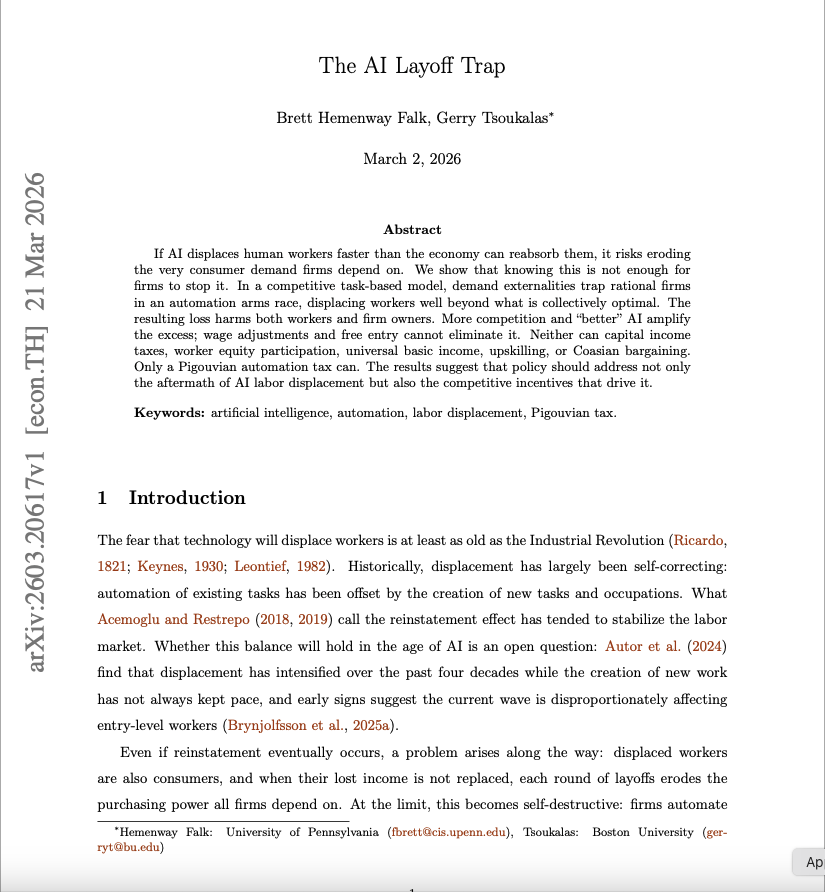
Two economists just published a mathematical proof that AI will destroy the economy.
Not might. Not could. Will — if nothing changes.
The paper is called "The AI Layoff Trap." Published March 2, 2026. Wharton School, University of Pennsylvania. Boston University. Peer reviewed. Mathematically modeled.
The conclusion is one sentence.
"At the limit, firms automate their way to boundless productivity and zero demand."
An economy that produces everything. And sells it to nobody.
Here is how you get there.
A company fires 500 workers and replaces them with AI. A competitor fires 700 to keep up. Another fires 1,000. Every company is behaving rationally. Every company is following the incentives correctly. And every company is building a trap for itself.
Because the workers who were fired were also customers.
When they lose their jobs faster than the economy can absorb them, they stop spending. Consumer demand falls. Companies respond by cutting costs — which means automating more workers — which means less spending — which means more falling demand — which means more automation.
The loop has no natural exit.
The researchers tested every proposed solution. Universal basic income. Capital income taxes. Worker equity participation. Upskilling programs. Corporate coordination agreements.
Every single one failed in the model.
The only intervention that worked: a Pigouvian automation tax — a per-task levy charged every time a company replaces a human with AI, forcing them to price in the demand they are destroying before they pull the trigger.
No government has implemented this. No major economy is seriously discussing it.
Meanwhile the numbers are already tracking the curve. 100,000 tech workers laid off in 2025. 92,000 more in the first months of 2026. Jack Dorsey fired half of Block's workforce and said publicly: "Within the next year, the majority of companies will reach the same conclusion."
Nobody is doing anything wrong. Companies are following their incentives perfectly. That is exactly the problem.
Rational behavior. At scale. Simultaneously. With no mechanism to stop it.
Two economists built the math. The math leads to one place.
Source: Falk & Tsoukalas · Wharton School + Boston University ·
https://t.co/4m8E9jQNYm
One of the more sinister trends of the past 40 years has been a cultural taboo against having any kind of intellectual life. We’re bombarded with relentless propaganda about how knowing things makes you a nerd and loser. Curiosity is empowering, & they don’t want you empowered.
Shifting Baseline Syndrom. Eins der großen Probleme in der Wahrnehmung des Artensterbens. Kurz gesagt: Das was wir als Heranwachsender kennen, wird als der Normalzustand empfunden. Damit verschiebt sich aber die Baseline von Generation zu Generation, und viel Information geht verloren… der tatsächliche Verlust an Vielfalt ist viel dramatischer als wir ihn wahrnehmen.
Imagine a 19-year-old scrolling TikTok. She watches a creator list five "signs you have undiagnosed anxiety." She recognizes three in herself. By the end of the week, she's describing herself as anxious to her friends. A month later, she's avoiding situations she used to handle fine.
What went wrong?
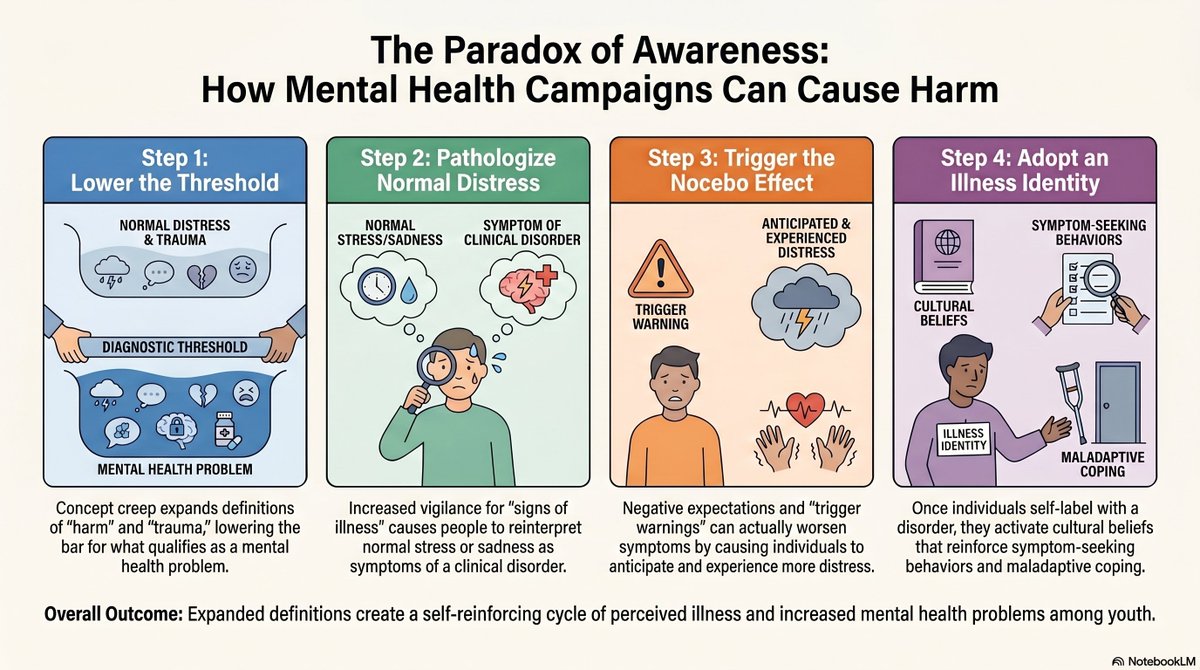
In a new paper by my PhD student Dasha Sandra, titled "Why mental health awareness can harm: Converging explanations for a societal problem", we argue that well-meaning mental health awareness can backfire, and we identify how. Four separate literatures (concept creep, nocebo effects, prevalence inflation, and illness self-labeling) have been circling the same problem from different angles. We show they converge on three mechanisms:
1.Awareness lowers the threshold for what counts as a disorder.
2. It trains people to scan their inner lives for symptoms and reinterpret normal distress as pathology.
3. Once someone adopts an illness identity, they behave in ways that confirm and deepen it.
The evidence is wide. Learning that loneliness is harmful makes solitude feel worse. Learning that stress is harmful worsens well-being and performance. Awareness videos about fake conditions like "wind turbine syndrome" produce real headaches. Trigger warnings raise anticipatory anxiety without reducing distress.
This does not mean awareness should stop. It means awareness can have unintended consequences, including manufacturing the suffering it tries to prevent. Inoculating people against these mechanisms works, and we already have evidence it does.
Link to paper: https://t.co/ucoGyhEuAj