Most people are surprised how much microplastic comes from everyday items like water bottles, food containers, and clothing.
Highest-impact swaps we cover: https://t.co/ofZXY3PK21
What's one product you've already switched away from plastic?
On the black nylon utensils: Germany's BfR found 10 of 33 polyamide kitchen utensils exceeded its guidance value for oligomer migration, and advises keeping contact with food above 70°C brief. Wood or stainless for anything that sits in a hot pan. We compared options here: https://t.co/DgGyvEnsNr
@UpriseRI 110 contaminated wells out of 198 tested is a rough ratio. The cost numbers in the recap explain the push: about $18K for a home filtration system vs roughly $8-9K to connect to the line. The up-to-$200 well-test reimbursement for people just outside the zone is a smart move.
@upnorthlive Before the bottled water stops, worth knowing: if a home isn't connected yet, EPA says to look for a filter certified to NSF/ANSI 53 or 58 for PFAS reduction, and to keep up with cartridge changes. Certification is what tells you it was actually tested for PFOA/PFOS.
@starsandstripes@sethrobson1@HanaKusumoto Key nuance in the piece: the foam they switched to in 2024 is still fluorinated. Per ITRC it doesn't contain or break down into PFOS/PFOA, but the end point is fluorine-free foam or water-based systems, with the last three fluorinated systems due out by Oct. 1.
For families on Cape Fear water while this plays out, a home filter is the part you control. EPA's advice: look for certification to NSF/ANSI 53 or NSF/ANSI 58 (reverse osmosis) for PFAS reduction, then actually change the cartridge on schedule. "Carbon filter" on the box alone doesn't tell you that.
@wbalradio All 15 sites is the number that sticks with me. Fragments showing up in about 93% of them points to bigger plastic breaking apart over time (bottles, bags, packaging), which is why keeping litter out of storm drains matters as much as any microbead ban.
@newscientist The detail buried in this one: the plant-based coating has lower heat tolerance than PTFE, so bakeware is off the table for now. First uses are things like waterproof textiles and maybe drink-can linings. For pans, plain stainless and cast iron already skip the coating question.
Wet wipes are one of the sneakiest plastic products in the house. Wales bans selling wipes that contain plastic on Dec 18, 2026; England follows May 19, 2027. Baby wipes, makeup wipes, moist toilet wipes and cleaning wipes all count. If the pack doesn't say "plastic-free," check what it's made of.
@ur_engineering@UofRBME@UofR One real use for a home test: checking whether your filter is actually doing its job, testing before and after. Methods still vary a lot between labs though, so comparing numbers across companies gets tricky. Curious if he got into that.
@pasnoja Fair, nobody can fix all of it. If you pick one thing, retire the most chipped pan first. Chips and flaking are when a coating starts shedding, and one plain cast iron or stainless pan lasts for years.
@AlyPackaging Window-free for me. That clear film goes straight in the trash the minute the box opens. A die-cut paper frame or a good photo on the box shows the doll fine, and a molded paper insert can keep the shoes in place.
@EcoAngels Steel is the easy part. The lid is where plastic usually sneaks back in, so check whether it's steel or silicone, and keep hot leftovers out of plastic tubs since heat speeds up shedding. We compared kids' options here: https://t.co/wenzGZBg1i
@lukecadell One label tip: phthalates rarely show up by name. The FDA notes fragrance ingredients don't have to be listed individually, so DEP can sit under "fragrance." If you'd rather skip it, fragrance-free is the simplest filter.
@pbrown4348 And that's on top of the particles. McGill researchers (2019) measured about 11.6 billion microplastics from a single plastic tea bag steeped at 95°C. Loose leaf in a steel infuser skips the bag entirely.
@lsthart Microfiber sheets are polyester, and they get washed constantly. IUCN's 2017 estimate (Boucher & Friot) put synthetic textile washing at about 35% of primary microplastics reaching the ocean. Cotton sheets are one of the easiest swaps on that list.
@BaltimoreBanner The hopeful part of this report: no plastic-bag film turned up in any Patapsco River sample, which advocates read as a possible sign the Baltimore city and county bag bans are working. Microbeads, banned in Maryland cosmetics since 2015, showed up at just one Maryland site.
@WNEP The detail that stood out in the PennEnvironment results: synthetic clothing fibers showed up at every site tested, ahead of fragments (93%) and film (47%). Laundry is one source people can actually cut at home: full loads, cold water, shorter cycles.
@YVWD Thanks for the straight answer. Turbidity tracking makes sense, and standard methods for counting microplastics in drinking water are still pretty new, so following the science is the honest answer for now. Appreciate you sharing it.
Hot take: the cheapest microplastic upgrade in most homes isn't a gadget. It's the vacuum you already own.
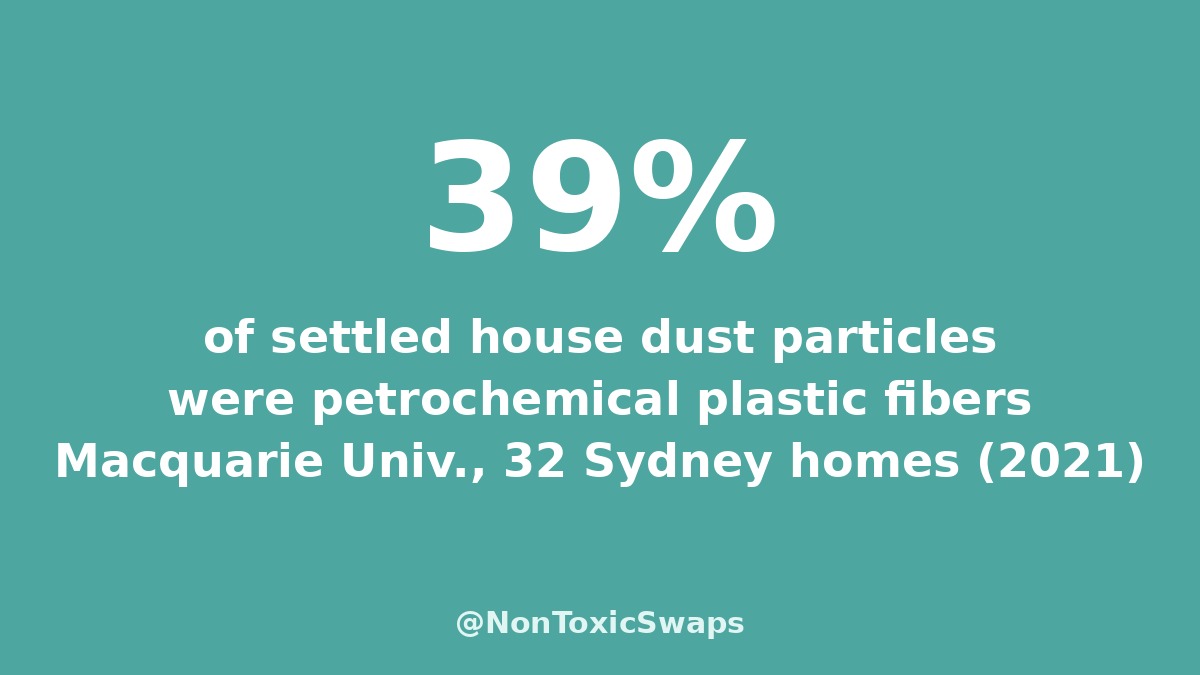
Macquarie University researchers collected settled dust in 32 Sydney homes for a month: 39% of the particles were petrochemical-based fibers. Carpeted homes had nearly double the plastic fibers, and homes vacuumed at least weekly had less.
You can't do everything. Vacuum weekly and start there.
@thedailymeal Enameled cast iron is a solid move for anyone getting off nonstick: no coating to scratch off, and the enamel handles tomato sauce and wine that strip seasoning on bare cast iron. Just retire it if the enamel chips on the cooking surface.