In 1964, a math professor went on live TV to prove he could beat every casino in Las Vegas. The casinos were already trying to ban him.
The show was called To Tell the Truth. Three men walked out, and all three claimed to be the author of the most-read book in Las Vegas libraries.
Only one was real.
His name was Ed Thorp. A few years earlier, he'd run blackjack through an IBM computer and found something the casinos had missed: the game isn't random. When the deck is rich in 10s and aces, the odds flip to the player.
So he did what no one does with a math paper. He took it to Vegas and tested it with real money.
He won. Then he published the method in a book, Beat the Dealer, and handed it to anyone who wanted it.
Casinos panicked. They added decks, shuffled earlier and threw out anyone who looked like they were counting.
On the show, a panelist asks if casinos can legally keep him out. His answer: they're private clubs, they can deal to whoever they want.
The celebrities were guessing who the real Dr. Thorp was. The casinos already knew his face.
And that wasn't even the best part. He took the same math to Wall Street and ran one of the first quant hedge funds. In 230 months, it had 3 losing months, none worse than 1%. Over the same stretch, the index had 96.
So was Thorp cheating the casino, or was the casino just betting nobody would ever do the math?
In 1964, a math professor went on live TV to prove he could beat every casino in Las Vegas. The casinos were already trying to ban him.
The show was called To Tell the Truth. Three men walked out, and all three claimed to be the author of the most-read book in Las Vegas libraries.
Only one was real.
His name was Ed Thorp. A few years earlier, he'd run blackjack through an IBM computer and found something the casinos had missed: the game isn't random. When the deck is rich in 10s and aces, the odds flip to the player.
So he did what no one does with a math paper. He took it to Vegas and tested it with real money.
He won. Then he published the method in a book, Beat the Dealer, and handed it to anyone who wanted it.
Casinos panicked. They added decks, shuffled earlier and threw out anyone who looked like they were counting.
On the show, a panelist asks if casinos can legally keep him out. His answer: they're private clubs, they can deal to whoever they want.
The celebrities were guessing who the real Dr. Thorp was. The casinos already knew his face.
And that wasn't even the best part. He took the same math to Wall Street and ran one of the first quant hedge funds. In 230 months, it had 3 losing months, none worse than 1%. Over the same stretch, the index had 96.
So was Thorp cheating the casino, or was the casino just betting nobody would ever do the math?
i'm f**king done with one AI doing all the bookkeeping alone...
it reads, writes, checks and approves its own work. and books a $75 duplicate like nothing happened.
so i'd split it into 6 @Grok Bots, one job each:
1. INBOX receives files
2. ROUTER assigns tasks
3. BOOKS writes entries
4. TRACE links every entry to its receipt
5. CHECK returns PASS / FAIL / PARK
6. REPORT builds the summary
→ $75 copy of the same receipt → excluded
→ $120 with no purpose → parked, ask owner
draft said $920. verified: $845.
6 documents. 37 actions. 30 seconds.
the bot that writes the entry should never approve it.
full breakdown below ↓
i built QUANTUM VANITY
a free tool that makes your Solana wallet start with any word you want
i tested it on my name:
ZYNexSFaVhb3az3pW9FxL8TCfjsohXwDbkyRd6rW4sJ
odds: 1 in 348,667,769
a normal PC finds it in ~30 min
how it works:
→ type a word, your name, ticker, anything
→ your PC generates millions of real wallets
→ keeps the one that starts with your word
→ import it into Phantom
→ runs 100% on your computer, keys never leave it
→ search several words at once
→ also catches pretty wallets: 77777, 12345, …8888
→ shows real odds + wait time before you start
why "quantum": it also simulates how a quantum computer would find the same wallet with Grover's algorithm, in ~23,000x fewer tries
fun fact: a wallet starting with "p" is 58x rarer than one with "B"
quote this with the name you want on your wallet
i'll tell you if it takes 1 minute or 1 million years 👇
https://t.co/PkHEZp1aJp
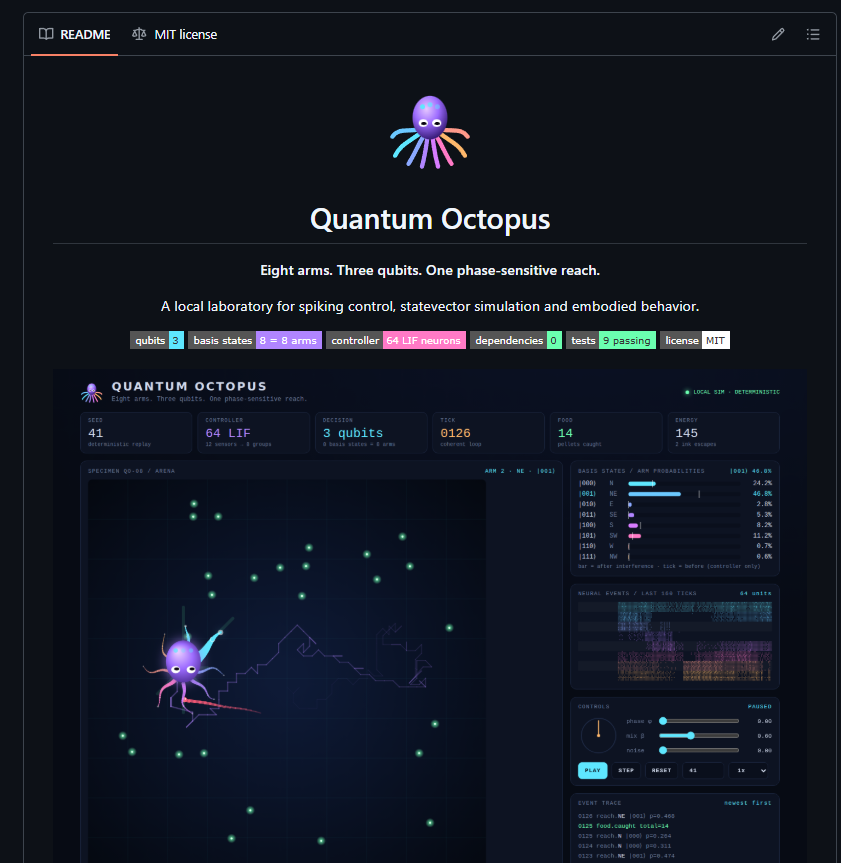
I built Quantum Octopus.
A octopus with a spiking brain and a 3-qubit decision loop.
3 qubits = 8 basis states = 8 arms. Every measurement is one arm reaching.
Change one phase. Same octopus, same world, same random numbers, different path.
Every spike, amplitude, gate and reach is visible.
Code + experiments:
https://t.co/ek5Y6O1E2y
made a multiplayer minecraft speedrun that runs in your browser. built it in one evening with @Grok
it's called sky shards
everyone races the same floating islands. new world every day
bridges are made of clouds and they melt in 20 seconds
@elonmusk today's record is 4m. think you can beat it?
https://t.co/ZRmID87vmZ
Two horses. One has a 20% chance of winning, the other 80%. A bookie knows the real odds. The crowd doesn't. $10,000 lands on one horse, $50,000 on the other.
Inside an MIT classroom, a professor asks one question: how does the bookie guarantee he never loses?
He ignores what he knows. Sets the odds not by probability but by how the money fell. Five to one, matching the market.
First horse wins, he pays $60,000 and collected $60,000. Second horse wins, same thing. Zero exposure. Fee on top. Riskless profit.
That's not gambling. That's pricing.
The same math prices every option contract on Wall Street. Black-Scholes, replicating portfolios, hedging. It starts with one insight: you don't need to predict the future. You structure the trade so the future doesn't matter.
The professor builds it step by step. Take any derivative. Find a combination of stock and cash that replicates the pay-off exactly. Hold both sides. Risk cancels. You keep the spread.
He pulls up Bloomberg with IBM call options and shows it in real numbers. Prices a digital option using nothing but two calls at different strikes. No model needed. Just replication.
Traders do this thousands of times a day. Enter a contract, hedge it on the exchange, walk away with a fee. No opinion on direction. Just structure.
The entire derivatives market works this way. Not prediction. Replication.
The people who understood that distinction first built the biggest fortunes in finance.