Your timeline shows you what’s trending.
We’re here for what it missed.
Overlooked stories. Strange events. Underreported signals—found beyond the feed, checked against credible sources, and put in context.
Welcome to Not In Your Feed.
Look beyond the algorithm.
This is what Earth’s rotation looks like when the sky gets dark enough.
This time-lapse was filmed at the Assy-Turgen Observatory in Kazakhstan, about 2,750 meters above sea level.
Across the sky, the Milky Way seems to slowly sweep past the observatory.
But the strange part is that the Milky Way is not really “moving across us” like this.
We are the ones moving.
Earth is rotating beneath the stars, turning a motion too slow for our eyes into something obvious once hours of night are compressed into seconds.
And at this altitude, far from most city light, the sky reveals just how much we normally don’t see.
My favorite part is the contrast:
one of humanity’s most advanced tools for looking into space sitting completely still…
while the entire sky appears to move around it.
If you could watch one full night of the sky in time-lapse from anywhere on Earth, where would you choose?
Two US stocks are about to pay investors roughly 0.7% of their current share price in cash.
For investors outside America, however, the interesting question is not whether you can collect the next dividend.
It is what you are buying to get it.
FMAO and JOUT both go ex-dividend on October 9. At recent prices, 100 shares would cost roughly $3,560 for FMAO or $4,440 for JOUT and produce the next gross dividend of $25 or $33 respectively. Investors generally need to own the shares before the October 9 ex-dividend date to receive those payments.
But that is not free money. A stock can adjust lower when it goes ex-dividend, and foreign investors may also lose part of the payment to US withholding tax.
The more useful comparison is what supports the income afterward.
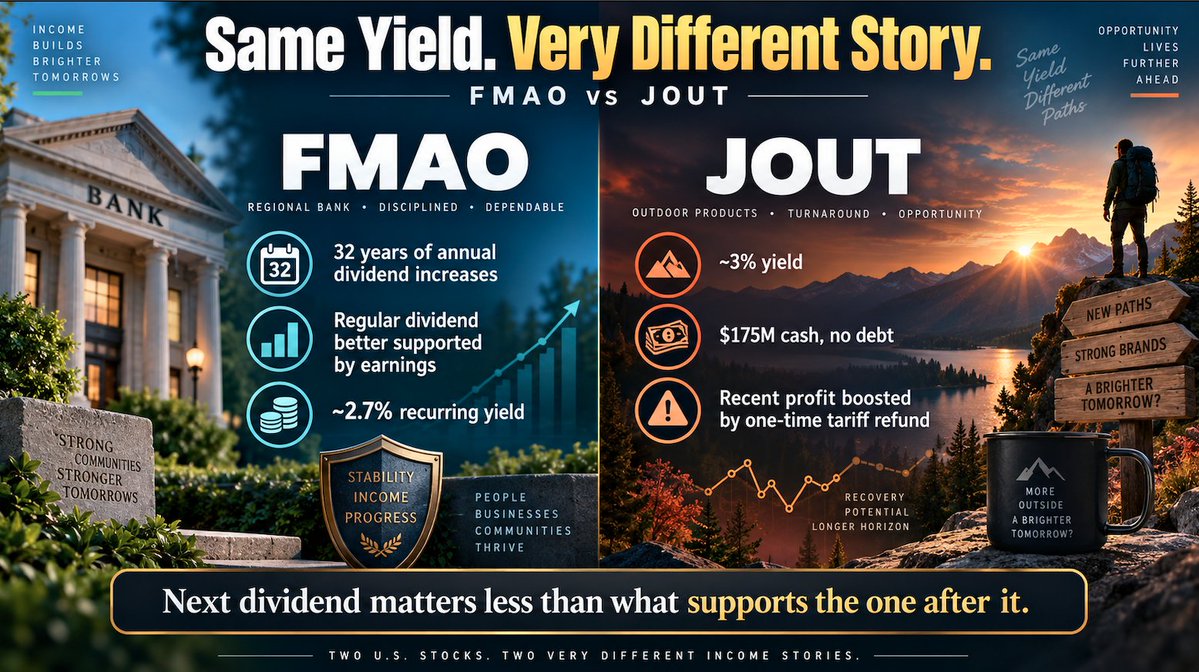
FMAO is the steadier case.
Its regular quarterly dividend actually rose from $0.23 to $0.24. The extra cent in this October's $0.25 payment is a one-time special dividend. More importantly, the bank says this is its 32nd consecutive year of increasing its annual dividend. It also reported a record $11.8 million second-quarter profit and its 93rd consecutive profitable quarter.
At around $35.6, the recurring $0.96 annual dividend works out to only about a 2.7% yield. So this is less a high-yield bet than a dividend-quality story.
JOUT is the more speculative one.
Its $1.32 annual dividend gives investors close to a 3% yield. The company also had about $175 million in cash and no debt at the end of its latest quarter, giving it a substantial cushion.
But its recent earnings recovery deserves skepticism.
JOUT earned $1.42 per share in its latest quarter, yet roughly $15 million of tariff refunds helped lift the result. That benefit is not something investors can simply assume will repeat.
So these are really two different bets.
FMAO asks: is a roughly 2.7% yield worth accepting for stronger evidence that the dividend can keep growing?
JOUT asks: is roughly 3% enough to pay you while you wait to see whether the business can recover without one-off help?
For an international investor, that is far more important than simply beating the October 8 cutoff.
Source: 3 High-Yield Dividends Paying Soon. But Your Deadline to Buy Is Days Away - AOL
https://t.co/XHlZgEhDof