Why speed matters
The one constant that I have observed in my professional life is that people underestimate the need to move fast.
Of course, doing good work takes time. I once spent six months writing a URL parser. But the fact that it took so long is not a feature, it is not a positive, it is a negative.
If everything is slow-moving around you, it is likely not going to be good. To fully make use of your brain, you need to move as close as possible to the speed of your thought.
If I give you two PhD students, one who completed their thesis in two years and one who took eight years… you can be almost certain that the two-year thesis will be much better.
Moving fast does not mean that you complete your projects quickly. Projects have many parts, and getting everything right may take a long time.
Nevertheless, you should move as fast as you can.
For multiple reasons:
1. A common mistake is to spend a lot of time—too much time—on a component of your project that does not matter. I once spent a lot of time building a podcast-like version of a course… only to find out later that students had no interest in the podcast format.
2. You learn by making mistakes. The faster you make mistakes, the faster you learn.
3. Your work degrades, becomes less relevant with time. And if you work slowly, you will be more likely to stick with your slightly obsolete work. You know that professor who spent seven years preparing lecture notes twenty years ago? He is not going to throw them away and start again, as that would be a new seven-year project. So he will keep teaching using aging lecture notes until he retires and someone finally updates the course.
What if you are doing open-heart surgery? Don’t you want someone who spends days preparing and who works slowly? No. You almost surely want the surgeon who does many, many open-heart surgeries. They are very likely to be the best one.
Now stop being so slow. Move!
@TXMCtrades I just read this and the first thing that comes to mind in “isn’t that the point”. Supply and demand set the value of all goods the maximum supply being known eliminates one of the variables making this a safer bet over a multi year timeframe than any other asset in history.
The Fed is Unable to Cause a Recession. Risk Assets are Yet to Realize This.
Guest report: written by @rpgoyal_
Markets are always pricing in a range of outcomes for the economy. That pricing bakes in the likely effects of monetary and fiscal policy. The post-Covid cycle in the US has been dominated by a large fiscal response to the pandemic, and more recently, a Fed reaction that has attempted to mitigate the inflationary effects of that fiscal response.
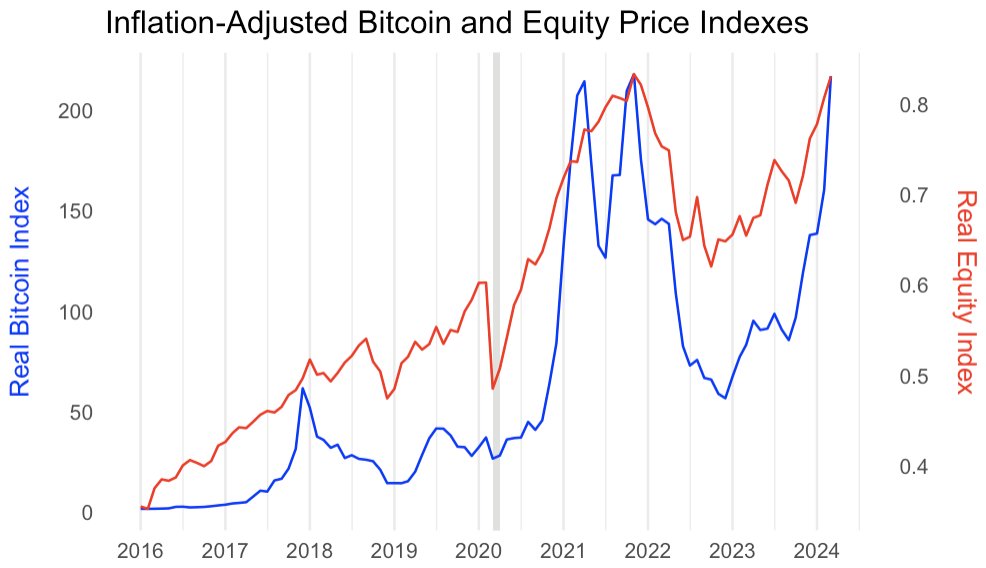
Both bond and risk markets have persistently given the Fed credit for its attempted tightening of conditions. Bond markets have consistently priced a return to lower interest rates, and stocks/Bitcoin have delivered a 0% real return over the last 2-3 years. This pricing is consistent with expectations that the Fed may cause a recession, and at the very least, that the Fed is capable of preventing inflation above its target of 2%.
In our view, the Fed is wholly unable to credibly produce such outcomes given current conditions. Risk assets are yet to fully acknowledge this.
Below are three of countless mechanisms through which the Fed’s interest rate hikes, in the current context, may be having an unintentionally stimulative effect on the economy, complicating its ability to combat inflation:
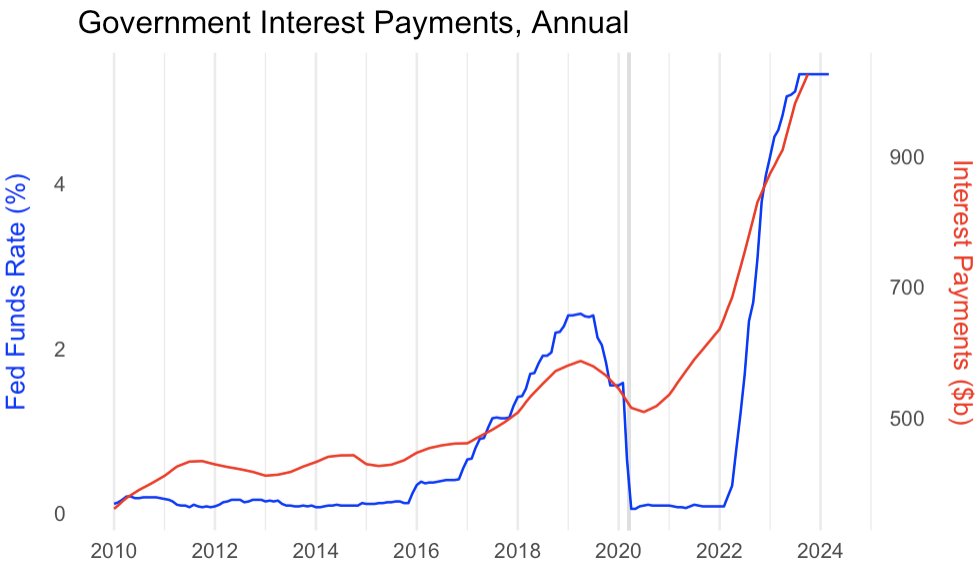
1) Rate hikes raised interest payments by the government to the private sector.
When the Fed raises rates, it rewards savers at the expense of borrowers. In a typical cycle, the private sector kicks off the recovery by increasing its borrowing. In the Covid cycle, the government did the borrowing, sending money to the private sector, making the private sector more of the saver.
With federal debt-to-GDP upwards of 120% post-Covid, the Fed’s rate hikes have doubled the government’s interest payments to the private sector, now annualizing at $1tn.
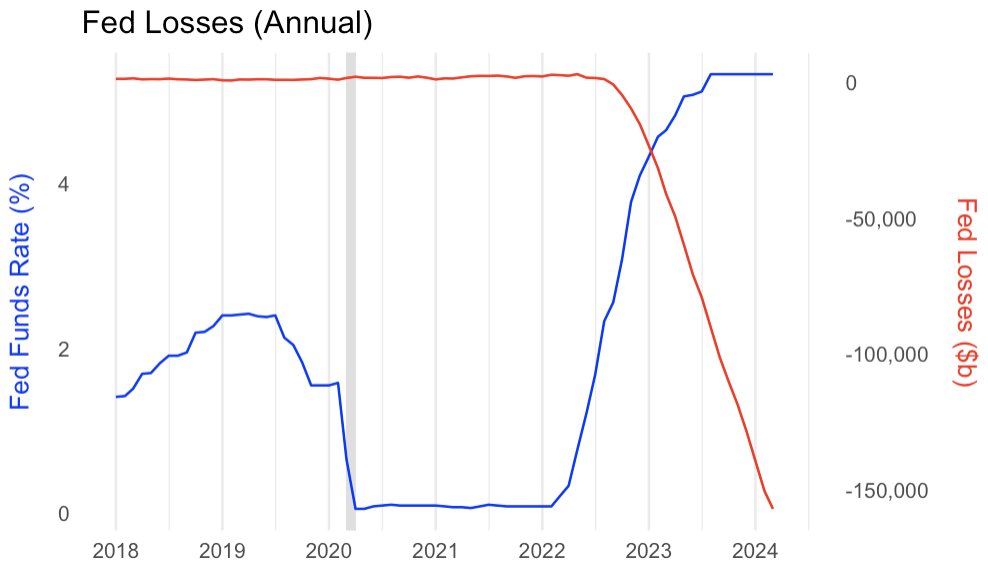
2) Rate hikes raised the Fed’s direct subsidy to the banking system.
The Fed owns long-term Treasury securities and owes short-term cash reserves to the banking sector. Typically, when the yield curve is positively sloped, this will produce a steady income stream for the Fed as the Fed’s holdings earn a spread over what the Fed pays on the reserves it owes.
Since 2022, the Fed’s rate hikes dramatically flattened and then inverted this yield curve: With reserves now yielding 5.5% and 10-year Treasury bonds yielding only 4.5%, the Fed is now “making a loss”. That loss is someone else’s gain; in this case, the banking sector which holds all of those reserves.
On an annual basis, the Fed’s balance sheet is producing a $150bn yearly loss, which is a direct stimulus check to the banks.
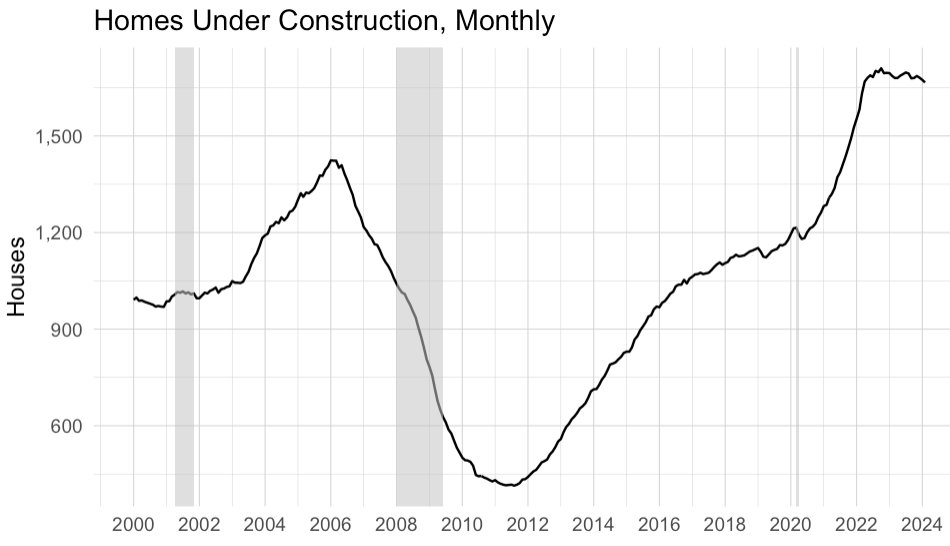
3) Rate hikes induced a housing construction boom.
The extraordinary fiscal support and Covid-specific dynamics produced a huge demand for residential property that was in the midst of clearing prior to the Fed’s rate hikes. As the Fed began raising rates, anyone with a preexisting mortgage became essentially shut out of the market, along with their home. The only way to satisfy the continued demand for homes was to build more, and this process has one of the highest GDP multipliers of any economic activity.
Homes under construction is still near all-time highs, and the slight decline in home sale prices is directly a result of housing shrinkflation; on a square footage basis, home prices are still at all-time highs.
The post-Covid era is one of fiscal dominance, starting with an extremely aggressive fiscal response to the pandemic. Fiscal dominance is not just a state of policy where the fiscal authority is shooting a bigger gun than the Fed; rather, it’s one where the choices of the fiscal authority necessarily unload the Fed’s gun, in which the way the Fed thinks about its policy starts to break down.
In such an environment, the only remaining option for the Fed is to be able to speak into existence its desired economic outcomes, using an elaborate apparatus of FOMC member speeches and financial media cooperation.
The Fed laid the groundwork for this model of policymaking in the early 2010s, when it became apparent that the Fed’s policy tools were ineffective in pulling the US economy out of the 2008 financial crisis.
Markets continue to give the Fed too much credibility that the Fed can achieve whatever economic outcome it desires. Today, that’s showing up as a 3-year period in which risk markets delivered a 0% real return, despite economic conditions having proven substantially more resilient than what was expected prior to the Fed’s rate hikes.
In our view, there is still a substantially upward adjustment that must take place for these markets to begin to reflect the reality of an incapacitated Fed that is unable to provide an antidote to the ongoing fiscal impulse.
Special thanks once again to @rpgoyal_ for guest-writing this report!