Florida elected a Republican governor who backed a U.S. Bitcoin reserve. Texas elected a Democratic senator who voted to create one for his state. The case for holding Bitcoin crosses party lines.
What do you think happens when you have the scarcest liquid asset the world has ever seen….
And an event happens that makes a portion of it less likely to hit the open market?
Same as it ever was.. buy the blood and in ten years laugh about it over beers with your boys.
Everyone worried about AI hacking crypto, but the internet and banking systems rely on weaker encryption.
That said, AI doesn’t need to break Bitcoin’s cryptography to cause damage, leaked data already enables more phishing, social engineering, etc,
Stay SAFU!
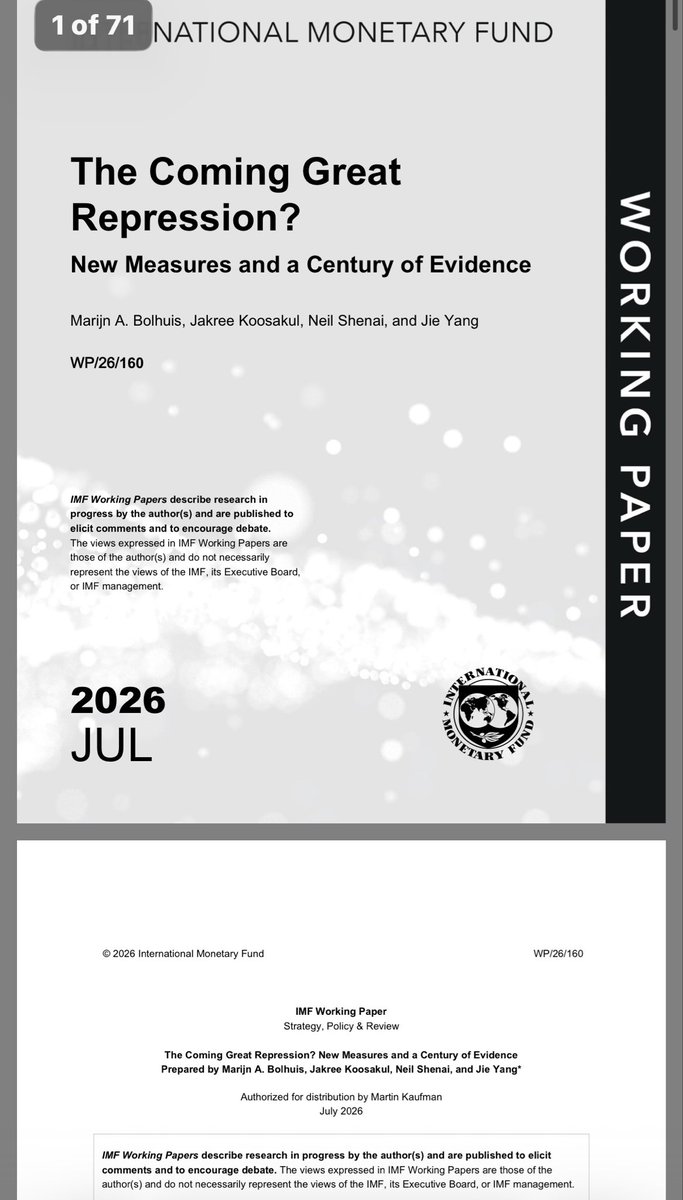
People - the debt will be inflated away but not all stores of wealth will be accessible to you. IMF paper documents the whole incoming regime of Financial Repression. You may see a balance in your brokerage or bank, but you will not be able to spend it.
Overview
The Western governments owe $100 trillions of dollars of debt. They can never pay this debt. They have no choice but to inflate it away as they did after the World Wars. This goes for all Western governments. First understand the basic mechanism of money supply expansion, QE.
Quantitive Easing or QE is a term used often but understood by very few.
It is simply the central bank (or Federal Reserve in the US) buying bad debt from other government debt holders. It can be called debt monetization and is mostly called “money printing”.
QE increases the size of the central bank (Feds) Balance Sheet.
But why does this cause inflation? Why do they call this inflating the debt away?
The answer is because prices go up because more money is bidding for the same goods and services so the price of these goods and services bids up.
The people pay for the debt with inflation and Financial Repression locks them from accessing the inflated assets.
The IMF just released their new paper “The Coming Great Repression”.
This is Financial Repression and its coming fast.
The governments will lock all exits from the fiat dollar/euro/yen systems then inflate the supplies to monetize the debt.
The early years before the events will be an attack on self sovereign assets and anything that shields wealth from government control.
The main stream media never even reported on this paper.
There will be an attack on Western citizen wealth.
Self Custody crypto and physical gold are the only lifeboats for wealth preservation under this incoming regime.
Look for more self custody FUD campaigns and more pressure to move to controlled custodial solutions behind “logins”.
There will be capital controls and guard rails around regulated custodial stores of value (banks, money markets, stocks and brokers) so you will not be able to withdraw or use your wealth even though you technically can see it.
This has begun in the UK and is rolling out towards 2030.
Remember just because you can see your bank balance does not mean you can spend it. That is Financial Repression an its a high probability outcome according to the IMF.
Hedge now into self custody L1 network stake and Bitcoin.
Not ETFs. Not treasury companies. Self custody.
Read it -> https://t.co/52DY1FZ6Bp
Every major zkVM (RISC Zero, SP1, etc.) still forces you to write code → compile to a VM → emulate that VM inside a circuit → then prove the circuit.
zkFOL deletes the middle steps.
It compiles first-order logic straight into polynomials. No bytecode. No virtual machine. No execution layer. The rule you write is the rule that gets proved.
Same machine.
Same fib(10,000) claim. Same algorithm:
zkFOL: 4.82 ms | 49.8 KB proof | <10 MB memory
RISC Zero: 3.69 s | 210 KB | 312 MB
SP1: up to 49 s | 1+ MB | up to 17 GB
That’s not incremental. That’s three orders of magnitude on hardware you already own with privacy as a free byproduct instead of an expensive extra layer.
Everyone else is still emulating a computer inside a proof system. zkFOL stopped.
@ModulusZK #zkFOL #ZK #ZeroKnowledge
Request for review: zkFOL, a direct arithmetisation of first-order logic, now public.
@ModulusZK compiles application rules written as first-order logic predicates straight to polynomial constraints. There is no bytecode and no zkVM. A state transition is accepted only with a proof that the predicate holds. The contract is the specification; a rule that cannot be proved does not execute.
The implementation is the construction in Murdoch J. Gabbay’s ePrint 2024/954, “Arithmetisation of computation via polynomial semantics for first-order logic”: truth maps to 0, conjunction and universal quantification to addition, disjunction and existential quantification to multiplication, with no encoding into an abstract machine.
Public material:
• Repo: https://t.co/VQWEq5XGFy
• Draft: https://t.co/nnEHwZ8wAp…
• Docs: https://t.co/agHVL1a1Nw
The published desktop-CPU comparison, fib(10,000) by fast doubling against RISC Zero 3.0.5 and SP1 6.3.1, is 4.82 ms and under 10 MB versus 3.69–49.24 s and 312 MB–17 GB. Those figures are ours. They have not been independently reproduced.
What we want is a technical review, not an endorsement. In particular: soundness of the shallow translation outside the finite models in the paper, the compiler from predicate to constraint system, the commitment scheme and any setup assumption, and a rerun of the fib benchmark.
If you review proof systems or polynomial commitments, a written objection is as useful as a confirmation. Repo, draft, and ePrint are linked above.
@0xJaehaerys@cryptodavidw@benediktbuenz@ronrothblum@pumatheuma@SuccinctLabs@BruestleJeremy@RiscZero@drakefjustin@0xAlbertG@ant_sabado@AnnaRRose@zeroknowledgefm@IOHK_Charles@VitalikButerin@EliBenSasson
I wasn’t going to comment since this is a really bad take IMO, but since it’s taken off I feel the need to. To my understanding, there is no evidence whatsoever pointing to a break of decades old hardness assumptions like elliptic curve cryptography. 1/n
One thing that took me years to learn, if your analysis is correct, you don’t have to nail the bottom, or sell the top.
On every trade you will leave value on the table. Let it go, be happy with what you managed to accomplish.
$CULT is $ETH on infinite leverage
#CultDAO's worst case scenario is going up as much as $ETH goes up (because of the big liquidity pool)
$CULT is built different.
thank you for you time.
Modulus is being rebuilt as an L1. Contracts are first-order logic predicates, enforced with ZK proofs. No bytecode & no VM. This can solve every smart contract level exploit in existence.
Currently updating website, docs & deciding what we want to make public on GitHub.
ZEC alone isn’t the full answer. Opt in privacy still leaves gaps against AI-scale tracking. Pair Zcash’s proven shielded pools with @ModulusZK FOL-powered ZK & you get something much stronger. Real privacy + practical scalability.
That combo will actually be a powerhouse.