One of the failures of the live action comicbook movies is making these overlord type villains into overly serious people. These motherfuckers are having fun.
The House just passed the KIDS Act, 267 to 117. To "protect kids," platforms would make everyone verify their age by handing over a government ID or getting their face scanned. It's in the Senate now.
We have a few tools to help people push back...
🚨 UPDATE on the freedom-killing KIDS Act. The bill has not yet shown up on the Senate legislation tracker, but we CANNOT RISK them rushing it through like they did in the House.
Call your Senators NOW and refer to it as H.R.7757, the KIDS Act.
🔗 Senator lookup tool + example message in replies!
No Doomposting
No Blackpilling
It’s time we start taking that Freedompill and defend our 1st Amendment! Left and Right unite as patriots to defend internet privacy and freedom of speech! UNITED WE STAND DIVIDED WE FALL!!! 🇺🇸
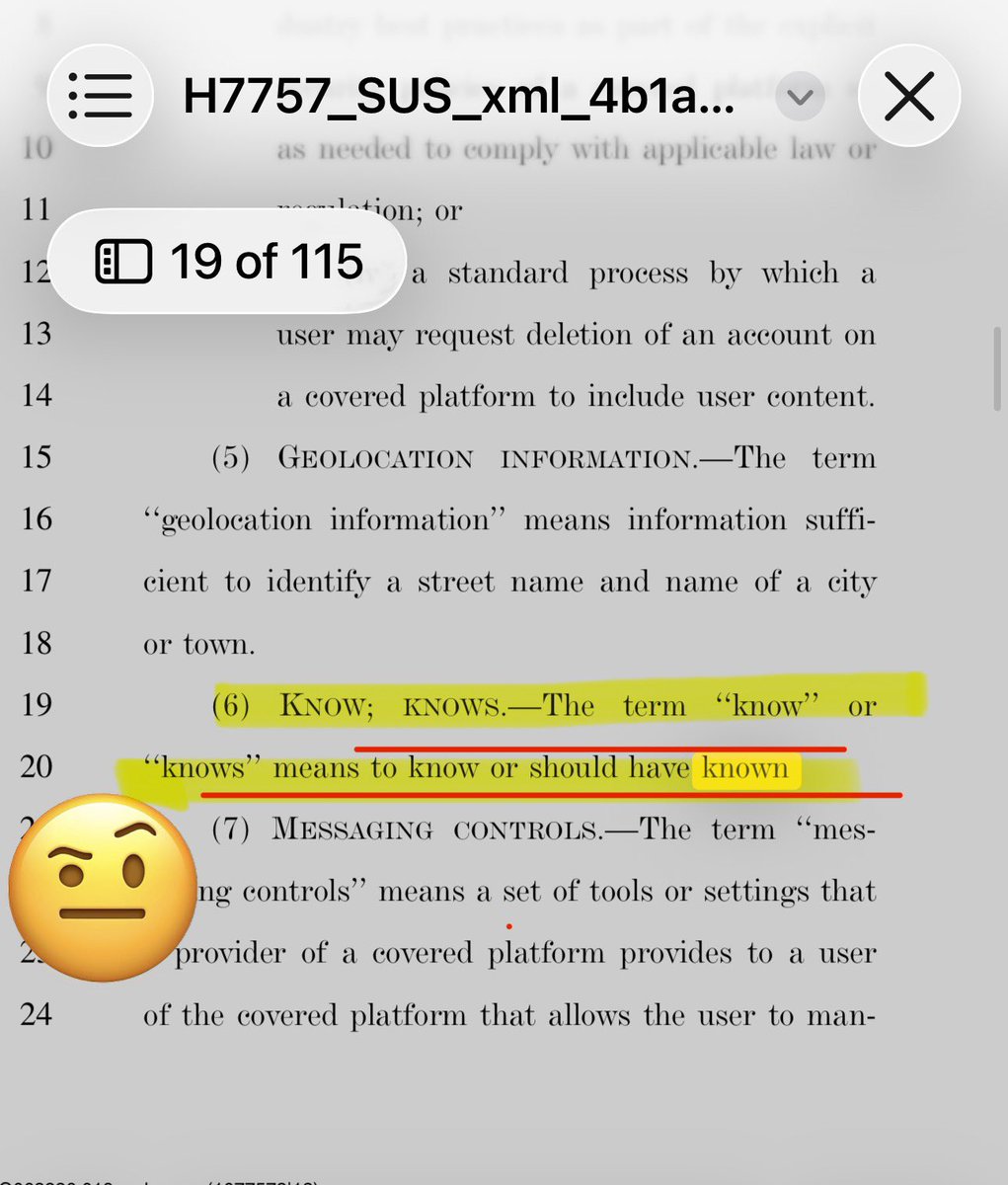
This section you see is from the (KIDS ACT) ⬅️
It shows you the REAL INTENTION on page 110. 🚨
First this ENTIRE bill is a wolf in sheep's clothing🚨 - it uses children's safety as a vehicle to expand government control over the internet, normalize surveillance and verification systems, and create a regulatory framework that can be expanded to adults later.⚠️
One section that LIFTS the MASK is page 110 🎭 where they RESTRICTED DC as ONLY place where you can CONSTITUTIONALLY CHALLENGE this SURVEILLANCE court IN COURT ‼️
In the jurisdiction provision (Section 702)
IF this bill were truly about protecting children, why would you need to concentrate all constitutional challenges in one court?
It TELLS you this is about controlling the legal narrative and preventing scattered rulings that might strike down provisions.⚠️⚠️
——-
Deeper look there are TONS of CONTRADICTIONS 🚨🚨
The bill says it does not require age verification in three separate places:
• Page 38, Section 220: "Nothing in this subtitle may be construed to require the provider of a covered platform to implement an age gating or age verification functionality"
• Page 99, Section 602(f): Same language for COPPA 2.0
• Page 13, Section 103(f): "Nothing in this section may be construed to require the submission of government-issued identification"
But every single protection in the bill is triggered by one phrase: when a platform "knows" a user is a minor. The "knows" standard is defined as "know or should have known" on pages 17, 40, 45, and 79.⚠️
This creates an impossible trap:🚨
1. If a platform does NOT verify age, it "should have known" minors were present and faces liability for failing to provide protections
2. If a platform DOES verify age, it collects age data on every user, which creates privacy risks and potential liability
The bill says "you don't have to verify age" while simultaneously making it impossible to comply without verifying age. This is not a contradiction. This is the design.
The bill uses children's safety as the vehicle to normalize age verification across the entire internet. Once age verification infrastructure exists for minors, it exists for everyone. The system built to check if you are 16 will be the same system used to check if you are 21, 35, or a registered voter.⚠️🚨🚨🚨
—
JURISDICTION SHELL GAME 🚨
Page 107, Section 702: "The United States District Court for the District of Columbia shall have exclusive jurisdiction over any challenge to the constitutionality of this Act or the constitutionality of any action, finding, or determination under this Act."
One court. All challenges. No exceptions.
This means:
• A company in California cannot challenge in the Ninth Circuit
• A civil liberties group in New York cannot challenge in the Second Circuit
• Every constitutional challenge must go to the same DC court that routinely handles federal government cases
This is designed to concentrate legal challenges in a venue favorable to the government and prevent multiple circuit courts from issuing injunctions against the law. If the DC court upholds the law once, it becomes extremely difficult to challenge elsewhere.🚨🚨
—-
THE ADVERTISING MEASUREMENT LOOPHOLE🚨🚨
Page 39, Section 233(b): "Nothing in this subtitle may be construed to limit the processing of personal information solely for measuring or reporting advertising or content performance, reach, or frequency, including through an independent measurement."
➡️⚠️🚨The "Stop Profiling Youth and Kids Act" does not stop profiling for advertising measurement. It only stops "market research." Platforms can still process minor's personal information for advertising performance metrics. This is the commercial exploitation pathway left open while the privacy provisions are presented as protections. 😆
—-
I had been seeing doom posts about the KIDS Act on my TL & here's my take:
We have the Senate & it has to get by that before it gets to the President.
Call your reps & make your voice known about this, be civil & respectful.
Vote out the people who voted yes in the midterms.
good, let's do this again with voting no on KOSA
Don't just retweet and donate, call all your representatives and senators to vote no on the bill that will destroy our freedom on our internet
there’s still time. please please please call your representatives & your senators as much as you can, tell them you’re against KOSA and the KIDS act. Please don’t give up now, we cannot let this pass.
202-224-3121
For everyone worried about KIDS Act’s and KOSA, here are some helpful links to help calm you down. We should all remain vigilant and worried but it’s not as clear cut as some might think:
1) There is significant opposition to both House and Senate versions (free speech / privacy concerns)
Links:
- ACLU (KOSA opposition; urges House to protect free speech):
https://t.co/3Hcx3xqAUr
- NetChoice (flags First Amendment concerns with the House KIDS Act):
https://t.co/lzqsPEEgVb
- EFF (opposition letter to KOSA; duty-of-care / surveillance concerns):
https://t.co/ImK4FWWvmT
Multiple major civil-liberties and privacy orgs oppose these bills for similar core reasons: chilling lawful speech and pressuring platforms into intrusive compliance.
2) Senate sponsors/co-authors have indicated the House version is “dead on arrival” (they don’t view it as acceptable)
Link:
- The Hill (explains the House-Senate mismatch and quotes Senate co-authors viewing House approach as nonstarter):
https://t.co/R9vfBisLVB
Even after House action, there’s meaningful disagreement between chambers. That mismatch tends to create delays, negotiations, and narrowing.
3) Even in the Senate, passage is not automatic; the bill could stall or fail because of internal disagreement
Link:
- The Hill (same article: “long odds,” why the Senate path is difficult):
https://t.co/R9vfBisLVB
When Senate authors publicly resist the House version, the practical effect is that a final bill must be reworked, something that can stall or collapse.
4) Similar “kids online”/age-check/duty-of-care style laws have already been treated as constitutionally risky in court, so lawsuits and injunction fights are very likely if a federal version becomes law
Links (examples of litigation challenging similar approaches on First Amendment grounds):
- NetChoice v. Griffin (Arkansas age verification / minors online litigation record via Justia):
https://t.co/spdUAJx40g
- NetChoice v. Griffin (court filing materials, via CourtListener recap):
https://t.co/Lwd5FgDmPW
- NetChoice v. Yost (Ohio parental notification / related First Amendment challenge PDF):
https://t.co/MdEcbilzOu
- NetChoice v. Skrmetti (Tennessee age-related minors online issues; includes preliminary-injunction posture):
https://t.co/9rqvJecEvq
So, courts have already enjoined or closely scrutinized similar laws. That’s strong “pattern evidence” that any federal version with comparable mechanics would face serious constitutional litigation.