Introducing Nullmask
Transact privately from the wallet you already have.
No new seed phrases.
No new addresses.
No new wallet.
Setup takes under 30 seconds.
On-chain privacy, finally built for how people actually use crypto.
👉 https://t.co/IxN29ndMl2
Learn more 👇
We built Nullmask because every existing privacy tool has the same flaw: they make you start over.
New wallet.
New seed.
New address.
New interface.
Most people never bother.
If privacy is too complicated, it will never be democratized.
Nullmask works differently.
It plugs into your existing wallet (MetaMask, hardware wallets, any multichain wallet) as a private network.
Your address stays the same. Your keys stay yours. You just gain privacy.
Here's what that looks like in practice:
① You shield tokens into your Nullmask balance. That deposit is visible on-chain.
② You transfer, swap, and transact inside Nullmask. Zero traces. Completely dark to any outside observer.
③ You withdraw to any address. That exit is visible on-chain but carries no cryptographic link back to your deposit.
Under the hood: every transaction is backed by a zero-knowledge proof.
Your funds are individually provable, not mixed with anyone else's. Compliance-first from day one.
Currently live on Ethereum with support for ETH, USDT, USDC, and QF.
Hardware wallet support included, which is a first for any EVM privacy protocol.
ERC-20 expansion, L2s, BNB Chain, and Solana are in progress.
Desktop app is live now.
Mobile coming soon.
👉 https://t.co/IxN29ndMl2
275 million students. One hack.
Harvard. Stanford. Princeton. 9,000 schools worldwide. All hit by the same group that took down ADT, Amtrak, and Vimeo this year.
Different targets. Same vulnerability every time.
The data existed. That was the problem.
Not weak passwords.
Not outdated software.
The fundamental decision to collect and store personal data at scale.
You cannot breach data that doesn't exist.
𝗡𝗨𝗟𝗟𝗠𝗔𝗦𝗞
Most people chase privacy in the wrong place.
They look at Monero. They look at Zcash. They buy a privacy coin and think the problem is solved.
But here's what they're actually using every day: USDC. USDT. Stablecoins. The assets tied to their real financial life.. salaries, payments, savings, DeFi positions.
Privacy coins can't touch any of that.
You can't send private USDC through Monero.
You can't shield your USDT through Zcash.
The moment you move back into stablecoins, you're fully exposed again.
The real privacy gap isn't ETH. It's the stablecoins you actually use.
Nullmask shields them. From the wallet you already have.
No new coins.
No new chains.
No new anything.
𝗡𝗨𝗟𝗟𝗠𝗔𝗦𝗞
48 countries now automatically report your crypto transactions to tax authorities.
Not in the future. Right now. CARF is live. DAC8 is live.
Every trade, every transfer, every wallet interaction.. collected, reported, and shared across governments automatically.
The era of flying under the radar is officially over.
This isn't a reason to panic. It's a reason to understand the difference between surveillance and compliance. Between handing over everything and proving what needs to be proven.
Zero-knowledge proofs let you do the latter. Prove your transactions are clean without exposing your entire financial history. Compliance without total transparency.
That's not a workaround. That's how privacy and regulation were always supposed to coexist.
𝗡𝗨𝗟𝗟𝗠𝗔𝗦𝗞
Privacy used to be a fringe obsession. Now it's infrastructure.
The shift happened because the problem became impossible to ignore. Your wallet is a public ledger. Every trade, every balance, every counterparty — permanently visible to anyone who looks.
The tools listed here are all building toward the same thing. The difference is where in the stack you solve it.
Most solve it at the chain or token level. You need a new coin, a new address, a new ecosystem.
Nullmask solves it at the wallet level. No new coins. No new seeds. No new anything. Just privacy, from the wallet you already have.
𝗡𝗨𝗟𝗟𝗠𝗔𝗦𝗞
Privacy used to sound like something only criminals cared about.
Now even regular crypto users are starting to realize:
having your wallet fully exposed on-chain is actually insane.
That shift is why privacy protocols are quietly heating up again.
The privacy sector now holds over $721M in TVL, and projects like Railgun are seeing real usage growth, not just idle money sitting around.
People want to:
• trade without exposing their entire wallet
• protect large transactions from trackers
• use DeFi without being watched every second
And the interesting part?
New privacy tools are becoming more compliant, not less.
Railgun’s “Proof of Innocence” lets users prove funds are clean without exposing full wallet history, exactly the type of balance institutions want.
At the same time, $ZEC - @Zcash has become the strongest mover among major privacy coins.
Why?
• Faster and better shielded transactions
• Reduced supply after the halving
• Growing institutional attention
• More people seeing privacy as infrastructure, not a niche
This isn’t just another hype narrative.
As blockchain analytics become more aggressive, privacy is slowly turning from an “extra feature” into something users may eventually expect by default.
Also pay attention to these projects building in the sector 👇
• @inconetwork
• @zama
• @aztecnetwork
• @iEx_ec
• @namada
• @RAILGUN_Project
• @Arcium
• @hinkal_protocol
• @AleoHQ
• @Scroll_ZKP
• @usxcapital
• @NullMaskio
• @zano_project
• @ShieldApp
Feels early again.
Ray Dalio said it.
Grayscale filed for it.
Institutions are demanding it.
Privacy is no longer a fringe conversation in crypto.
It is the conversation.
The only question left is who builds the infrastructure that actually works.
Not for a new token, not for a new chain, but for the assets people already hold.
That's what we're building.
Nullmask
Most people think shielding a transaction is enough. It's not.
Even if your transaction is encrypted on-chain, the act of sending it reveals something: your IP address. The server that receives your transaction knows where it came from. That's a linkability problem.
Nullmask solves this with a decentralized relayer network.
When you send a shielded transaction, the Nullmask proxy doesn't broadcast it directly. It forwards it to a relayer, an independent node that submits the transaction to the contract on your behalf.
The relayer pays the gas.
You stay invisible.
The relayer sees the shielded transaction.
It doesn't know who sent it.
The contract sees the proof.
It doesn't know who created it.
End to end: no on-chain link between you and your transaction. No IP exposure. No metadata trail.
That's what complete privacy looks like.
NULLMASK
Privacy coins are having a moment.
Zcash at $600. Monero at all-time highs. Grayscale filing for a spot ZEC ETF. The market is screaming for privacy and capital is flowing toward it fast.
But here's the problem that nobody wants to talk about.
Every one of these assets asks you to leave behind the tokens you actually use. Your USDC. Your USDT. Your ETH. The stablecoins tied to your real financial life.
You can't send private USDC through Monero. You can't shield your USDT through Zcash.
Privacy coins solve privacy by creating a new silo.
Nullmask solves privacy by adding it to the silo you're already in.
The demand is real. The market is just still looking in the wrong place.
NULLMASK
Ray Dalio just named the problem.
Bitcoin's full transparency is why central banks won't touch it.
Why institutions won't move treasury operations on-chain. Why serious money keeps waiting on the sidelines.
Transparency was never the goal.
Trustlessness was. Privacy is how you get both.
NULLMASK
While Bitcoin gets a lot of attention, it hasn’t played the safe-haven role many expected. In my view, there are a few reasons why.
First, Bitcoin lacks privacy. Transactions can be monitored and potentially controlled, which is why central banks aren’t looking to hold it.
Second, it also has a high correlation with tech stocks. When investors get squeezed in other areas of their portfolio, they sell their Bitcoin to cover it.
Third, it’s a relatively small and controllable market, whereas gold stands alone. There is only one gold.
Ultimately, gold is more widely held, deeply established, and still plays a central role in the global system.
76% of all crypto stolen in 2026 is now sitting in North Korea.
Not retail hackers. Not opportunistic scammers.
A nation state with intelligence resources, blockchain analysts, and unlimited time, systematically studying on-chain data, tracing wallets, and extracting value.
Your transaction history isn't just visible to analytics firms and curious strangers. It's visible to state-level actors who are very good at following the money.
On-chain privacy isn't paranoia. It's basic operational security.
NULLMASK
Math. Not promises.
- The government keeps renewing mass surveillance laws.
- Hackers keep stealing centralized databases.
- Nation states keep studying your on-chain history.
The only answer is systems that don't require trust in the first place. Not trust in a company. Not trust in a government. Not trust in an operator.
Math. Not promises.
NULLMASK
Privacy is not the enemy of compliance. Surveillance is not the same as accountability.
These two things keep getting confused.. by regulators, by institutions, by journalists covering crypto.
Compliance requires that the right parties, under the right conditions, can verify that transactions were legitimate. It does not require that everyone can see everything all the time.
Surveillance is not accountability. It's a blunt instrument that catches criminals and innocent people in the same net, stores everything indefinitely, and creates databases that will inevitably be breached.
ZK proofs offer a third path. Selective disclosure. Prove what needs to be proven. Reveal nothing else.
Regulators get accountability. Users get privacy. Nobody has to compromise.
That's not a workaround. That's a more precise implementation of what compliance actually demands.
NULLMASK
Most people assume crypto privacy means hiding ETH.
But your ETH transactions are a fraction of your on-chain footprint.
The real exposure is everything else.
USDC payments, USDT transfers, ERC-20 interactions. The stablecoins you use for actual commerce. The tokens tied to your real financial life.
Nullmask shields all of it.
Every note in the Nullmask protocol carries a token type field. Shielded transfers verify that input and output token types match.
The privacy layer works identically whether you're transacting in ETH, USDC, USDT, or any ERC-20.
Privacy shouldn't be a feature reserved for one asset. It should be the default for everything you hold.
NULLMASK
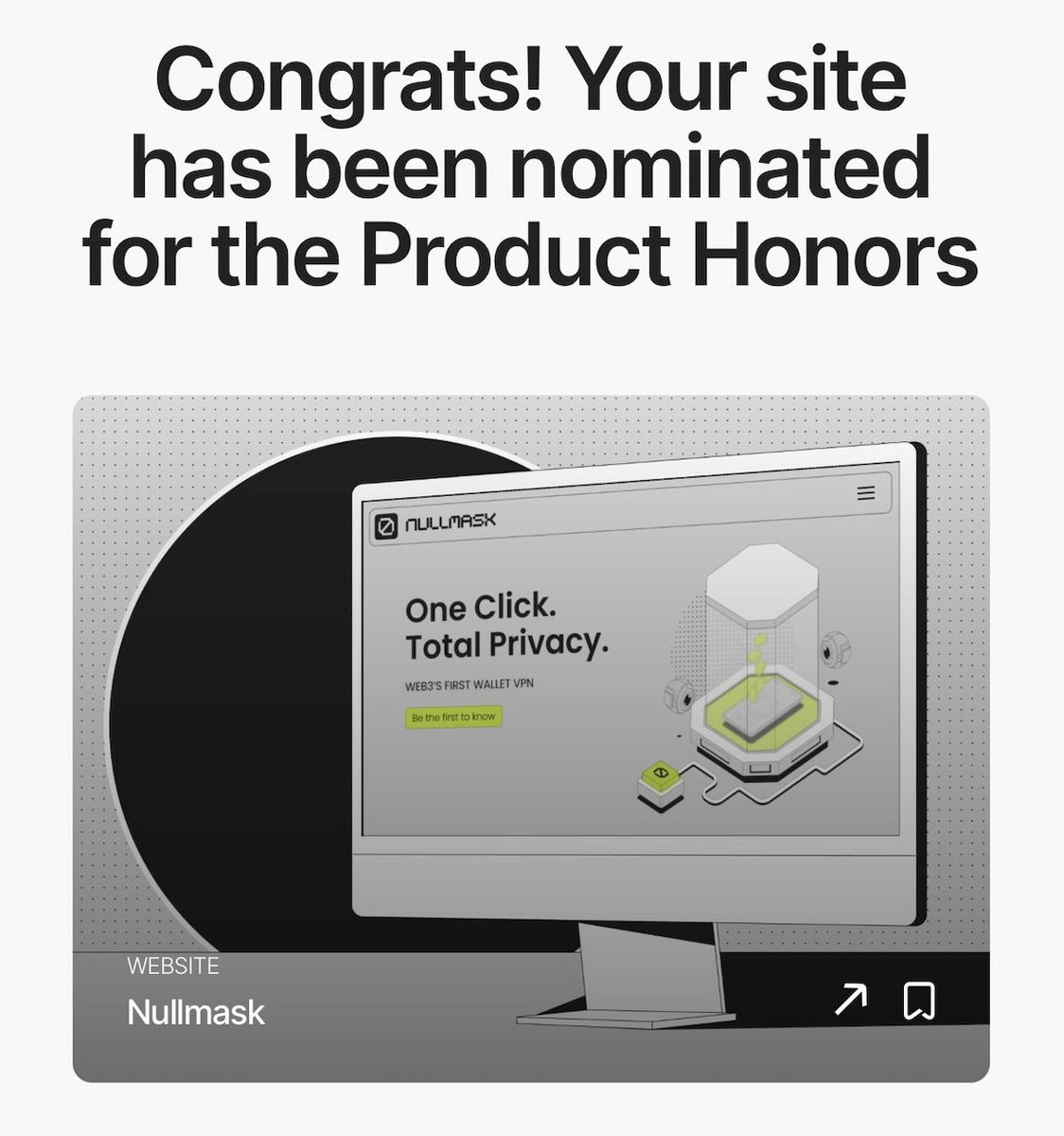
Awwwards recognizes the best-designed products on the internet. They just nominated Nullmask for Product Honors.
For years, bad UX was the price you paid for privacy. Complicated setups. New wallets. New seed phrases. New everything.
The tools were built for cryptographers, not people.
We built privacy for everyone. No new wallets. No new seeds. 30 seconds to set up.
Vote here: https://t.co/mEaSYQANOR
Turns out good design and real privacy aren't mutually exclusive.
NULLMASK
Congress just extended FISA Section 702 by 45 days.
For those unfamiliar: Section 702 is the law that authorizes mass collection of communications data. Emails. Messages. Calls. No warrant required if you're communicating with someone overseas.
They passed it in 2008 as a temporary measure.
They've renewed it every single time it's come up for a vote. It has never expired. It never will.
This is not a conspiracy theory. It is US law. It is public record. And it is the clearest possible signal that governments are not going to protect your privacy.
They're going to legislate around it.
You cannot opt out of Section 702. But you can control what you put on-chain.
Privacy isn't coming from Washington. It has to come from the infrastructure itself.
NULLMASK
The era of public-by-default blockchains is ending.
Because the people who were supposed to move serious money onto these rails looked at a fully public ledger and said: absolutely not.
Institutions, banks, asset managers, they didn't need convincing that privacy matters.
They needed someone to build it properly.
The demand was always there.
The infrastructure wasn't.
It is now.
We have arrived.
NULLMASK
Anyone still building serious financial infrastructure on public-by-default blockchains is building for yesterday.
Not because regulators said so. Not because institutions demanded it.
Because it was always the wrong default.
The idea that every transaction, every balance, every counterparty relationship should be permanently visible to anyone on earth was never a feature.
It was an oversight that nobody fixed.
Finance has always had privacy. Cash is private. Wire transfers are private. Your bank statement is private.
The blockchain was the anomaly and the industry is finally correcting it.
The question now isn't whether on-chain finance will be private. It's who builds the privacy layer that actually works.
NULLMASK
Your transaction history is more sensitive than your home address.
Your address tells people where you live..
Your transaction history tells them:
How you live.
What you earn.
What you spend.
Who you pay.
What you believe in.
What you're afraid of.
What you're planning.
Every on-chain transaction you've ever made is public. Permanently. Searchable by anyone with an internet connection and five minutes to spare.
We've normalized something that should horrify us.
Your financial life is yours.
Not your employer's. Not your government's. Not a blockchain analytics firm's. Not a stranger's.
NULLMASK