At 6 AM, Ulaanbaatar is already in motion.Beneath Mongolia’s vast sky, apartment lights flicker awake and the first headlights emerge through the winter haze. Across the city, mornings unfold in different ways: a cup of milk tea shared at home, a crowded bus ride across town, a shop opening its doors, a student preparing for the day ahead.Each routine may seem ordinary on its own. Together, they form the quiet rhythm of a city shaped by perseverance, ambition, and an enduring sense of purpose.
Same hour.
Different stories.
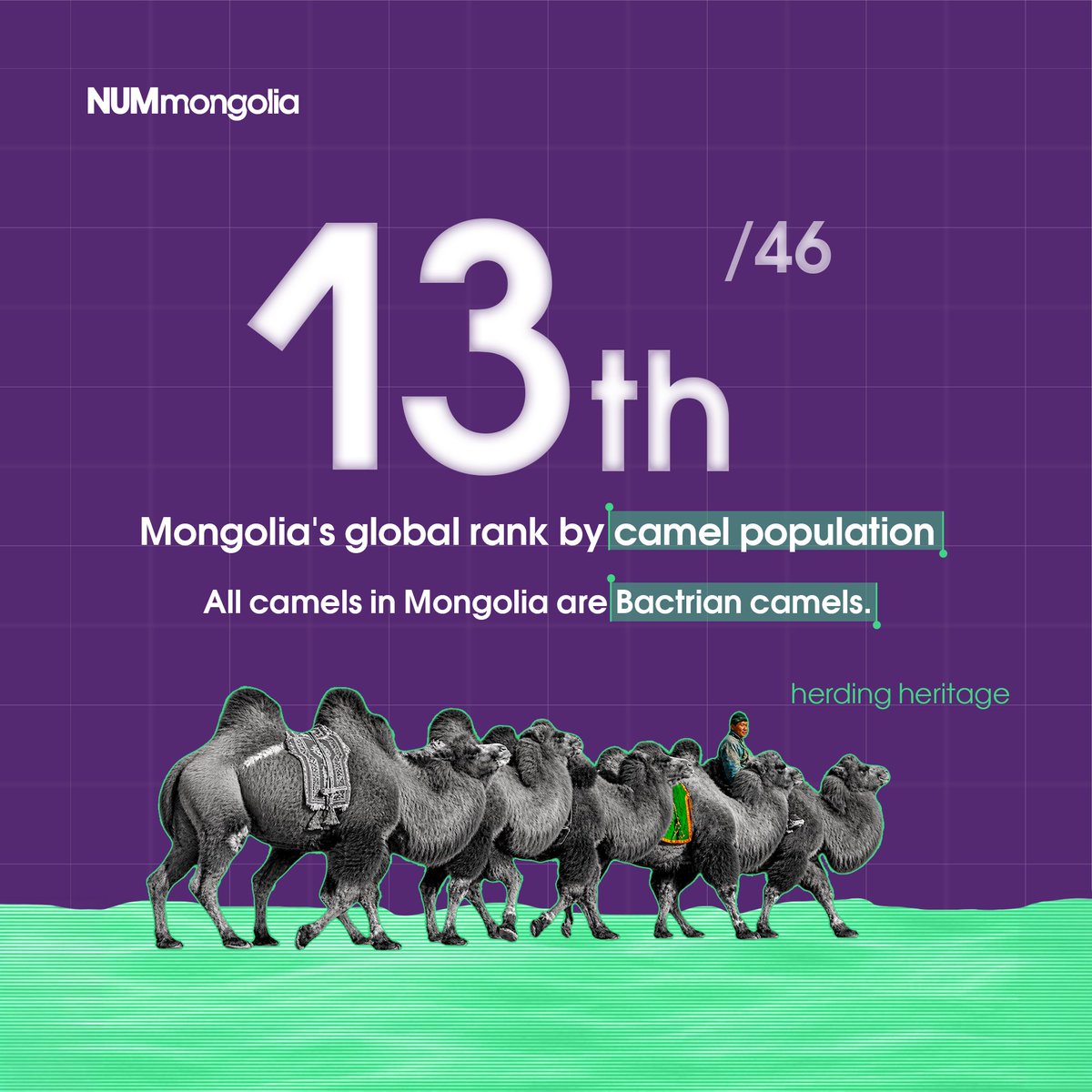
Content: According to FAOSTAT data from the UN Food and Agriculture Organization (FAO), the world had 44.3 million camels in 2024. Camels belong to the camelid family, which includes two-humped (Bactrian) and one-humped (dromedary) camels as well as alpacas, guanacos, llamas and vicuñas. Camelids make an important contribution to food security, nutrition, household incomes and economic growth, and hold a special place in the culture and social life of many countries.
Most of the world’s camels live in Africa, where Chad, Somalia, Sudan and Kenya have the largest herds. With 480,567 camels, Mongolia ranks 13th in the world and accounts for 1.08% of the global total. Because most of the world’s camels are one-humped dromedaries, Bactrian camels make up only about 5–10% of the total. Mongolia’s entire camel herd, however, is Bactrian, a feature that is rare worldwide.
In recent years, the market value of Bactrian camels and their products has been rising, and in some countries they have come to be called “white gold” and “ever-flowing wealth”. According to Mongolia’s 2025 livestock census, the camel population reached 501,300, up 4.3% from the previous year, laying the groundwork for higher production of camel-based raw materials and products.
According to the Ministry of Food, Agriculture and Light Industry, Mongolia also produces an average of 2,300 tonnes of camel wool and 12,000 tonnes of camel milk each year.
Camel milk stands out for its high nutritional value. Compared with milk from other livestock, it is rich in amino acids such as leucine, isoleucine and methionine, in vitamins B and C, and in minerals such as calcium, phosphorus and potassium. It is also considered the dairy product closest in composition to human breast milk, with a high content of beneficial bacteria. Studies show that its composition varies with location, season, the camel’s age and its diet, but on average camel milk contains 2.15–4.9% protein, 1.2–4.5% fat, 3.5–4.5% lactose and 0.6–0.9% minerals.
Because of these nutritional qualities, global demand for camel milk is growing steadily. Kenya leads world camel milk production with 1.165 million tonnes a year, followed by Somalia (0.958 million tonnes) and Mali (0.271 million tonnes). Camel farming is also an important source of income for herding households in Kenya: camel milk sales make up 40.9% of household income in the rainy season and 35.7% in the dry season. Kenya began supplying camel milk to China in January 2024, and its main export markets for camel milk and meat are the United Arab Emirates and Saudi Arabia.
As the global market for camel products expands and their consumption and economic value grow, Mongolia, home to a large share of the world’s Bactrian camels, is in a relatively strong position. The steady growth of its camel herd and rising production of camel wool and milk create opportunities to increase processing, make more value-added products and diversify the country’s exports.
Content: In 2025, 26 foreign production companies filmed in Mongolia. Their projects included 11 television programmes, 9 documentary series, 3 commercials, 2 documentary films and 1 reality show, a sign of Mongolia’s growing appeal as a location for international film and media production.
This momentum has been building for several years. Major broadcasters and production companies, including the BBC, BBC Studios, CNN, NHK, TBS and Nippon Television, have chosen Mongolia as a filming location.
Policy reforms have helped drive this growth. On 2 July 2021, Parliament adopted a revised Law on Culture and the Law on the Promotion of Film Art. Together, they created a legal framework to strengthen the creative industries and make Mongolia more competitive as a destination for international film production and investment.
Beyond supporting Mongolian filmmakers, the reforms have made the country more attractive to foreign production companies, international co-productions and investors in the creative industries. They have also given Mongolia a way to show its landscapes, nomadic heritage and culture to audiences around the world, laying the groundwork for it to become a competitive filming hub in the region.
In World Population Review’s compilation of 2025 International IQ Test data, Mongolia ranks 11th of 142 countries and territories, with an average score of 102.61. The top three are Hong Kong (107.73), South Korea (106.97) and China (106.48).
Mongolia sits just above New Zealand (102.35), Vietnam (102.26) and Spain (102.24), and slightly ahead of Canada (102.09), the United Kingdom (101.57) and the United States (101.04). The Central Asian countries score lower: Uzbekistan (96.54), Kazakhstan (95.92), Kyrgyzstan (94.48) and Tajikistan (93.39) are all more than six points behind.
World Population Review says the differences between countries mostly reflect the quality of education, access to schooling, early-childhood nutrition and familiarity with standardised tests, not fixed differences in ability.
The scores come from 1,352,763 people who chose to take the same online test. They describe those test-takers, not whole populations, so the ranking reflects who took the test rather than how intelligent each nation is.
Content: According to ITC Trade Map data, Mongolia accounted for an estimated 58.5% of global metallurgical fluorspar exports in 2025. Mongolia has also begun exporting to new markets, including Hong Kong (China) and Luxembourg.
This comes amid tightening global supply. According to the U.S. Geological Survey’s (USGS) Mineral Commodity Summaries (February 2026), world fluorspar mine production is estimated to have fallen by 1% to 10 million tonnes in 2025. In China, supply remained constrained by rectification measures on fluorspar mining, with some mines suspending production for safety inspections. As a result, China’s fluorspar imports in the first half of 2025 rose by 48% year on year to 856,000 tonnes, with 86% sourced from Mongolia.
USGS also estimates that Mongolia holds 34 million tonnes of fluorspar reserves, about 10% of the world total and the 4th largest globally, behind only China, Mexico and South Africa. Mongolia’s 2025 production is estimated at 1.5 million tonnes, about 15% of global output.
#usgs #metalurgia #fluorspar #mongolia #geology
Content: According to Mongolia’s National Open Data Portal, as of Q3 2026, companies with U.S. investment made up 1.8% of all foreign-invested enterprises in Mongolia. By value, however, U.S. investors accounted for 4.1% of the US$55.1 billion in foreign investment that entered the country between 1990 and the first half of 2026.
The Investment Climate Statements (ICS) are annual reports by the U.S. Department of State on business and investment conditions in more than 170 economies. The 2026 edition has a dedicated chapter on Mongolia.
What the 2026 report highlights:
The report finds that Mongolia imposes few market-access barriers, that international franchises have performed better than expected, and that agriculture and livestock show strong promise. It also mentions Invest Mongolia, the government’s investment promotion agency, and Mongolia’s signing of the WTO Investment Facilitation for Development (IFD) Agreement. On trade, the Interim Trade Agreement between Mongolia and the Eurasian Economic Union (EAEU) entered into force in July 2026.
Outlook (our assessment):
Historically, more favourable assessments of Mongolia’s investment climate have generally been accompanied by stronger U.S. investment activity. The 2026 report points to opportunities in market access, franchising, agriculture, and livestock, while continuing to note dispute resolution as a concern. Whether these opportunities translate into higher investment flows will depend largely on the predictability of the business environment and the effectiveness of commercial dispute-resolution mechanisms.
#mongolia #investor #investmentclimate #usdepartmentofstate #ics
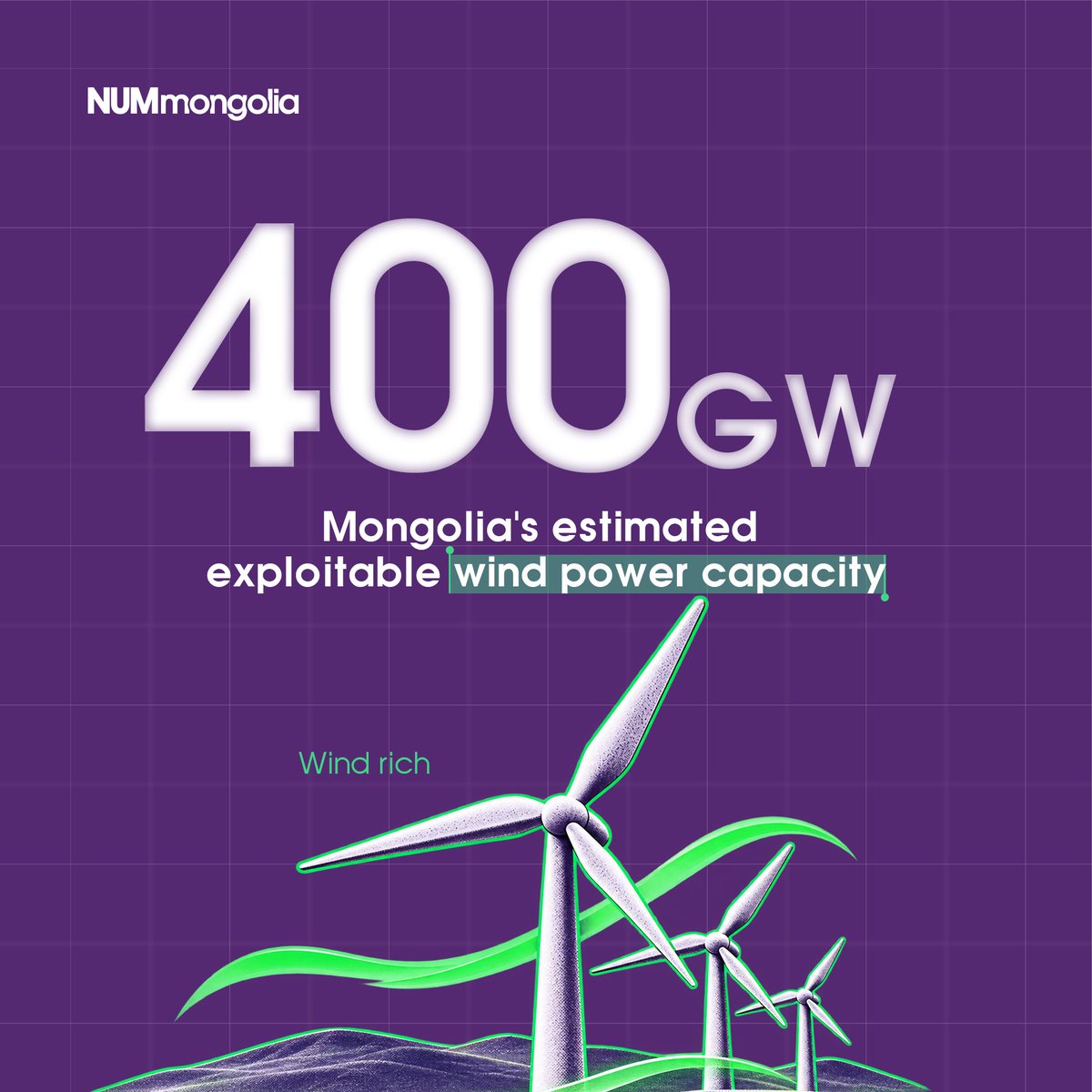
Content: According to a 2026 OECD report on sustainable infrastructure in Central and Southeast Asia, Mongolia has vast untapped potential for renewable energy, especially wind and solar power. The country’s total wind power capacity is estimated at 2.13 TW (2,130 GW), enough to produce around 2,600 terawatt-hours (TWh) of electricity a year.
About 400 GW of this is considered realistically usable. The best areas are in the windy south and southeast, such as Ömnögovi and Dornogovi provinces.
Mongolia is also opening its doors to investors. In July 2026, Parliament amended the Investment Law to open more sectors to foreign investment, including renewable energy, data centres and artificial intelligence.
Content: According to a 2026 OECD report on sustainable infrastructure in Central and Southeast Asia, Mongolia has huge solar power potential that remains largely untapped.
The country enjoys 270–300 sunny days a year, and an estimated 700 GW of solar capacity could realistically be put to use. That could generate thousands of terawatt-hours (TWh) of electricity a year, far more than Mongolia uses today. Yet installed solar capacity is still only 90 MW.
Sunlight is strongest in the south and east of the country. In the west, several projects aim to improve efficiency and reduce the electricity lost in transmission. Solar power has also transformed life in the countryside: since 2002, more than 100,000 small solar units have been installed, bringing electricity to about 70% of nomadic households.
Mongolia is also opening its doors to investors. In July 2026, Parliament amended the Investment Law to open more sectors to foreign investment, including renewable energy, data centres and artificial intelligence.
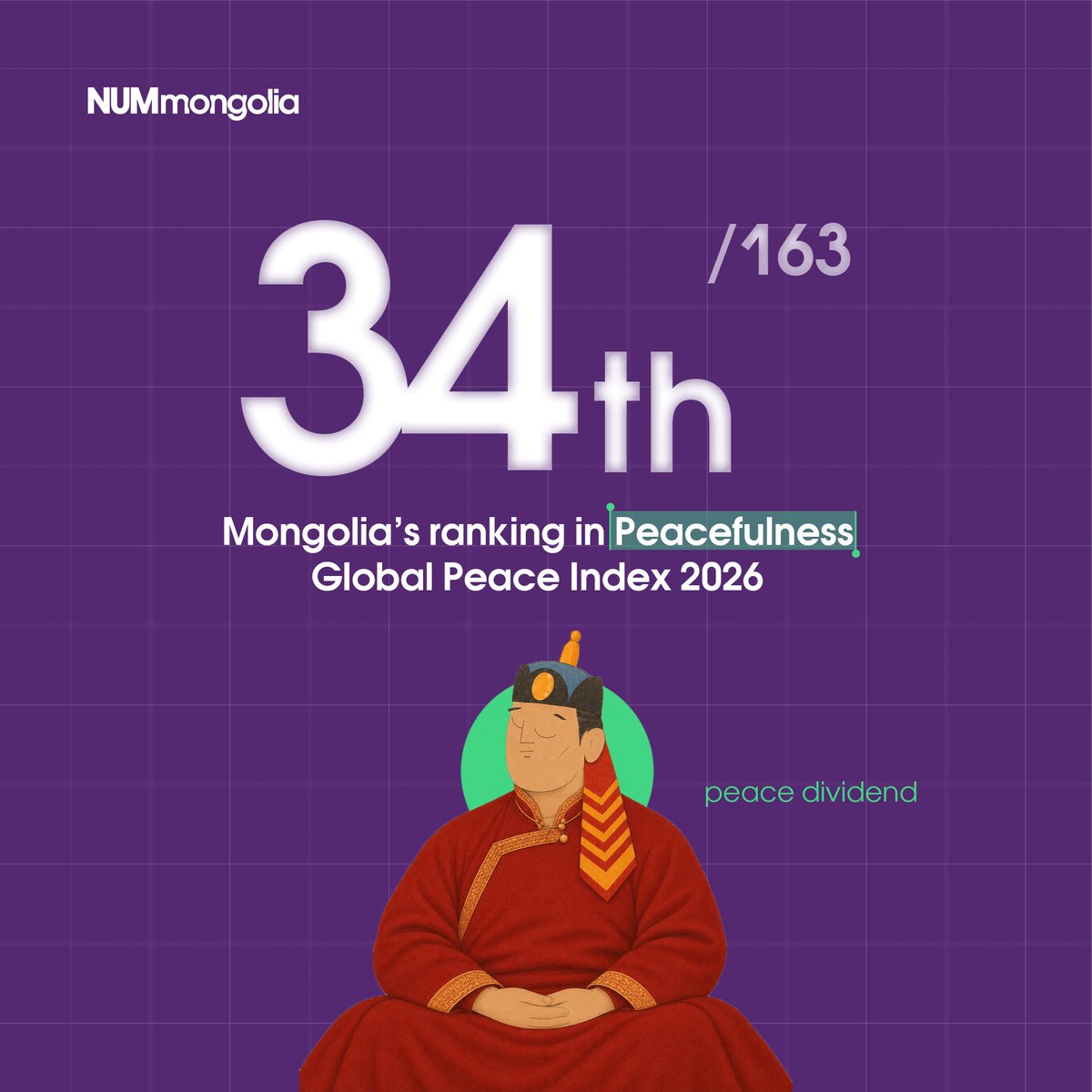
Content: According to the Global Peace Index (GPI) 2026, published by the Institute for Economics and Peace (IEP), Mongolia ranks 34th of 163 countries, up four places, with a score of 1.692 (the lower the score, the more peaceful the country).
The GPI is a composite index made up of 23 quantitative and qualitative indicators. Mongolia is 7th among 19 Asia-Pacific countries and ranks 12th globally in the Militarisation domain.
Mongolia achieves the best possible score (1 out of 5) on 7 of the 23 indicators: Violent Demonstrations, Terrorism Impact, Deaths from Internal Conflict, Deaths from External Conflict, Weapons Exports, Internal Conflicts Fought and External Conflicts Fought. Its Ongoing Domestic and International Conflict domain score of 1.302 is tied for 17th globally.
Several other indicators come very close to the best possible score: Refugees and IDPs (1.023), Nuclear and Heavy Weapons (1.029) and Weapons Imports (1.113). Military Expenditure (% GDP) scores 1.44. Neighbouring Countries Relations scores 2 out of 5.
Content: Creative outputs is Mongolia's strongest pillar in the Global Innovation Index 2026, where it ranks 41st globally. Driven by its trademark and industrial design results, this performance helped lift Mongolia to 72nd place among 139 economies.
Published by the World Intellectual Property Organization (WIPO), the index shows Mongolia rising six places from 78th in the previous edition. It ranks 13th in South East Asia, East Asia and Oceania and is among the region's largest climbers this year. The rise was driven primarily by innovation outputs, where Mongolia ranks 57th, well ahead of its 93rd place in innovation inputs.
The Creative outputs pillar captures how an economy's creativity translates into brands, designs and cultural and digital products. It comprises three sub-pillars: intangible assets, creative goods and services, and online creativity.
Intangible assets is the standout. Mongolia ranks 8th in this sub-pillar, underpinned by trademarks and industrial designs, both ranked 3rd globally. Relative to the size of the economy, Mongolian businesses and creators are among the world's most active in protecting their brands and designs.
Content: Fiscal Health is Mongolia's highest-performing indicator in the 2026 Index of Economic Freedom, with a score of 96.1, ranking 24th globally and 9th in the Asia-Pacific region.
According to the Index of Economic Freedom 2026, published by The Heritage Foundation, Mongolia’s economic freedom score is 63.9, making its economy the 69th freest in the world. The score has risen by 1.3 points from last year, and Mongolia ranks 13th out of 39 countries in the Asia-Pacific region. It is higher than both the world and regional averages, and the 2026 Index classifies Mongolia’s economy as “moderately free”.
Fiscal health is a multifaceted concept that encompasses more than just the balance of revenues and expenditures. It involves the assessment of a government's ability to provide services, meet financial commitments, and maintain a level of financial flexibility to respond to both short-term and long-term challenges and opportunities.
Among the 12 components of the 2026 Index of Economic Freedom, Fiscal Health stands out as Mongolia's strongest-performing indicator. Mongolia scored 96.1 points in Fiscal Health, ranking 24th among 184 economies worldwide and 9th in the Asia-Pacific region.
@Heritage
#economy #mongolia #economicfreedom #index
3/3
Third stage of development (from 2005): In 2005, Mongol Shiltgeen JSC listed on the Mongolian Stock Exchange and offered 44,792 shares to the public, opening a new era in which companies raised financing through the capital market. In 2006, companies including Genco Tour Bureau, Zoos Bank and BDSec offered their shares to the public, raising a total of MNT 7.65 billion. In step with the market's development, the Securities Commission was dissolved, and the Financial Regulatory Commission was established to regulate and supervise the securities market.
Content: In its 1992 study Mongolia: Privatization and System Transformation in an Isolated Economy, the World Bank highlighted that Mongolia introduced a voucher-based privatization scheme before any country in Eastern Europe.
Largely unnoticed by the West, Mongolia began to move away from Soviet domination and a centrally planned economy with the first stirring of Glasnost. Though still within the context of central planning, economic decentralization began as early as 1984, but by 1990 the country was on the way to implementing a radical transformation program which aimed to create a market economy.
Such a program, like those in Eastern Europe after 1990, would need to address the entire spectrum of economic reform, including price and trade liberalization, rapid privatization, and a fundamental change in the economic role of the state. Mongolia's program aimed at all these areas, in particular privatization where an innovative voucher scheme was initiated before any country in Eastern Europe. Moreover, the program was initiated under exceptionally difficult conditions, due to the withdrawal of Soviet aid and serious disruption of trading links within COMECON.
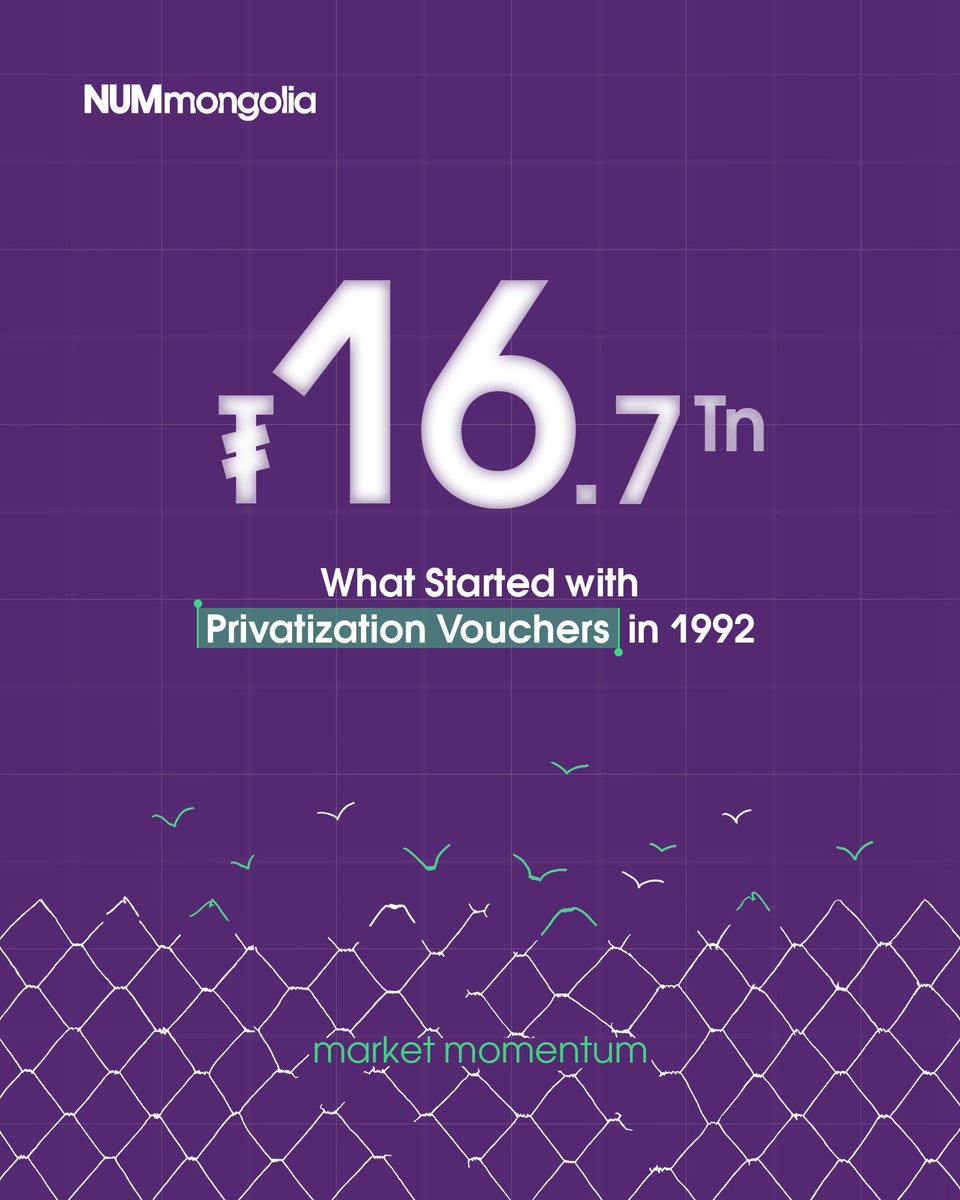
Built on the foundation laid by privatization, Mongolia's capital market has developed in stages, growing into a market system in which companies can raise capital and investors can invest through a wide range of financial instruments. As a result of this development, the market capitalization of Mongolia's capital market rose 26.5% year on year as of the third quarter of 2026, reaching MNT 16.7 trillion.
To support this market growth, the Mongolian Stock Exchange JSC has begun introducing market making and building the framework for short selling and securities lending and borrowing, and has updated its rules for launching ETFs and products based on new indices.
It has also launched trading of the Future Tech Innovation ETF and the Gold Trust ETF, and laid the groundwork for products based on the TOP 20 ETF, a dividend index and a bond index. Together with the London Stock Exchange Group and the Mongolian Central Securities Depository (MCSD), it announced the “Mongolian Capital Market 2.0” programme, laying the foundation for long-term work on upgrading trading technology, enabling dual listing of listed companies and expanding access to international markets. As a result, average daily trading value has now reached MNT 70.5 billion.
1/3
First stage of development (1990–1995): In 1992, Mongolia's new democratic Constitution formally recognized citizens' right to private property, laying the legal foundation for a capital market in Mongolia. The Mongolian Stock Exchange was established in 1991, and the first trading to privatize state property with investment vouchers took place on 7 February 1992. Vouchers were distributed to citizens free of charge, and state-owned enterprises were converted into joint-stock companies, allowing citizens to buy shares with their vouchers and become shareholders. Privatization created about 1.2 million shareholders and transferred 96.4 million shares worth MNT 8.3 billion into citizens' ownership, and the shares of 470 joint-stock companies were listed on the Mongolian Stock Exchange, forming the foundation of the securities market.
2/3
Second stage of development (1995–2005): Secondary market trading in securities began in August 1995. Whereas vouchers had been converted into shares on the primary market, the secondary market allowed shareholders to freely buy and sell their shares for cash. During this period, the number of listed companies increased, market capitalization reached MNT 55.7 billion, and its share of GDP grew. Nevertheless, the market was still shaped more by its origins in privatization than by the classic role of attracting investment.
Content: A maiden bearing a nugget of gold on her head could wander the Silk Road safely: where Mongolia–Uzbekistan trade began
More than 800 years ago, present-day Mongolia and Uzbekistan were connected as part of a broader Central Eurasian economic and political space. During the Pax Mongolica, large parts of Central Eurasia were united under a single imperial system that facilitated the flourishing of the Silk Roads, one of history’s most significant transcontinental trade networks. Commercial centers such as Samarkand and Bukhara in present-day Uzbekistan emerged as major hubs linking East Asia, Central Asia, the Middle East, and Europe, while the Mongol Empire provided the security, connectivity, and institutional framework necessary for the movement of goods, merchants, and ideas across continents. Today, the growing partnership between Mongolia and Uzbekistan reflects a renewed connection rooted in centuries of shared participation in the Silk Roads of Central Eurasia.
2025 was a landmark year in Mongolia-Uzbekistan relations, as the two countries elevated their ties to a “Comprehensive Partnership”. During the state visit of President Shavkat Miromonovich Mirziyoyev of the Republic of Uzbekistan, 14 documents on relations and cooperation were signed under the Comprehensive Partnership. This not only confirmed that Mongolia–Uzbekistan relations had reached a new level, but also laid the foundation for long-term cooperation in trade, investment, agriculture, transport and logistics.
At the same time, trade turnover between the two countries has tripled over the past five years, from around USD 10 million to USD 31.7 million, a sign of intensifying economic cooperation.
That year, 87% of Mongolia’s USD 25.2 million in exports to Uzbekistan consisted of sheep-related products such as Live sheep, Frozen Sheep Carcasses, Fresh/Chilled Sheep Carcasses.
#paxmongolica #mongolia #uzbekistan #trade #sheep
Content: Mongolia's services exports reached USD 1.9 billion.
International trade in services is conducted to a very large and increasing extent through electronic means. The revolution in communications technologies has made many services tradable across borders and has increased the importance of their contribution to international trade, economic growth and development. Cross-border services trade is greatly facilitated by the ease with which services products can be traded as digitalized information flows. The General Agreement on Trade in Services (GATS) established the first framework of international law and multilateral commitments where this trade can take place securely.
In Mongolia, transport, travel, and other business services remain the dominant components of services exports. Total services exports reached USD 1.92 billion in 2025, with transport services accounting for USD 739.6 million, travel services for USD 700.1 million, and other business services for USD 295.3 million.
Financial services recorded the highest growth among all services export categories, rising by 250% to USD 42.2 million. This growth underscores Mongolia's increasing ability to diversify its export base beyond traditional transport and tourism activities and highlights the country's growing competitiveness in knowledge-intensive and technology-enabled service sectors.
Policy restrictions to services trade, non-tariff barriers in nature, impose costs equivalent to very high ad valorem duties, often exceeding those applied to goods. Eliminating these barriers could generate substantial economic gains, warranting greater visibility in policy discussions.
OECD Services Trade Restrictiveness Index (STRI) 2026 estimates indicate that comprehensive reforms addressing both economy-wide and sector-specific barriers could reduce annual global trade costs by approximately USD 1.6 trillion. This equates to nearly 1.4% of global GDP or 18.6% of global services trade value, with notable benefits in professional services, financial services, transport, and communications.
The most significant trade cost reductions could be achieved in financial services, where services trade policy reforms that would reduce countries’ STRIs halfway towards the best performer are estimated to lower trade costs by 29% in commercial banking and 16% in insurance. Air transport could also see significant trade cost benefits (17% reduction).
As financial services continue to emerge as a key driver of global services trade, this strong performance demonstrates Mongolia's capacity to participate more actively in high-value, knowledge-based service exports and to strengthen its position in international markets.