In 2019 we were invited to take part in "Xog'e: Hipersticiones para los cuerpos por venir", a collection by the wonderful online literary magazine Página Salmón @rp_salmon. The collection is finally out in e-book format, available at the PS online store: https://t.co/dSNNqyOaTX
Plutonics Vol. :(::) is out on March 13th! Check out our piece "Lady Strider", a translation of a time-sorcerous poem on wandering deities, mosquitos & space-faring plagues by 19th-century polymath Doña Casilda Ávila, w/illustrations & notes by members of Colectiva Tzitzimiyotl.
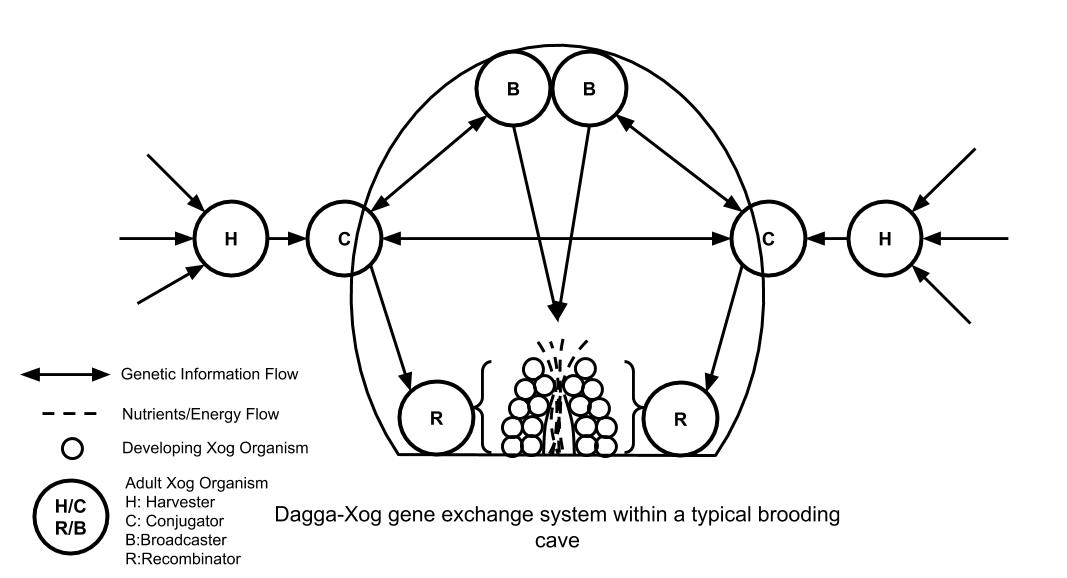
Notice no information is passed from Recombinators to Conjugators, nor from these to Harvesters. Eva de León attributed this to a cultural taboo rathen than a physiological limitation, since the channels opened by Conjugators easily allow for two-way gene transfer.
Reproductive strategy of the deep-ocean dwelling Dagga-Xog People, who used hydrothermal vent caves as "chemical nurseries" for their young.
Reproduced from a hand-drawn diagram by Dr. Eva de León, part of the October 1966 IMEX Biology Lesson Plan.
Harvesters wandered the ocean to collect genetic material for the Conjugators at the cave's entrances, who then shuffled the genes for Recombinators to then assemble into eggs while Broadcasters saturated the water with material for the new organisms to "learn" as they develop.
While the Pnakotic Xog'e was written in the Yithian script on basalt tablets, the "Cryptolithic Xog'e" found by Lombardo could more accurately be described as "sculpted" into its material medium, with properties like color, density, and chemical make-up carrying semantic value.
FROM THE NOTES OF TEODORA LOMBARDO: ON XOG COMMUNICATION
While the Ur-Xog of the Cambrian led extremely solitary lifestyles, the Xog peoples of the Permian were, with exceptions, highly gregarious as a result of their more limited and socially mediated metamorphic abilities.
Before Lombardo’s discovery, the Xog’e was known to the Alhazredian tradition via a Yithian copy contained in the Library of Pnakotus, whence it fragmentedly found its way into tomes like The Tablets of Jheg Selem, The Book of Eibon, and the Grimoires of Doña Casilda Ávila.
In a 1957 letter to future IMEX faculty, Teodora Lombardo wrote: "The enormous investment of cruelty needed to stave off communism attests to the deep evolutionary mechanisms of its emancipatory program, a heresy of hope that entire extinction events could not uproot."
The west has spent so much time demonizing communism it can’t even appropriate useful and helpful gestures from communist countries and will instead be pointlessly cruel on those points to distance itself from the possibility it could be referred to as such.
Idealized body plan example of a 4-sexed Xog specimen.
(:) - Harvester organs
((:)) - Conjugator organs
(((:))) - Recombinator organs
((((:)))) - Broadcaster organs
From the notebooks of Eva de León: On Xog Physiology and Reproduction
The Late Permian Xog Peoples were a diverse, cosmopolitan clade of lichen-like species united by a broad "macroculture" that shaped, among other things, general body plans and reproductive strategies.
Being lichen-like colonial assemblages of organisms, a "single" Xog specimen would usually develop a multi-sexed reproductive system consisting of multiple eightfold clusters of organ-assemblages of different sexes, linked in complex networks of gene communication.