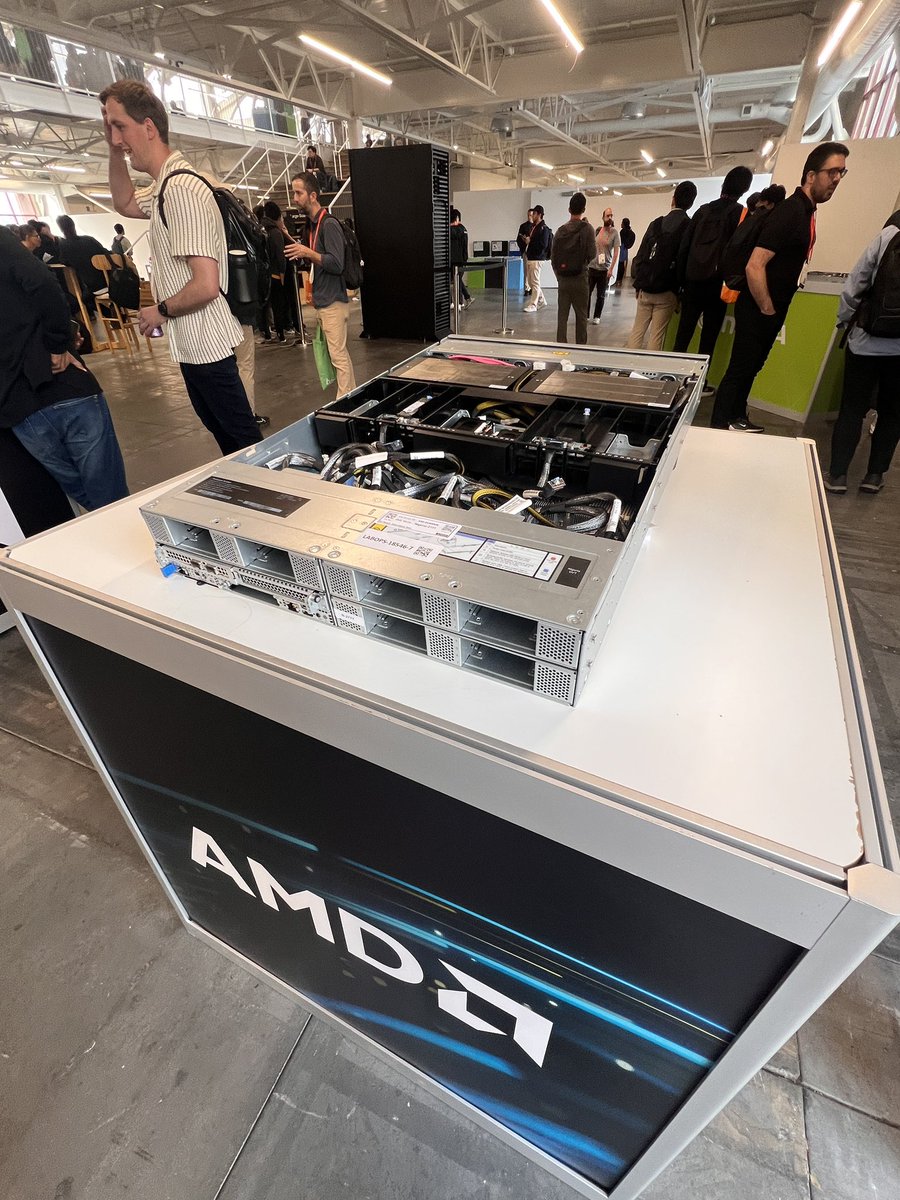
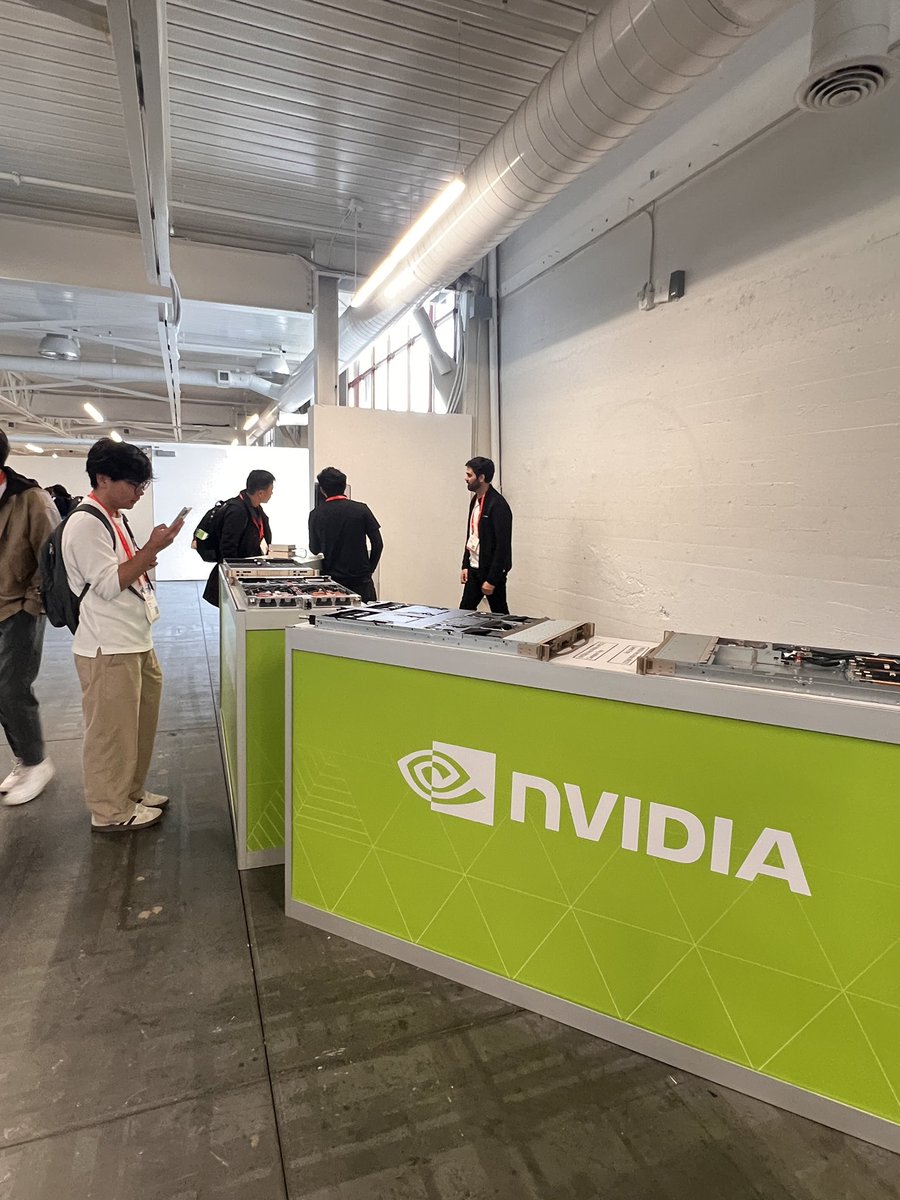
A takeaway from @lilianweng’s talk today:
As AI gets more capable, it’s easier to fall into “fake learning”. You read a clear explanation and feel like you’ve learned something, but the information can go right through your head without sticking.
Right after hearing the NVIDIA news this morning, I saw the new GPU on display at SGLang Summit. I also spotted booths for a few data companies that had rejected me.🤣
My résumé didn’t make it in. My Expo Pass did.
Seeing the GPU made me wonder how much faster an agent actually finishes a task when its model runs faster.
Agents can also help improve the software that runs their models. OpenRSI agents tested inference optimizations for SGLang-Omni, building on verified gains from one round to the next. Maintainers merged 14 PRs across eight models. That made “AI improving AI” feel a lot more concrete to me.
Anyway, back to grinding.
临渊羡鱼,不如退而结网🕸️
Every time I leave a big event, I think, “Okay, back to studying.” There are always a few ideas that make something click in the moment. But hearing someone explain an idea and being able to use it yourself are two different things. I’ve still got a long way to go.
Why AI Infrastructure Matters
Most conversations about AI start with models and apps. Which model is smarter? Which product is better? I recently read a post about why class advantages persist, and it made me ask a different question: every time an AI product serves a user, who gets paid along the way?
The post used “infrastructure” broadly to mean things people repeatedly rely on: housing, licenses, platforms, brands, and distribution channels. Rent is a simple example. Part of your paycheck goes to your landlord because they own a place you need to live. They can reinvest that income in other assets, and some of those assets can be passed down. Over time, ownership generates income that can buy more ownership.
You can see a similar dynamic in AI. An app relies on compute, cloud services, and inference software to serve users. NVIDIA is a good example. When teams have already built their deployment workflows and tooling around its ecosystem, sticking with that stack can be the easiest choice when they need more compute. The hardware generates revenue, and the software ecosystem gives teams a reason to keep buying it.
What interests me more is how infrastructure changes which products are viable in the first place.
An agent might call a model dozens of times to complete a single task. A small increase in the cost per call can eat into the margin on the entire task. Bring inference costs down far enough, and a workflow that only made sense as a demo might become a product users can afford. Or take prefix caching. When requests share a long prefix, an inference engine can reuse work it has already done and cut the time users wait for the first token. Those improvements shape what teams can charge, how responsive the product feels, and which workflows are worth shipping.
That’s part of what I want to explore at the SGLang Summit. Open source gives infrastructure projects a way into production: developers can try the software and deploy it themselves. Once teams build their deployment scripts, monitoring, and performance tuning around an inference engine, it becomes part of how they operate. The question I’m curious about with SGLang and RadixArk is what teams will pay for once they already use the open-source engine. Is it managed hosting, operational support, or something else?
It also changes how I think about starting a company. You put time and money into solving a problem, deliver something customers can use, and gradually earn their trust. When the same problem comes up and they come back to you, you’ve earned a place in their workflow. Falling costs can create openings here. A task that was too expensive or too slow to automate last year might be worth building a business around today.
I used to think infrastructure was far removed from the work I wanted to do. Now, when I look at a role or a project, I ask more concrete questions. Will I get to see why customers pay? Which upstream decisions determine what I can deliver and at what cost? What problem comes up often enough that I could get good at solving it?
An early engineering role can give me access to customers and workflows I’d struggle to reach on my own. That’s where I’d like to learn which part of the workflow is worth building for someday.
Anyone else at SGLang Summit tomorrow? I'll be at Fort Mason Thu + Fri for the agent and inference sessions. Building agents or hiring 2027 new grads? Let's meet up, DMs open.
hey, i’m Nylaaaaaa
20 y/o girl in tech @ ucla
side quests: cooking & baking, painting, editing vids, pottery, daydreaming, weekend costco combat, boba & cake field research, and hyping up other rising stars;
spent 5 years tutoring k–12 kids in english part-time;
post memes and unhinged videos on RedNote. somehow, got 13k likes.
just trying to make the world a little better while i’m here🙌
when i’m stressed, i chug coconut water and order hot pot spicy enough to give me a new problem
💻coding for fun (until it stops compiling)
I thought I needed experience to get an internship.
Turns out, the internship is where I got the experience.
During my sophomore year, I came across an internship opportunity in a field I had no direct experience in.
I almost talked myself out of it.
But I reached out anyway.
To my surprise, the team was interested in my coursework projects and undergraduate research experience.
Things I had considered “just school projects” turned out to be relevant to what they were looking for.
I got the internship.
And that’s where I started developing the skills I thought I needed before applying.
Looking back, I wonder how many opportunities we miss simply because we assume we’re not qualified enough.
Sometimes the opportunity comes before the expertise.
Don’t reject yourself before the company does.
#JobSearch #newgrad
#jobhunting #Internship #NewGrad #TechCareers #CareerGrowth