How do coding agents transfer memories across domains?
New work from @kangsan_kim_, with CDS' @mengyer, @kchonyc, & @ylecun, plus collaborators, finds reusable reasoning strategies beat detailed code traces — +3.7% across six benchmarks.
https://t.co/9HbM9Rfmvc
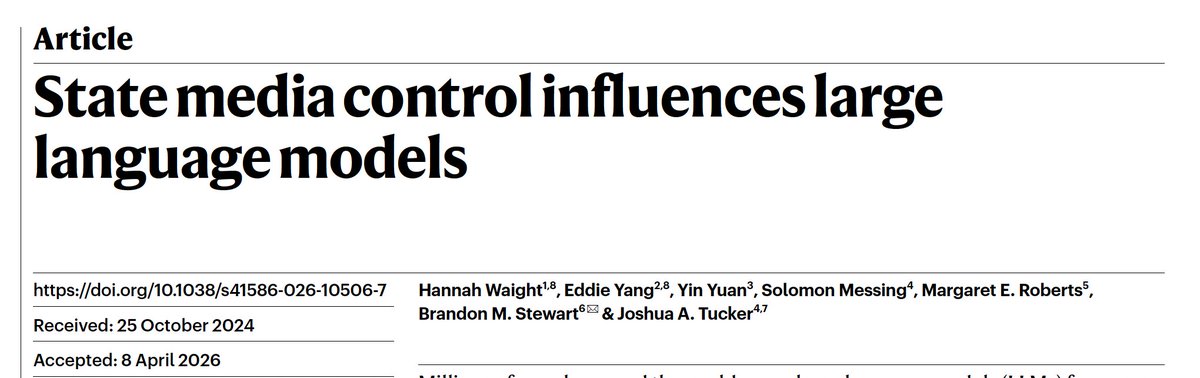
"Institutional influence": how governments shape AI chatbots through the training data they ingest — with measurable effects on what the models actually say.
A new Nature study by CDS-affiliated Prof. Joshua Tucker (@j_a_tucker) and CSMAP's Sol Messing (@SolomonMg).
🧵
1/ Excited to report we have a new paper out @Nature today! The bottom line: training data for LLMs does not just fall from the sky - it is created in the context of existing social political institutions - and that has consequences for LLM output.
https://t.co/OWdprh9Tzo
Can a grammar book replace training data for AI translation?
NYU Linguistics PhD student Jackson Petty (@jowenpetty), CDS Assoc. Prof. Tal Linzen (@tallinzen), and CDS MS student Jaulie Goe tested this with synthetic languages.
https://t.co/0qmgH8fhBm
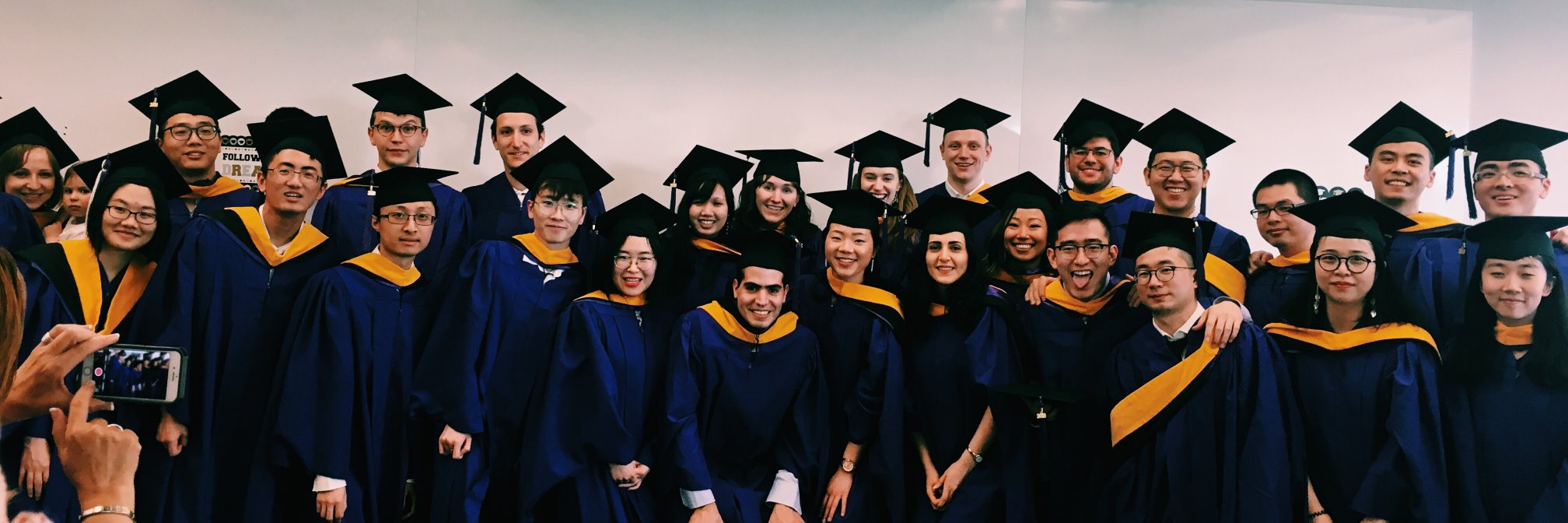
🎓 Congrats to all our newest CDS MS graduates!
Clinical Professor Pascal Wallisch (@Pascallisch), Director of Graduate Studies Brian McFee, and MS Admissions Ambassador Vidhi Manek, graduating herself, addressed the class. ✨
The field is lucky to have you. 🥂
Are chemists done & is NMR solved? Not so fast! 🤔
Outperforming software is not the goal, to be truly useful, AI needs to operate like a human chemist under real lab conditions.
✨Check our #ICML2026 AI4Science Spotlight!
🔗OpenReview: https://t.co/sgh9djOqUG
Thread 🧵
(1/7)
🎓✨ Hats off to our newest PhDs!
CDS hosted an in-person graduation lunch reception for students graduating in May and August 2026, joined by faculty guests for an afternoon of food, toasts, and well-earned recognition. 🥂
Congrats to all our grads!
Congrats to CDS honorees at the 2026 Courant Student Prizes & Fellowships Celebration!
Pathbreaker: Geri Bakushi, Rafael Mateus Carrion.
MS Academic: Harshit Bhargava, Zijin Hu, Hanzhe Wu, Trueman Wu.
UG Academic: Dingyu Fu, Jack Tinker, Selena Zhang, Sifan ‘Silvia’ Zheng.
The CDS Graduate Student Community Building Group hosted UNDP Chief of Investigations Luis F. Socorro and Team Lead Mohamed A. Marrakchi at CDS.
They discussed large language models in fraud detection.
Second-year MSDS students also demoed their capstone project.
Co-authors on “Language Model Teams as Distributed Systems” include Elizabeth Mieczkowski (@beth_miecz, first author), Natalia Vélez (@natvelali), and Thomas L. Griffiths of Princeton, and Katherine M. Collins of Princeton, MIT and Cambridge.
CDS Faculty Fellow @sucholutsky co-authored a new paper arguing that teams of language models should be studied like distributed computer systems, with similar coordination and scaling challenges.
https://t.co/Z3s2a0BTi8
The first CDS research feature of the summer has dropped 📮 @yingwww_ improves AI system physical movement planning, @NickATomlin and @gregd_nlp teach AI agents to trade off cost and certainty, and more on this month’s feature.
#datascience
https://t.co/jcFJmQ4QQC
CDS Assistant Professor Mengye Ren (@mengyer) argues in a new paper that AI selfhood requires continual learning. Today’s LLMs wake from amnesia each session and read a diary of a past self — never extending themselves through new experience. https://t.co/UczreIJ2l2
🎓 Congrats to our newest CDS undergraduate alumni! ✨
Clinical Assistant Professor & Director of Undergraduate Studies Louis Mittel addressed the class, sending the graduates off into the field. 🥂
🚨 New publication from our team in Radiology Advances!
🔥 Acute pancreatitis is a leading cause of GI hospitalization. Severe AP can be life-threatening, but early severity prediction remains challenging.
Eero P. Simoncelli, CDS founding member and professor, was elected to the National Academy of Sciences, recognizing “distinguished and continuing achievements in original research.”
He studies how brains and machines represent visual information.
https://t.co/CG0OkaJ5gP
Co-led by Max Rudolph (UT Austin), Nathan Lichtlé (UC Berkeley) & Sobhan Mohammadpour (MIT), with CDS-affiliated Asst Prof Eugene Vinitsky (@EugeneVinitsky) among senior authors.
2/2
Simple deep RL was thought to fail in imperfect-info games like poker.
A new ICLR 2026 paper shows that with proper tuning, generic methods like PPO match or beat specialized approaches like fictitious play and counterfactual regret minimization.
https://t.co/RvkZ6XxR6J
1/2