We are a network of 700+ VCs, LPs, and family offices operating in NYC. We share your ambition to find and support the next world-changing founders in New York.
Has the bar for venture returns fundamentally shifted?
"I'm not interested if it can't be a billion-dollar position anymore.
I'll make small investments with friends, but I need a billion-dollar position to get excited today.
You've got to be worth north of $10 billion for it to even make sense given dilution." @jasonlk
Have venture outcome expectations fundamentally changed forever @nchirls@Rick_Zullo@honam@infoarbitrage
A founder nails early traction, customers are happy, metrics look solid. Then a new AI capability drops, a competitor reprices to zero or the use case gets absorbed into a platform. Finding durable product / market fit is harder than ever right now.
Occasional setbacks are a part of trying ambitious stuff. Kudos to @JeffBezos for trying. I’m sure he will succeed next time. Try and fail but don’t fail to try
Right now, VCs care about one thing only…defensibility / moats so don’t bother pitching anything else. Like throw away the entire deck and just have one slide on that.
This Allbirds story is so insane:
→ $BIRD IPO'd in 2021 at a $4 billion valuation
→ Silicon Valley's favorite shoe
→ Lost 99.5% of its value in 4 years
→ Closed every US store
→ Sold the entire brand for $39 million
→ Renamed itself "NewBird AI"
→ Using $50M to buy GPUs and compete with AWS
→ Stock up 450% today on 875x normal volume
This is the most unhinged corporate pivot of the decade and the newest meme stock entrant
@paulg This is the real problem with using AI as a research tool. It sounds right often enough that you stop checking. We catch this constantly with legal agents. The ones that sound most confident are the ones you have to verify the hardest.
This week I talked to 3 different VCs who are thinking about taking a pause from investing. The AI market is super frothy and the vibes feel off so why not focus on other projects for now? One is looking to found a company, one move to Europe and one start a coaching biz 🤔
Once a founder chooses the venture-backed route, the most financially conservative thing they can do is grow as fast as possible, build hype, keep raising, and take secondaries off the table each round. Almost the opposite of what used to be the conservative move: get to cash flow positive ASAP. Conservative now means playing offense.
This wasn’t really ever the model. You don’t actually grant all the options in the pool, and the pool only gets to 20% when there are hundreds and hundreds of employees.
On the AI side…wish more founders were doing what Kevin suggests!
This is the answer to people who scratch their heads at VCs doing seeds at $100M valuations. That said, the company needs to have the potential to be bigger than we can imagine. Too often I see investors paying up for vertical-focused bets. If you’re going to swing for $T, the potential needs to be horizontal. It needs to touch a big chunk of the world economy.
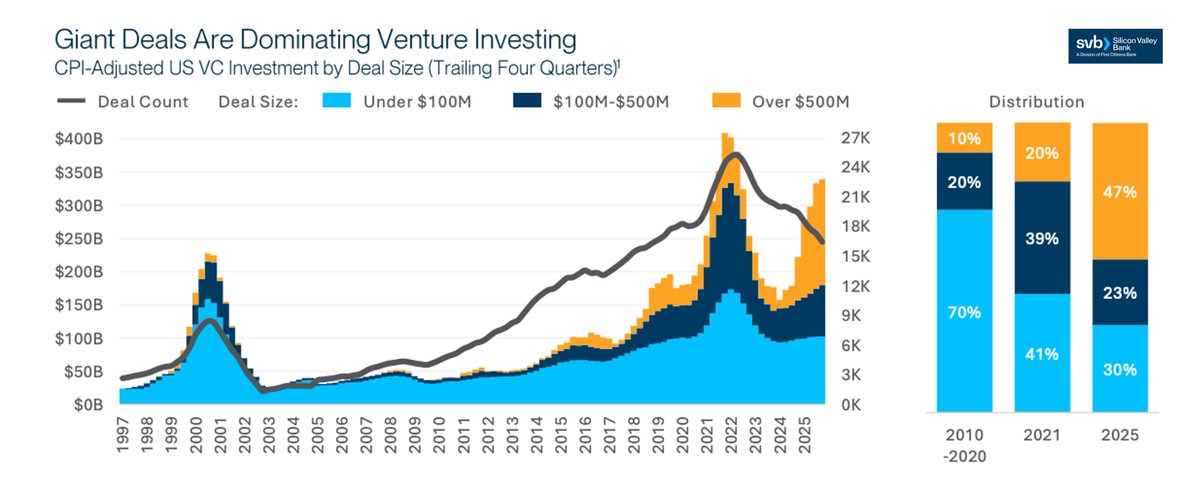
The VC market has evolved dramatically over last 15+ years as cos stay private longer. Yesterday's small/mid cap public investor is now called "venture capital." True VC has roughly doubled since 2015, while the "smidcap alt" class has grown by ≈$250B annually. (chart via SVB)
Vertical AI? Of course that’s your contention. Of course it is.
You just finished watching a Sequoia deck breakdown on “AI for Law” and now you think you’re going to disrupt Deloitte with a few fine-tuned prompts and a clever GPT wrapper.
You’ll believe that right up until next month when you crack open Sutton & Barto and start throwing around “policy gradients” like you just invented reinforcement learning, quoting enterprise API limits like they’re state secrets.
Then you’ll finally talk to a real GC or a hospital CIO and realize your “vertical AI” isn’t an LLM with a moat — it’s a brittle workflow taped together by LangChain and Zapier. You’ll start quoting HIPAA clauses, SOC2 reports, and latency budgets like gospel while your RAG pipeline silently dies because the data you need lives in some 2004 SharePoint server.
After that, you’ll get real ambitious, quoting Bessemer’s State of the Cloud and pretending you actually understand CAC:LTV ratios when your model inference costs are eating your gross margin alive. You’ll cite “fine-tuning efficiency” and “domain specificity” while your token burn rate climbs faster than your MRR.
“Well, as a matter of fact, I won’t, because Vertical AI is the next SaaS wave. Every industry gets its own copilot. The TAM is enormous—”
Right. The TAM. The slide every founder prints before they have a single paying customer. I’ve seen that movie. We called it “SaaS 2010.” It ended with 50 identical dashboards selling into the same ten budget owners.
That’s not a moat; that’s a mosh pit.
Is that your thing now? You read a16z’s “Who Owns the Vertical?” post and suddenly you’re a prophet of industry transformation?
You start throwing around words like “semantic layer,” “closed-loop feedback,” and “multi-agent orchestration” to impress LPs who haven’t logged into Notion since 2019?
One, don’t do that.
Two, you dropped a $500K pre-seed check into a wrapper app that could’ve been invalidated by a weekend of customer discovery.
“Well, at least I’m betting on founders who ship.”
Yeah, maybe. But I’m betting on founders who understand — who’ve lived the problem, who know the regulations, the sales cycles, the data formats, and the people who actually write the checks. The ones who know that “vertical” doesn’t mean “small TAM,” it means defensible domain expertise.
First principles isn’t about duct-taping a chatbot onto a workflow. It’s about asking whether this industry’s data, process, and trust layers can even support automation yet — and if so, what new infrastructure has to exist to make it real.
But hey, if you’ve got an issue with that, we can always take it up with E.
Solo founders have shot upwards since ChatGPT launched.
VCs remain more hesitant to fund them, yes. But that's less and less every year.
Data only looks at companies on Carta, which implies the startup would like to give equity to its employees even if it doesn't raise VC.