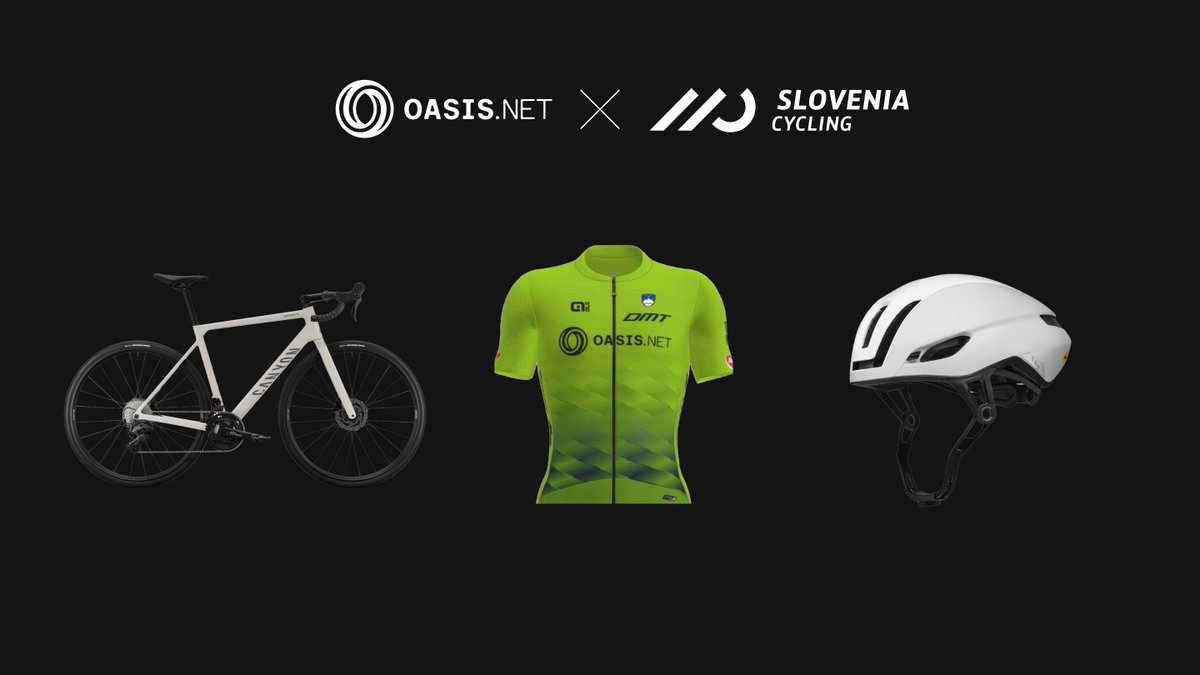
The Challenge Hub is open.
Predict cycling's biggest races, and earn a shot at a Canyon racing bike & other prizes.
Free to enter. Make your picks: https://t.co/UKmCpxCc8u
3/ The alternative is confidential inference: the model runs inside hardware where even the operator cannot read the inputs.
Not we will not look. We cannot.
For software that knows everything about you, that distinction is the whole game.
1/ Your AI assistant is becoming the most privileged software in your life. It reads your email, your calendar, your health data, your messages.
The question nobody asks: where does that context actually go the moment the model processes it?
2/ On most stacks, private means the company promises not to look. That is a policy, not a guarantee.
At inference time the data sits readable in memory, on a server you do not control. Trust is doing all the work.
Wednesday ritual: trivia night in the Oasis Discord. And the Challenge Hub is open , next race opens soon
One rewards what you know about privacy tech, the other rewards whether you can actually call a podium.
Both free to join.
3/ That is the whole difference between trust our RNG and here is the proof.
Onchain games, prediction markets, and raffles that hide the dice are asking for faith.
The ones worth playing let you check the math.
1/ Decoded: Onchain Randomness
Every raffle, every loot drop, every random winner onchain has the same problem.
If one party can predict or nudge the outcome, the game was rigged before it started.
Fair randomness is harder than it looks.
2/ The fix is verifiable randomness: a value nobody, not even the operator, can predict in advance or tamper with after the fact, plus a proof anyone can check.
You do not trust that the draw was fair. You verify it.
This week: a Decoded on how you prove a random draw was not rigged, a Thursday read on the software that already knows everything about you, and the Challenge Hub open all season. Predictions are free.
Privacy stopped being a feature request and became a design constraint.
The apps people will actually trust in a few years are the ones being built for it right now, quietly, before it is the headline.
3/ Confidential compute changes the calculus. Replace operator discretion with attested code, and the operator role becomes verifiable rather than trusted. The operator can't change the rules at runtime; they ship the rules and let the enclave execute them. Operator risk doesn't disappear, but it becomes auditable.
1/ Operator risk is the next narrative in DeFi. Every "decentralized" product has at least one operator: a sequencer, a multisig, an oracle, a frontend. When something breaks, it's almost always the operator that failed. The discourse hasn't caught up to the math yet.
2/ The trouble with operator risk is that it compounds silently. A product can ship beautifully decentralized smart contracts and still have a centralized failure mode hidden in one operator that no audit catches. Every operator is a probability of failure the user is implicitly accepting.
The Challenge Hub is open.
Predict the podiums of the season's biggest races, earn a raffle ticket for every right call, and play for a Canyon Endurance CF 5 at season's end.
Free to enter. https://t.co/W0FWGcG4hf
3/ Most "compliant DeFi" attempts default to surveillance because the cryptographic primitives feel hard. They're not. Confidential compute, attestable rules, and verifiable credentials are in production today. Compliant DeFi rails will be private by design, or they won't be DeFi.
1/ Decoded: Privacy-Preserving Compliance
The assumption is that compliance and privacy are opposites. If a regulator can audit, the user is exposed. If the user is private, the regulator is shut out. Neither is true. Compliance is a verification problem, not a surveillance one.
2/ The fix is selective disclosure plus attestation. The user proves the specific property the regulator needs (jurisdiction, KYC tier, sanctions status) without revealing the rest. The contract enforces the rule. The auditor verifies the run. Nobody sees more than they need to.