There used to be huge efforts to communicate Kaspa $kas to the broader public.
But then core leads decided they "want a change" and just forcefully appointed this weird "committee" of bumbling morons such as Eyal Yanlonka and Gilad Cohen Aviram who completely destroyed the brand, while the community was too high on copium to push back.
A year and a half later, and nobody filled the vacuum. Probably discouraged by how the last people who tried to were treated, some of them personally publicly humiliated by Sompolinsky himself.
Core devs are working their asses off for an amazing tech that hardly no one will ever know about because YS went on an ego trip and shot all the messengers. Only a bit too late did people realize that holy shit, good marketing costs good money, and just because there were people willing to do it voluntarily doesn't mean more of them are lining up. Somewhat due to how those before them were abused by Sompolinsky and Sutton, but also because Kaspa isn't the sexy new kid on the black everybody wants a piece of.
Utter leadership failure that completely destroyed an unprecedentally powerful brand (e.g. got KuCoin to list without a fee). Followed by a total lack of accountability that assures no one with actual, monetizable skills will never, ever, try to step up again. At least not without guarantees the current ecosystem can't afford to provide.
As long as S&M don't take responsibility, apologize, and defer themselves to a purely technological position. As long as Kaspa is led by a dishonest, vindictive narcissist that hasn't the slightest capacity for public discussion, Kaspa will keep struggling until it dies.
I'd have stopped caring a long time ago if I wasn't financially tethered to Kaspa via a fat bag I'm too stubborn to sell.
This stupidity is costing me money.
ALERT: 🇪🇺 6 DAYS LEFT BEFORE MiCA SHUTS THE DOOR.
The EU transition period ends July 1.
Of the 1,200 plus crypto firms that operated under old national licenses, only around 210 have secured a full MiCA license.
More than 80% are still unlicensed with days on the clock.
https://t.co/lpmiycYUBl
U know what is that? first post-quantum signature on kaspa just landed. XMSS^MT
The script is huge (~84KB) because it has to unroll a loop of ~1,650 hashings on-chain but it verifies. and it works.
isn't that cool?
toccata to everyone
🖨️ Silverscript : Rendre l'argent intelligent lisible par les humains [1/2]
Dans le Post 3, nous avons vu que Toccata donne à Kaspa un super-pouvoir : l'introspection. Mais soyons honnêtes, manipuler directement des octets et des opcodes de bas niveau (le langage machine du réseau), c'est l'équivalent de coder un site web moderne en assembleur. C'est lourd, ultra-complexe et la moindre erreur peut coûter une fortune.
C'est ici qu'entre en scène la pièce maîtresse ergonomique de Toccata, dévoilée par le core dev Ori Newman : Silverscript.
👉 Aujourd'hui, on découvre comment ce langage de haut niveau traduit nos intentions humaines en règles cryptographiques inviolables, et quelles sont ses fonctions indispensables.
_____________________________________
🛠️ De l'assembleur à la syntaxe moderne
Inspiré de CashScript, Silverscript apporte une syntaxe moderne proche du JavaScript ou du Solidity, mais adaptée à la vitesse de Kaspa.
Au lieu d'aligner des opcodes obscurs, les développeurs écrivent des structures claires avec des conditions (if/else), des fonctions, et surtout la commande require qui impose des conditions strictes pour valider une transaction.
Reprenons notre fil rouge : Bob bloque ses KAS dans le covenant en attendant sa voiture. En Silverscript, le contrat ressemble à ça :
covenant CarSale(pubkey alice, pubkey bob, int price) {
function releaseToAlice() {
require(tx.outputs[0].value == price);
require(tx.outputs[0].recipient == alice);
require(hasProofOfDelivery());
}
}
Tout le travail de traduction en opcodes machine est géré automatiquement par le compilateur.
_____________________________________
🧰 La boîte à outils indispensable du contrat
Pour faire fonctionner ce contrat (ou n'importe quelle application DeFi), Silverscript s'appuie sur quatre types de fonctions et variables absolument vitales :
🔹 L'identification (checkSig) : Même si le contrat contraint la destination de l'argent, il faut valider qui initie l'action. La fonction checkSig(signature, pubkey) vérifie cryptographiquement que la bonne personne signe la transaction (ex: Bob qui demande son remboursement).
🔹 L'introspection (tx.outputs) : C'est l'œil du contrat. Des variables comme tx.outputs[0].value permettent de scanner en temps réel la destination pour s'assurer que le montant envoyé correspond pile au prix de la voiture.
🔹 Le contrôle du temps (tx.age) : L'argent programmable a besoin d'une montre. tx.age mesure le temps écoulé depuis le blocage des fonds. C'est ce qui permet d'écrire "si 3 jours sont passés, Bob est remboursé automatiquement".
🔹 Le hachage cryptographique (sha256) : Pour prouver sans encombrer le réseau. Au lieu de stocker un gros document de livraison on-chain, on stocke son empreinte unique (le hash). La fonction sha256 vérifie que la preuve fournie correspond au hash attendu. C'est aussi la base des Swaps décentralisés de pair-à-pair avec Bitcoin.
_____________________________________
🔒 Le modèle d'état local : Le secret de la sécurité absolue
La véritable force de Silverscript réside dans son exécution. Contrairement à Ethereum et sa machine virtuelle globale (l'EVM) où tous les contrats partagent un état commun (générant des risques massifs de hacks par réentrance), Silverscript fonctionne sur un modèle d'état local.
Chaque contrat vit de manière totalement hermétique à l'intérieur d'un UTXO individuel.
Cette architecture supprime d'un coup des catégories entières de failles logiques. Les contrats ne peuvent pas interférer entre eux de façon imprévue. C'est ultra-sécurisé, déterministe, et cela préserve la rapidité phénoménale du BlockDAG de Kaspa car chaque transaction est validée en parallèle.
Suite 👇
We hear the Kaspa community and understand why dynamic address support is important. kaspa:native is technically different from Bitcoin-like UTXO networks such as BTC, LTC, DOGE, etc. Its architecture requires a separate implementation approach, so this feature cannot be added in the same way as for other UTXO-based networks.
That’s why dynamic address support is being rolled out step by step. We started with networks where the implementation of this feature is the same, while Kaspa requires additional dedicated work and validation before it can be delivered properly.
Kaspa is a priority and the team is actively working through the technical scope right now. We’re not putting a firm date on it yet because we want to deliver it right, but the Kaspa community hasn’t been forgotten and we’ll come back with concrete timing once it’s confirmed.
epilogue
Agents are helping create layers of programming languages that will help them, in turn, build end-to-end applications. Both silverscript and argent were and are being built with massive help from llms. The experience shows that they/codex are particularly good at developing compilers. (Both because there are many references of compiler code in the world, and also -- in my opinion -- because syntactic formality is natural to them).
If we were to let an agent build a complex application directly in Kaspa’s script language (=the eqv of assembly), it would wander off and stumble over countless hurdles.
But, like humans, the gradual creation of abstraction layers, here in the form of programming languages translating to each other in a formal way, allows us to formalize the transition from business logic to final code. The abstraction layers become the braces. Humans and agents forge them together, and then both can use them to move more safely from business logic toward raw executable code.
prologue
Taking my dr.’s (Sompolinsky) advice to rest a bit and have fun after Toccata’s release, I started experimenting with argent: a small high-level DSL for multi-contract covenant apps that produces silverscript code.
Please don’t laugh at this definition of “rest” ;) Releasing heavy core consensus upgrades carries a massive burden of mainnet responsibility. Playing with language compilers and application structure is exploratory work. So yes, for some ppl, it might genuinely feel like resting.
---
About three months ago, during the development of Toccata and silverscript, Ori (@someone235) threw a quick sentence at me: “You can implement a mechanism similar to MAST using ICC.”
(Stay with us if you want to understand what MAST is and why Ori was only partially right.)
Around that time, I started playing with complex scripts over silverscript and mostly tried to understand what a complex contract system over the new Kaspa script engine/silverscript could look like (or if one could be built at all). One thing led to another and I started trying to develop a chess game over silverscript. “okay codex, let’s start developing chess, let’s start with a chess game with basic movement rules, no complications. An array of 64 cells representing the board, public keys for black/white, turn, movement. The bare minimum that is still sufficiently complex.”
Of course, the first attempt didn’t go so well. As is fitting for a compiler in its early days, I quickly reached a state where I was the first one walking through certain code paths. This triggered a burst of contributions to silverscript itself and/or finding temporary workarounds.
The second attempt got stuck on the boundaries of the script itself. It turns out that implementing all the game rules for every possible piece plus scan loops statically unrolled to 64 iterations is, how should I put it, not really workable and tends to blow up. I came to the conclusion that the logic needed to be shattered into different contracts, meaning different scripts.
But how do you do that within the boundaries of a game? And what if I want to implement a decentralized chess league with players and scores that persist and update over time?
(By the way, chess is a complex and interesting test case for development, but don’t mistakenly think for a second that this discussion is limited to or aimed at games.)
>>
Kaspa behaves like a dissipative structure at the consensus layer: an open system held far from equilibrium by continuous external energy flow. Hashrate is the incoming energy gradient. Miners consume electricity, perform irreversible proof-of-work, and inject candidate blocks into a globally distributed network. That network is not clean or synchronized. It has propagation delay, regional topology, bandwidth asymmetry, mempool variation, adversarial behavior, and stochastic block discovery. These conditions create turbulence. Honest miners will frequently discover valid blocks before hearing about each other’s blocks, especially at high block rates. In a linear chain, that parallelism becomes structural waste because the protocol must suppress block production relative to network latency so that only one branch survives cleanly.
Kaspa does not suppress the turbulence. It organizes it. The blockDAG is the visible structure produced by this nonequilibrium process. Each block references multiple parents, carrying local knowledge of the network’s recent past. GHOSTDAG then extracts order from that messy geometry by distinguishing well-connected honest blocks from poorly connected or adversarial blocks. The blue-set and k-cluster logic function like a stability filter: blocks that fit the cooperative propagation pattern are pulled into the ordered body of consensus, while outliers are pushed later in ordering. This is why Kaspa is not merely fast proof-of-work. Its speed comes from a different thermodynamic posture. Instead of treating latency-induced parallelism as failure, it turns latency into a consensus signal. The disorder is not erased; it is metabolized into structure.
The fixed supply and emission schedule act as boundary conditions. They define the monetary container. But the living process is the continual conversion of external energy, network noise, and probabilistic miner activity into irreversible settlement time. Every accepted ordering is a scar left by burned energy and resolved uncertainty. Kaspa is therefore best framed as a far-from-equilibrium monetary structure: energy flows in, entropy is produced, blocks collide, and GHOSTDAG turns that collision field into ordered digital finality.
🔥 RustyKaspa v2.0.1 est officiellement disponible sur le Mainnet !
C’est une mise à jour cruciale en pleine dernière ligne droite avant le hard fork Toccata (prévu pour le 30 juin). L'équipe livre ici des améliorations très concrètes pour solidifier le réseau :
⚙️ Support Toccata & Covenants : Optimisation des preuves cryptographiques liées aux covenants et alignement avec la nouvelle architecture.
🛡️ Stabilité du réseau : Améliorations directes sur la synchronisation et la résilience des nœuds.
🛠️ Outils Dev : Nouvelles fonctionnalités de génération de transactions et d'inspection avancée des bases de données.
💼 Raffinements Wallets : Meilleure gestion des covenants pour les clients et les portefeuilles.
🔄 Ce qu'il faut retenir sur la méthode :
L’équipe technique change de rythme et passe à un cycle de livraisons plus courtes mais beaucoup plus fréquentes.
En clair : Finies les longues attentes, les optimisations arrivent désormais en flux tendu et plus rapidement chez les opérateurs et les développeurs.
📈 C'est un excellent signal. Le travail de transition vers Toccata avance de façon ultra-régulière, chirurgicale et structurée.
⚠️ Avis aux opérateurs de nœuds (Mainnet) : Il est temps de passer à la mise à jour !
#Kaspa #Toccata
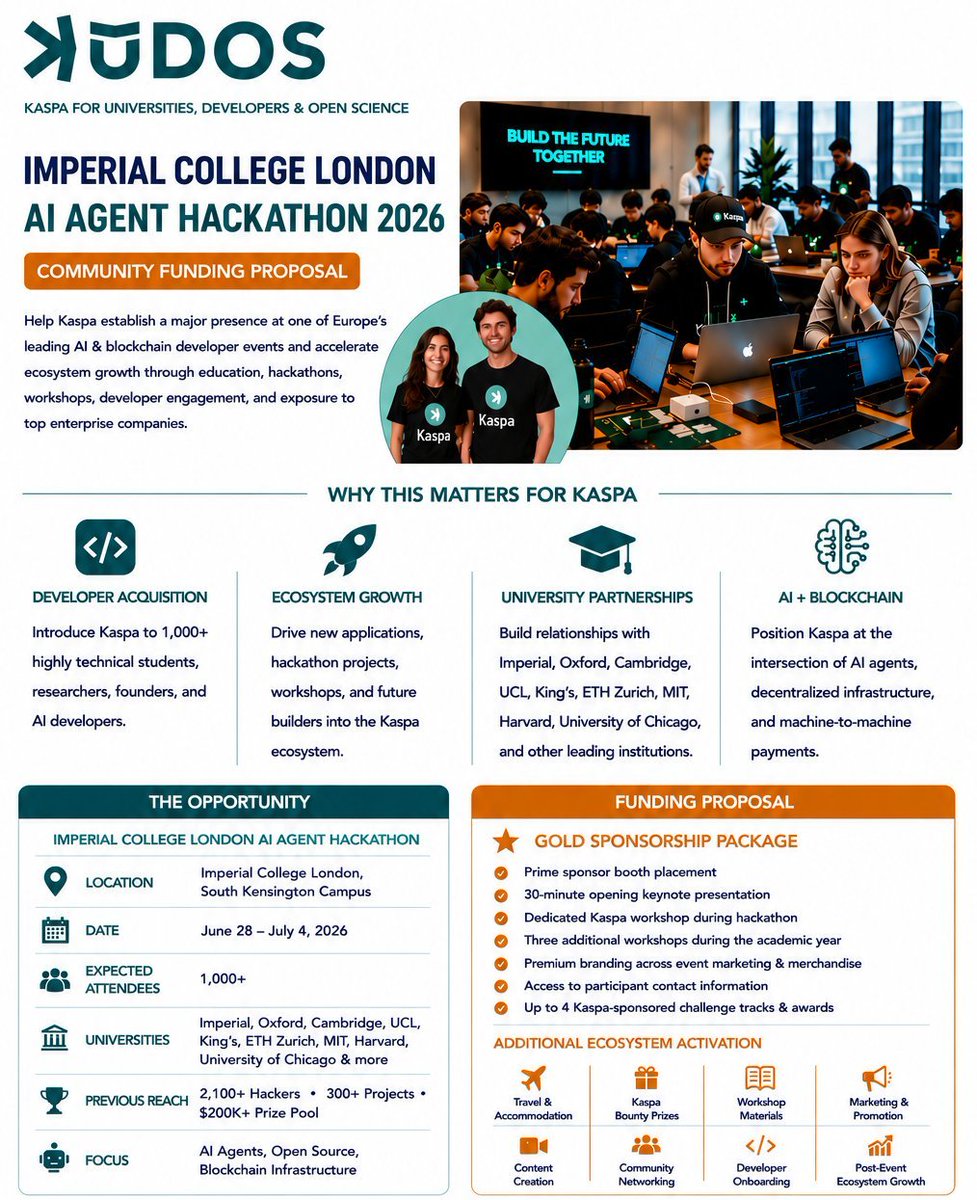
The fundraiser to get #Kaspa at Imperial College London has reached its $8,000 milestone!
Its great to see the $KAS donations coming in: 138 transactions so far.
We are happy to have reached enough funds and can go to Imperial to create awareness about Kaspa.
The funds upto $10,000 will be used for the streched goals for additional visibility including merchandise.
ps. If it happens to be the case that the donations keep going and we reach Silver, a lot more can be done even. Silver includes a booth and a 30-minute keynote talk during the opening and closing ceremony as awell as a bounty for the hackaton. That will increase the exposure a lot.
We do expect to be signing off with the organizers coming week. If so, we will ofcourse give another update.
To donate visit https://t.co/evk0x5h9G3 for the details or use:
kaspa:qrryda035xkx02l7yg7lx65ct89zk6ku2greszt475rvn80z6ydkyy9q3zl8r
🚨 Anthropic a annoncé avoir reçu une directive du gouvernement américain lui imposant de suspendre l’accès à ses modèles Fable 5 et Mythos 5 pour les ressortissants étrangers. L’annonce est beaucoup plus importante qu’elle n’en a l’air.
➡️ Cette restriction ne vise pas seulement des utilisateurs situés hors des États-Unis mais pourrait aussi concerner des étrangers vivant aux États-Unis, voire des employés étrangers travaillant directement chez Anthropic. Impossible de filtrer proprement tout cela en urgence, donc Anthropic explique devoir couper l’accès à ces modèles pour l’ensemble de ses clients.
⚠️ C’est potentiellement un moment charnière pour toute l’industrie de l’IA. Jusqu’ici, les États-Unis contrôlaient surtout les briques physiques de l’IA mais là, on passe à l’étage supérieur puisque le modèle lui-même devient une technologie stratégique au même titre que certaines technologies de défense, de cybersécurité ou de calcul avancé.
🧐 Officiellement, le sujet est la sécurité nationale. Le gouvernement américain craindrait qu’un jailbreak permette d’utiliser Fable 5 pour identifier des failles logicielles. Franchement, personne ne peut balayer cet argument d’un revers de main. Mais là où l’affaire devient bien problématique, c’est qu’Anthropic explique ne pas avoir reçu d’explication technique précise, et conteste la gravité du risque.
🤔 Si un jailbreak limité suffit à justifier la suspension d’un modèle entier, alors soyons francs, tous les grands modèles avancés deviennent potentiellement bloquables. Aucun modèle n’est parfaitement robuste, aucun système d’IA n’est impossible à contourner, donc si le standard réglementaire devient “il existe une faille, donc on coupe”, alors on entre dans un monde où l’accès aux modèles ne dépend plus seulement de leur performance, de leur sécurité ou de leur adoption commerciale, mais aussi d’une décision administrative prise à très haut niveau.
🤭 Le plus ironique est qu’Anthropic n’est pas vraiment l’acteur le plus libertarien du secteur. C’est même l’un des labs les plus favorables à l’encadrement de l’IA, à la sécurité des modèles et à une forme de régulation responsable.
1️⃣ Pour les entreprises clientes, le message est aussi assez brutal car un modèle sur lequel vous construisez vos produits, vos workflows ou vos outils internes peut devenir indisponible du jour au lendemain pour des raisons réglementaires ou géopolitiques. Cela va probablement pousser encore plus d’acteurs à diversifier leurs fournisseurs, à renforcer leurs architectures multi-modèles, à garder des alternatives open source ou souveraines, et à ne pas dépendre d’un seul lab américain, aussi puissant soit-il.
2️⃣ Pour les investisseurs, c’est également un signal très important. La valeur dans l’IA ne va pas seulement se jouer sur le meilleur benchmark, le meilleur raisonnement ou la meilleure interface utilisateur. Elle va aussi se jouer sur la capacité des acteurs à gérer la conformité, la sécurité nationale, les relations gouvernementales, la distribution internationale et la confiance des grandes entreprises. En clair, la prime de valorisation ne sera pas uniquement donnée aux modèles les plus performants mais aux acteurs capables de rester déployables à grande échelle dans un environnement réglementaire de plus en plus dur.
🤷♂️ À long terme, je trouve que l’annonce reste bullish parce qu’elle confirme que les modèles deviennent tellement puissants qu’ils sont désormais traités comme des actifs stratégiques. Mais c’est bien bearish pour l’idée naïve d’un marché mondial de l’IA totalement ouvert, fluide et accessible à tous.
On entre dans une phase beaucoup plus sérieuse, beaucoup plus géopolitique, et probablement beaucoup plus fragmentée. Comme je l’ai déjà écrit.
Kaspa's biggest challenge is not the technology, it’s that the market hasn't figured out how to value it yet.
Crypto in general is very good at pricing narratives and very much worse at pricing infrastructure.
The market can quickly understand memes, hype, and speculation but how do you value a network that's focused on throughput, decentralization, security, and long term scalability?
You usually don't.
At least not until it's already obvious and that’s why I find Kaspa so interesting.
The debate isn't whether people know it exists.
The debate is whether they understand what they're looking at right now.
My $kas bags are still very solid and untouched 🫡
#kaspa $kas
Thrilled to host @asaefstroem, a protocol developer and ZK engineer, author of KIP-16, ZK verification opcodes in Kaspa L1.
He will deliver a talk "A Path Down Covenant Road: What Covenants & ZK Unlock on Post-Toccata Kaspa" at our Kaspa x Igra day, June 19 at Berlin Blockchain Week.
Register here: https://t.co/r29TfrviwR
Every smart contract chain - Ethereum, Solana etc, make apps share one computer. One app lags, everyone lags. Kaspa's Toccata upgrade (testnet now, mainnet this month) does it differently: every app gets its own lane. No traffic jams. Real time decentralization #rtd
First meeting with @hus_qy where he will explain the vision for vProgs, the next major milestone for #Kaspa, and where the community can interact.
What are vProgs? Sovereign dApps, with their own state, sequenced by Kaspa L1, that perform the heavyweight calculations and send a ZK proof to L1.
Each application resides in its own logical zone with its own rules: gas model, state growth parameters, and incentives.
No application can corrupt the state of another.
vProgs achieves a perfect combination of atomicity and sovereignty. Can you imagine depositing an asset in one protocol or contract, taking out a loan in another, and buying an asset in yet another, all in the same transaction, at the speed of light, and over a PoW network?
This is part of the next milestone for #Kaspa.
Remember that #Kaspa is pure POW, achieving what no one has achieved before: scaling the Nakamoto consensus and giving it high-level expressiveness and programmability.
You don't need to be a Kaspian to attend, just a curious person who wants to see firsthand what's being built by the most innovative decentralized network in the entire ecosystem.
You're invited!
https://t.co/vkxrKtmHos
Introducing Claude Fable 5: a Mythos-class model that we’ve made safe for general use.
Its capabilities exceed those of any model we’ve ever made generally available.
since many (~4) asked me about the zcash bug - - - earlier this year I had this convo with a zcash core dev:
zk: it's weird that kaspa is pruning past records
me: why does it need to keep 'em?
zk: the whole point of ledgers is to prove correctness of all state transitions
me: the whole point of ledgers is to provide focal points for the consensus state
zk: the whole point...
me: hmm then why did you come work in zcash? you know the Sprout->Sapling counterfeiting bug
zk: Turnstile guarantees that the counterfeit could have been very limited
me: true but you still cannot prove or even reason about correct state transitions besides the total supply cap
zk: that's actually a good point
----
the most hardcore cryptography coin is shifting away from correctness proofs to practical-enough proofs. I believe this is a step in the right+practical direction, yet the paradigm shift should not go unnoticed - -cryptography is giving way to consensus.
if you came to zcash for cryptographic integrity, reconsider. there are many good reasons to root for zcash prospering. zcash is serving a more important role than bitcoin, whose utility for the original mission is by now blurry. cryptographic integrity is/should not be one of those reasons.
----
BTW the bug should definitely have been exploited. I don't know the personal values of Taylor Hornby, and I shouldn't be required to make the effort to learn them. I only know that if I found such an exploit, it wouldn't take me more than a few minutes to tempt myself into printing a longint amount of ZEC and deciding later what to do with it.
I wouldn't necessarily use it to exit the pool immediately and corrupt the supply, I'd wait to see if some portion of the broken pool does not seem to migrate on time (probably lost funds), in which case I would not think twice before claiming the funds myself.
you could argue that no harm done, and you might be right, but then again you are here -- in zcash / in crypto -- for its consensus dynamics, the ability to coordinate interests and convictions across different trust zones around some shared asset; not for some pristine mathematical integrity.



![Wevn_Space's tweet photo. 🖨️ Silverscript : Rendre l'argent intelligent lisible par les humains [1/2]
Dans le Post 3, nous avons vu que Toccata donne à Kaspa un super-pouvoir : l'introspection. Mais soyons honnêtes, manipuler directement des octets et des opcodes de bas niveau (le langage machine du réseau), c'est l'équivalent de coder un site web moderne en assembleur. C'est lourd, ultra-complexe et la moindre erreur peut coûter une fortune.
C'est ici qu'entre en scène la pièce maîtresse ergonomique de Toccata, dévoilée par le core dev Ori Newman : Silverscript.
👉 Aujourd'hui, on découvre comment ce langage de haut niveau traduit nos intentions humaines en règles cryptographiques inviolables, et quelles sont ses fonctions indispensables.
_____________________________________
🛠️ De l'assembleur à la syntaxe moderne
Inspiré de CashScript, Silverscript apporte une syntaxe moderne proche du JavaScript ou du Solidity, mais adaptée à la vitesse de Kaspa.
Au lieu d'aligner des opcodes obscurs, les développeurs écrivent des structures claires avec des conditions (if/else), des fonctions, et surtout la commande require qui impose des conditions strictes pour valider une transaction.
Reprenons notre fil rouge : Bob bloque ses KAS dans le covenant en attendant sa voiture. En Silverscript, le contrat ressemble à ça :
covenant CarSale(pubkey alice, pubkey bob, int price) {
function releaseToAlice() {
require(tx.outputs[0].value == price);
require(tx.outputs[0].recipient == alice);
require(hasProofOfDelivery());
}
}
Tout le travail de traduction en opcodes machine est géré automatiquement par le compilateur.
_____________________________________
🧰 La boîte à outils indispensable du contrat
Pour faire fonctionner ce contrat (ou n'importe quelle application DeFi), Silverscript s'appuie sur quatre types de fonctions et variables absolument vitales :
🔹 L'identification (checkSig) : Même si le contrat contraint la destination de l'argent, il faut valider qui initie l'action. La fonction checkSig(signature, pubkey) vérifie cryptographiquement que la bonne personne signe la transaction (ex: Bob qui demande son remboursement).
🔹 L'introspection (tx.outputs) : C'est l'œil du contrat. Des variables comme tx.outputs[0].value permettent de scanner en temps réel la destination pour s'assurer que le montant envoyé correspond pile au prix de la voiture.
🔹 Le contrôle du temps (tx.age) : L'argent programmable a besoin d'une montre. tx.age mesure le temps écoulé depuis le blocage des fonds. C'est ce qui permet d'écrire "si 3 jours sont passés, Bob est remboursé automatiquement".
🔹 Le hachage cryptographique (sha256) : Pour prouver sans encombrer le réseau. Au lieu de stocker un gros document de livraison on-chain, on stocke son empreinte unique (le hash). La fonction sha256 vérifie que la preuve fournie correspond au hash attendu. C'est aussi la base des Swaps décentralisés de pair-à-pair avec Bitcoin.
_____________________________________
🔒 Le modèle d'état local : Le secret de la sécurité absolue
La véritable force de Silverscript réside dans son exécution. Contrairement à Ethereum et sa machine virtuelle globale (l'EVM) où tous les contrats partagent un état commun (générant des risques massifs de hacks par réentrance), Silverscript fonctionne sur un modèle d'état local.
Chaque contrat vit de manière totalement hermétique à l'intérieur d'un UTXO individuel.
Cette architecture supprime d'un coup des catégories entières de failles logiques. Les contrats ne peuvent pas interférer entre eux de façon imprévue. C'est ultra-sécurisé, déterministe, et cela préserve la rapidité phénoménale du BlockDAG de Kaspa car chaque transaction est validée en parallèle.
Suite 👇](https://pbs.twimg.com/media/HLetkD9aUAAd3JR.jpg)