Think about how many different platforms we use just to manage everyday life.
One for learning, another for healthcare, and several more for work and career development. The information gets scattered, and connecting everything becomes another task on its own.
What caught my attention about @cere_bree is its 4Core DNA vision.
Instead of treating these areas as completely separate experiences, CereBree aims to connect enterprise, healthcare and individual intelligence through one ecosystem, with Cognie at the center.
And $CRX has a role beyond simply being a token. Its intended utility includes platform payments such as subscriptions, credits and one-time purchases, alongside access tiers and participation rewards.
I find the bigger idea interesting: building an ecosystem where different parts of life can work together rather than making users jump between disconnected platforms.
The real test will be how smoothly these connections work in everyday use.
One ecosystem, multiple needs. That’s an approach worth watching.
@Cere_Bree
Managing multiple wallets and networks gets messy when you have to check everything separately.
That’s where @perptools makes a difference.
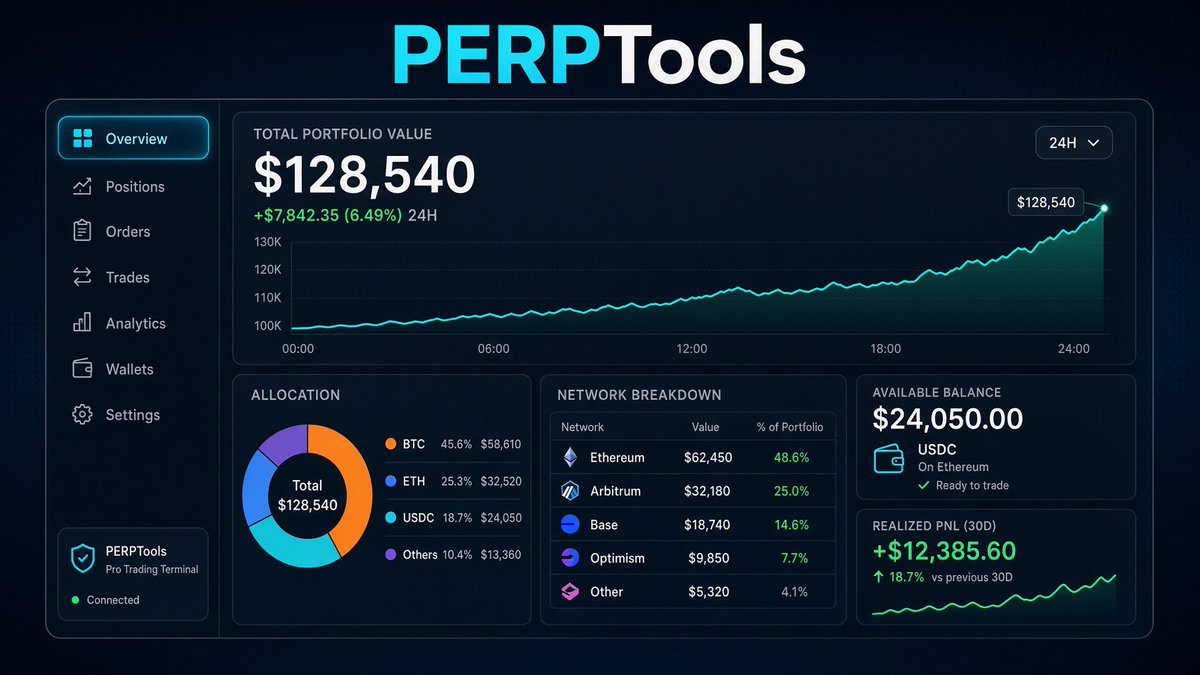
It brings your entire portfolio into one dashboard, showing total value, realized PnL, and available balance side by side.
Spot and perps stay under the same view, making it easier to track your positions and understand where you stand before entering your next trade.
No more switching between tabs just to find the numbers you need.
Less time managing dashboards, more focus on trading.
Try it here: https://t.co/DTZEL9sdEK
@perptools
One thing that always bothered me about online games is how players are expected to trust every random result.
You roll the dice, open a loot box, or play a crash game, but how do you really know the outcome wasn’t manipulated?
This is where @quipnetwork caught my attention with QVRF.
It uses quantum hardware to generate random numbers and makes the results independently verifiable.
The interesting part is how it works. Before anyone requests a draw, a Merkle root is committed to Ethereum. After the draw, people can check the proof against that earlier record.
So if someone questions a particular result, there’s something public they can actually look at instead of just trusting the game operator.
Quantum Echoes has already used this approach, with each reveal coming from a QVRF draw committed before the request.
I like the idea because fairness shouldn’t depend entirely on what a platform tells its users. Players should have a way to check things for themselves.
There’s still more to explore across the Quip ecosystem, but this is one feature I find genuinely interesting.
Would you trust a game more if you could verify every random result yourself?
https://t.co/HAv0hjfZEs
Good morning guys
Something people might be overlooking in the AI race is that having money to build data centers doesn’t mean you can get them running quickly.
Power availability is becoming a serious bottleneck. In some markets, new data centers can wait years just to get access to the electricity grid.
Meanwhile, @Acurast is approaching computing from a completely different direction.
There are already 360K+ phones on its network running workloads.
Instead of waiting for more massive data centers to become available, Acurast is putting existing smartphone hardware to work as distributed computing infrastructure.
What I find interesting is the shift in perspective.
We’ve spent years treating smartphones mainly as devices that consume computing services. Now they’re becoming part of the infrastructure that provides those services.
I don’t think smartphones will replace every data center, but they could become a meaningful part of how the next generation of compute is delivered.
Sometimes the next computing resource isn’t something we need to build from scratch. It’s already sitting in people’s pockets.
@Acurast
Explore Acurast through my invite:
https://t.co/ZeUR6w0gLW
Sharing patient records between hospitals isn’t just about moving data. It’s about making sure the right people have access to the right information, with permission.
Imagine a patient allowing one researcher to access their scans for a specific study, without giving unlimited access to their entire medical history.
That’s where @Cere_Bree’s approach gets interesting.
Through Oracle Blockchain Platform, consent, data provenance and access activity can be tracked while sensitive medical records remain off-chain.
The goal isn’t to put private health data on a blockchain. It’s to make access more transparent and accountable.
As healthcare becomes more connected, shouldn’t patients have more control over how their data is shared?
Official docs: https://t.co/B8jx7RtQdO
I wanted to understand how QuipSwap works without risking any real assets, so I decided to try Paper Mode on @quipnetwork.
The process was pretty straightforward.
I opened a practice listing, checked what the maker was offering and what they wanted in return, then took the other side of the trade.
One signature later, I checked the Points page and found 1 QP waiting there.
The interesting part? No gas fees, no assets moved, and no change to my wallet balance.
That’s what makes Paper Mode useful. You can get familiar with the entire order book flow before trying a real swap.
Live swaps follow the same listing process, but assets only move after the maker accepts and both sides complete the on-chain commitment.
You can earn 1 QP per qualifying paper swap, up to 5 per day. Just make sure to check the current quest card for the exact rates.
If you haven’t tried it yet, here’s the listing page:
https://t.co/HAv0hjfZEs
Curious to know, what’s the first listing you came across? What did you need to give and what could you receive?
One screen that shows every wallet and every network at once changes how you size the next trade.
You see total value, realized PnL, and available balance sitting next to each other. No more opening three tabs to check if the last ETH perp fills are still green before you add size.
The dashboard keeps spot and perps under the same view, so the decision is right in front of you instead of behind another click.
Less time hunting numbers. More time on the actual entry.
Try it here: https://t.co/DTZEL9sdEK
@perptools
I checked my @Acurast Processor dashboard today, and there’s something interesting about what I’m seeing.
My current balance is 1.41 ACU.
The phone is showing:
→ Compute Status: Active
→ Last heartbeat: 21 seconds ago
→ Attestation: Verified
→ Deployments: None currently scheduled
One thing I find interesting is that my phone can remain active and attested even when there’s no deployment scheduled at that moment.
That distinction matters.
Being connected to the network and being assigned an actual computing workload are two different things.
Acurast also has a base reward mechanism for eligible online and attested Processors, while assigned workloads can contribute additional reward weight.
I’m using the Processor Lite setup, so I don’t need to factory reset my everyday phone or remove my personal apps and data.
It just stays connected and makes its computing power available when needed.
I like that I can check the status myself and see what’s happening instead of simply assuming my phone is contributing.
Still exploring how far this can go, but giving an everyday smartphone a role in decentralized computing is a pretty interesting idea.
Want to try it with your own phone?
@Acurast
Join through my invite:
https://t.co/ZeUR6w0gLW
One thing about job hunting that often gets overlooked is understanding why a role isn’t the right fit yet.
You might have the experience, but still be missing a few skills that employers are looking for.
That’s where @Cere_Bree uWork gets interesting.
From AI Resume Analysis to Smart Job Matching and Skill Gap Analysis, the idea is to help people understand where they stand before deciding what to work on next.
I like the fact that it connects finding opportunities with actually preparing for them.
If you’re planning your next career move, give uWork a try. Upload your CV, explore relevant roles, and see where you can improve.
https://t.co/X7dTUHXPsz
@Cere_Bree
I used to think connecting my wallet to a new security network would automatically protect everything inside it.
But that’s not how @quipnetwork works.
Connecting your existing wallet is just the starting point. Quip creates a separate account address on the same chain, and that’s where things get interesting.
Your original wallet stays exactly as it is. Any assets sitting there still follow the same security rules as before.
The extra protection only applies to assets you move into your new Quip Account.
On EVM chains, Quip adds a post-quantum SHRINCS signature alongside the regular ECDSA signature. So moving funds out requires both signatures.
Your original wallet still handles transactions and gas fees, but the additional signature acts as another security layer.
One thing worth understanding here: upgrading one address doesn’t automatically secure every address connected to the same wallet.
You get to decide which assets you want to put behind that extra layer of protection.
The process is pretty straightforward:
→ Connect your existing wallet
→ Create your Quip Account
→ Save the new wallet address
→ Move the assets you want to protect
No chain switching. No bridge required.
I like this approach because you don’t have to move everything at once. You stay in control of what gets additional protection.
If you’re exploring post-quantum wallet security, it��s worth understanding how this works.
Start here: https://t.co/HAv0hjfZEs
@quipnetwork
Job hunting can feel frustrating when you have skills but struggle to find the right opportunities.
Sometimes the problem isn’t a lack of potential. It’s knowing how to present your experience and where it actually fits.
That’s what makes @cere_bree’s uWork interesting to me.
The idea of connecting your skills, career growth, and relevant job opportunities in one place could make the process a lot more focused.
If you���re exploring your next career move, upload your CV and see what uWork can help you discover.
https://t.co/X7dTUHYni7