@RobSchneider@AnikaWells The wildest thing for me is that she just suddenly appeared out of nowhere, appointed by the “CONSERVATIVE” PM Turnbull. She was never elected. Nobody ever asked for this. Just unbelievable.
@DrewPavlou and I'm sure the Gadigal clan's ancestors who are demanding "their land" back today can all trace their lineage back to those 50-80 people perfectly & without discrepency, too...
@Caneable1978@KatyKray73 No he’s a “traditional custodian of the land,” so, I guess that means he tends to gardens, cuts the grass, sweeps sidewalks etc. 😆
@Roadman_Podcast Same reason there’s significantly smaller pay, if any, for male athletes in lower grades. They’re not at the cutting edge of human performance. Therefore, fewer people watching. Therefore, less sponsorship money. It’s very simple!
One of Ayn Rand's very best observations, which has aged like fine wine:
"Socialism is not a movement of the people. It is a movement of the intellectuals, originated, led and controlled by the intellectuals, carried by them out of their stuffy ivory towers into those bloody fields of practice where they unite with their allies and executors: the thugs."
@spikedonline You discount the existence of gay men in genuinely loving, long-term relationships. It might start being all about sex, but just as in straight relationships, it grows into something deeper with the right person. That's what we all want at the end of the day, no?
@Lisa9Sophia “us”? You’re just as tribal as she is if you think you’re somehow responsible for what individuals did hundreds of years ago because you happen to have the same skin colour.
@Anthonywodillon The Yes activists seem to have a very outdated view of the Australian demographic. Blaming the white people is to ignore the vast multicultural scope of Aus society in 2023. In reality, the “white people” were probably more likely to vote Yes!
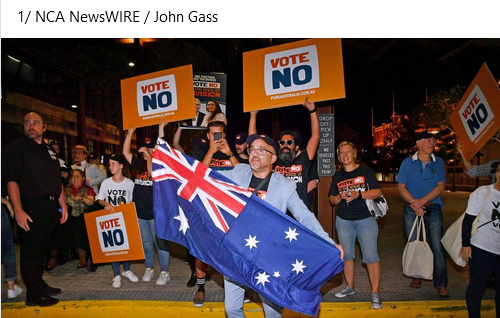
No result was an act of insurrection against the progressive establishment
Nick Cater The Australian October 16, 2023
If there were ever any doubts Australia had made the right decision on Saturday, they were quickly put to rest by a group of Indigenous leaders who released a statement later that evening. The statement blamed “newcomers” who had refused to acknowledge “that the brutal dispossession of our people underwrote their every advantage in this country”.
“That people who have only been on this continent for 235 years would refuse to recognise those whose home this land has been for 60,000 and more years is beyond reason.”
The oldest person in Australia is Catherina van der Linden, who celebrated her 111th birthday in August. She arrived as a hardworking migrant from The Netherlands in 1958 and has never dispossessed anyone or anything, as far as we know. The prosaic truth that no one currently alive occupied this continent much more than a century ago explains why many Australians regarded the voice as unjust. Saturday’s result was a repudiation of the black-armband approach to history.
Australians outside the Tesla zone have told the elite they’ve had enough of the national guilt trip. They’re sick of the self-flagellating speeches, national apologies, welcome to country and all the other politically correct performances.
It is a call to let bygones be bygones, recognising the pursuit of historical grievances springs from the same unforgiving logic that justifies the Palestinian cause.
Above all, it is a rejection of the insufferable arrogance of the anointed and their presumption of superior wisdom and morality. The No vote amounts to an act of insurrection by outsiders against the progressive establishment.
That much is evident from the wide variation between comfortable inner metropolitan electorates and outer metropolitan and regional seats. As a rule of thumb, the higher the support for the referendum proposal, the harder it is to find a tradie. In the seat of Flynn, which centres on Gladstone in central Queensland, almost one in five people has a trade certificate. In the seat of Melbourne, on the other hand, the tradies make up just 5 per cent of the population. The latest counting shows that 78 per cent of voters in Melbourne voted yes while 84 per cent in Flynn voted no.
The pattern is reversed for university graduates. In the 33 electorates where the vote was running in favour of the voice at the close of Saturday night’s count, one in three residents has a graduate or higher degree. In the No seats, it is one in six.
At its heart, the voice was an intellectual project framed around an abstract concept of Aboriginal and Torres Strait Islander Australians rather than a practical measure designed to improve everyday lives. People declaring themselves Indigenous account for 1.5 per cent of the population in the Yes seats. In the No seats, it is 4.8 per cent.
The five seats with the largest proportion of Indigenous residents – Lingiari (40.3 per cent), Parkes (16.4 per cent), Leichhardt (16.3 per cent), Durack (15.2 per cent) and Kennedy (14.8 per cent) – voted no by an average of 71 per cent. The results in the five electorates with the smallest Indigenous population – Goldstein (0.2 per cent), Chisholm (0.3 per cent), Bradfield (0.3 per cent), Kooyong (0.3 per cent) and Higgins (0.3 per cent) – averaged 56 per cent in favour.
That doesn’t mean all Aboriginal people were against the voice any more than we can assume every tradie voted no. Indigenous people were split, despite the hubris of the Indigenous elite in their references to “our people”.
The intelligentsia may find it impossible to concede defeat on anything more than a technical amendment to the Constitution. The Indigenous leaders’ unsigned statement on Saturday hinted darkly at “the role of racism and prejudice against Indigenous people”. They said Australians who voted no should “reflect hard on this question”.
Pointing the finger at the “dinosaurs” and “dickheads” who populate the morally bankrupt land on the other side of the argument offers an easy way out for the voice crusaders. They will not have to dwell on the uncomfortable truth that the result is a rejection of their entire vision of the world, in which Indigenous Australians sit on a higher moral plane, as people who have been wronged by others, who deserve to be redressed.
The Sydney Morning Herald got it badly wrong in a headline on Sunday. “Devastating verdict,” it read. “Australia tells First Nations people ‘you are not special’.” The overwhelming sentiment among No voters was the very opposite.
“They have said no to grievance and the push from activists to suggest that we are a racist country when we are absolutely not a racist country,” Jacinta Nampijinpa Price said on Saturday. “We are all part of the fabric of this nation.”
The founding philosophy of modern Australia, 19th-century liberalism rooted in Christianity, holds that every person is unique, just as all lives matter. No one, however, is more special than anyone else.
On Saturday, Anthony Albanese finally hit the right tone in a speech expressing optimism and a “new national purpose”. The referendum offers a mandate for just that, should the PM have the courage to take it.
Albanese should recognise the result as a call for the end to the policy of separatism that began under Gough Whitlam and has yet to be challenged. The self-determination policy, as it was called, was intended to empower Aboriginal and Torres Strait Islander people by granting them control of settlements where they might practice their traditional customs.
The descent of these Rousseauean-inspired idylls into welfare sinkholes riddled with social dysfunction was immediate and is now all but irreversible. The most tragic mistake was the assumption that Aboriginal people held abnormally strong communal values that rose above the wishes of any individual. The free market barely operates across much of central and northern Australia.
Adopting capitalism may have brought a couple of billion people out of poverty in the last 30 years, but in large parts of remote Australia, it is effectively banned.
Saturday’s result provides an opportunity to liberate Aboriginal Australians from the debilitating assumption that they are victims from birth. It is a chance to break the tyranny of low expectations. Every Indigenous citizen should be able to exercise their full rights as citizens to alter the course of their lives for good or ill.
Nick Cater is senior fellow at the Menzies Research Centre.