A surprisingly popular orthodontic blog written by orthodontic researcher/clinician and Emeritus Professor of Orthodontics at the University of Manchester UK.
Thoughts and Reflections about our profession
In this guest blog, Dr. Bjorn Ludwig reflects on the evolution of our profession. He effectively outlines several challenges and concludes with some intriguing ideas on how we can progress.
https://t.co/tSv7geZFGB
Non-nutritive sucking habits (NNSH) with pacifiers are common among young children, with an incidence of 82%. Those of us fortunate enough to have children will know the value of a pacifier. But do they cause malocclusion?
https://t.co/z48o3C621s
Let us talk about Mewing?
This new post is about " Mewing” which has been gaining popularity in the media lately. My 11-year-old granddaughter showed me Mewing she was amazed that I knew anything about it! This is what I think. https://t.co/zUJWWBKjHq
#Mewing#orthodontics
Several papers published over the past year have shown that Invisalign may not achieve all intended tooth movements. Limited research has been done into the effectiveness of clear aligners in torquing incisors. A new paper addresses this question.
https://t.co/zDY3OlzxXY
I've got fed up with Twitter and I cannot support it any longer. I have switched to BlueSky, which is gaining momentum. @koborthodonticblog.bsky.social https://t.co/QxHjfhZYOA
Does Diamond status make me better than you?
This guest post by Dr. Dhru Shah provides valuable insight into the incentives for providing specific treatments. His comments are highly relevant to the current incentive systems in orthodontics.
https://t.co/n1VCKENq4m
LightForce makes claims using dodgy evidence?
In a previous post, I discussed LightForce making unsupported claims without independent, high-quality research. Since then, LightForce has updated its study. Here is what I think about it.
https://t.co/oHft8668aB
A development in clear aligner treatment is Dental Monitoring, a form of teledentistry that enables the operator to monitor treatment remotely. This new paper looks at the standard of treatment with remote monitoring.
https://t.co/y2AxY9qpIY
We all know that treating anterior open bites (AOBs) can be pretty challenging.
Several reports of successful treatment of anterior open bites with aligners have recently been published. This new paper sheds some light on how this is achieved.
https://t.co/Emxqqj7uWQ
Some orthodontists promote orthodontic treatment as a way to manage children's breathing problems. The American Academy of Sleep Medicine organized a consensus meeting to assess the evidence for this treatment. Here is my interpretation of the findings.
https://t.co/6sowXsKesH
Occasionally, a journal publishes a paper that is as a “Classic.” This UK-based team has done an excellent trial examining bone-anchored protraction treatment. Importantly they report outcomes relevant to both clinicians and our patients.
https://t.co/rqAqscMNyj
Rarely, a research paper is published that makes me think about the findings and holds great value for clinicians and researchers. If you are a clinician scientist, please read this post, as it is highly relevant to our specialty.
https://t.co/uCd7nkqkPk
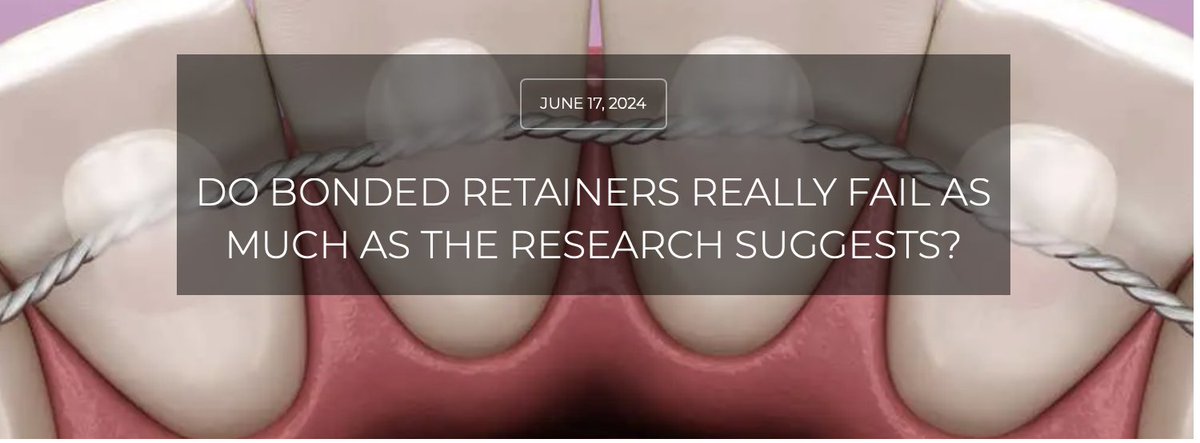
After my previous post on high failure rates of bonded retainers in clinical trials, I contacted Simon Littlewood, an expert in retention and trials, to provide some insight on this issue. He has kindly shared a detailed explanation in this guest post.
https://t.co/JpisgFsLmT
A new, really good clinical trial of aligning archwires. The wire doesn't matter.
The choice of archwire is important when we plan initial alignment. This new trial aims to fill that gap in our knowledge of aligning archwires.
https://t.co/rAhx5LXeU5
Maxillary expansion seems to be becoming a popular treatment method.
With this explosion of interest in expansion, we must base our treatment decisions on high-quality data. This new study adds to our knowledge.
https://t.co/Z2zD0r90sZ
This post is by Padhraig Fleming. He discusses a new paper examining the radiation exposure and risk of orthodontic radiographs. These results are interesting and clinically relevant.
https://t.co/yDVcTLfnsy
Do plastic aligners cause harm?
I read an interesting blog post about a new research paper that proposes a connection between nanoplastics and cardiovascular health. This made me wonder whether plastic clear aligners could contribute to this problem.
https://t.co/7UL6bJP1th