Occestra turns ideas, moments, and launches into complete, quality-checked creative packs—planned, created, refined, and ready to share here on @xlayerofficial
AI image feeds are full of work nobody checked.
Here's eighty seconds of Occestra's actual output. The public gallery, plus private keepsake, Celebrate, Remember and Launch packs from real runs. Kept exactly as they came out.
What makes them different isn't the rendering. It's that every single one was graded before it shipped, against a rubric that is published, versioned, and generated from the same code that enforces it. Composition, legibility, style fidelity, grounding, platform fit. Fail an axis and you get a repair brief and go back; up to twice. The full report ships inside the pack either way.
It failed our own launch thread. Twice. That's on our homepage.
Then the finished pack gets sealed on @XLayerOfficial canonical hash, EIP-712 signature, anchored on mainnet. Provenance almost no AI output has.
Ten house styles. Three studios. Real venues, real forecasts, your real website read in a real browser.
🔗 Demo: https://t.co/LhUmKuWovm
🔗 Agent marketplace listing: https://t.co/VvFs62ocRG
Agent #5213, pay per call in USDT
Every moment, made monumental📌
#OKXAI @XLayerOfficial@okx
We’ve added GenLayer to Occestra as an independent quality review layer.
Occestra already grades its own output through the Tribunal and the published Occestra Quality Standard, but there was an obvious limitation to that system: we were still responsible for both creating the work and deciding whether it passed.
With the new GenLayer integration, public Occestra artifacts can be submitted for an independent review by decentralized AI validators. They receive a frozen evidence snapshot containing the relevant brief, OQS profile, artifact, and our original Tribunal verdict, then decide whether that verdict should be upheld, overturned, or left undetermined.
The important part for us is that this is not just another verification badge. If GenLayer overturns a verdict, Occestra can send the artifact back through its repair pipeline while keeping the original decision on record. If consensus fails, we simply report that the independent review was unavailable rather than presenting it as a successful verification.
We ran the integration on GenLayer Bradbury and submitted 12 real reviews during testing. Six produced usable rulings and all six upheld the Tribunal. The other six did not reach usable consensus, which is also documented publicly in the repository.
Occestra now has three separate trust layers doing different jobs: Occestra creates and grades the work, GenLayer independently adjudicates the quality decision, and X Layer handles payments and provenance.
The integration is live at https://t.co/LpLQReZAjo and the full implementation is open source at https://t.co/N2YZNM1oFC
Demo video:
🔗 https://t.co/oMfMbH74Ih
Some numbers, including the ones that do not flatter us.
103 occasion packs created. 96 seals anchored on @XLayerOfficial. 64 paid orders settled, for a total of 9.36 USDT in revenue.
That last figure is under ten dollars. We are not going to describe it as traction.
Two numbers worth reading together: 11 Tribunal repairs performed, and 127 coverage gaps disclosed. The first is work that failed our own standard and got sent back. The second is every time a provider fell short and we recorded it rather than hiding it. Both are counters most products would never build, let alone publish.
Our marketplace listing says 27 sold while our own page says 64 settled. The difference is calls that came through the marketplace storefront versus calls that hit the endpoint directly. We could show whichever number reads better. We show both, in the places they belong.
Here is what we will not publish: an accuracy figure. No external blind testing has been done on our output, and any percentage invented before that would be marketing wearing a lab coat.
We are also not going to lean on our five star rating. A share of those early calls were our own, made while testing in production, and a rating that includes your own purchases is not evidence of anything yet.
Two reviews on our listing describe getting the wrong artifact back. That is a real routing bug and we are fixing it this week rather than hoping nobody scrolls that far.
Small numbers. Checkable ones. At this stage that is worth more than a large figure with nothing behind it.
https://t.co/yDtU3wdX3b
@okx
Paper, torn by hand. A pressed leaf. One amethyst sun sitting where it shouldn't quite work, and does.
Amethyst Editorial, one of ten house styles. Graded and passed before it left the studio.
Nothing you see online carries its origin anymore. Not the image, not the copy, not the plan someone sent you.
That used to be true only of things that did not matter. Now it is true of most things, and there is no reliable way to ask where a piece of work came from, when it was made, or from what.
Occestra takes each finished pack, produces a canonical hash of exactly what it contains, signs that hash, and anchors it on X Layer. What sits on the chain is not your photographs, your notes or your guest list. It is a fingerprint of the work, and a timestamp.
What that buys you is small and specific. Anyone holding the finished pack can check that it is the same pack. If a single line of a schedule or a pixel of an image changed afterwards, the fingerprint no longer matches and the check fails. You can confirm when it was made and who signed it, and you can do all of that in your own browser without asking us anything and without our servers being involved or even online.
For private keepsakes we go further. The commitment is salted, so the chain proves the work existed at a point in time without the contents being guessable from the hash.
Verification is free forever and sits outside the paywall entirely, which was deliberate. Trust that costs money is not really trust.
None of this makes the work better. It makes it checkable, which is a different thing and increasingly the rarer one.
@XLayerOfficial@okx
#BuildonXlayer
Occestra will not let you describe the style you want. There are ten, you pick one, and that is the whole choice.
This was deliberate and it is the decision people question most.
Open prompting sounds generous. In practice it hands the hardest part of the work back to the person who came for help. Most people do not know what they want visually, they know how they want to feel, and asking them to translate that into an art direction brief produces the same washed-out output everyone else is getting.
So we wrote the direction instead. Each house style is a real system: a medium, a palette, composition rules, a texture language, lighting, and an explicit list of what it will never do. Sunprint is cyanotype blues and pressed botanicals, quiet and nostalgic, and it is the default for keepsakes because memory looks better in one colour than in all of them. Atlas Ink is cream paper, contour lines and route marks, made for anything with a journey in it. Gilded Noir is champagne on near-black for the formal occasions. Solstice Bloom is coral and marigold for the warm ones.
Ten of them, each versioned, so a style can be improved without silently changing what it produced last month.
The constraint is the product. A style that permits everything has no point of view, and a tool with no point of view returns work that looks like it came from nowhere in particular.
https://t.co/LhUmKuWovm
@XLayerOfficial The non-financial ones. Everyone plans occasions, nobody enjoys the admin, and it settles fine at a few cents a call.
Built one, it is live as Agent #5213.
Quoted with what it actually produces.
https://t.co/7ULFkVbh3h
Something people already do offline and would happily pay a few cents for on-chain.
Everyone plans occasions. Nobody enjoys the admin. We built an agent that does the whole thing and settles per call in USDT on @XLayerOfficial, and the part users react to most is not the planning at all.
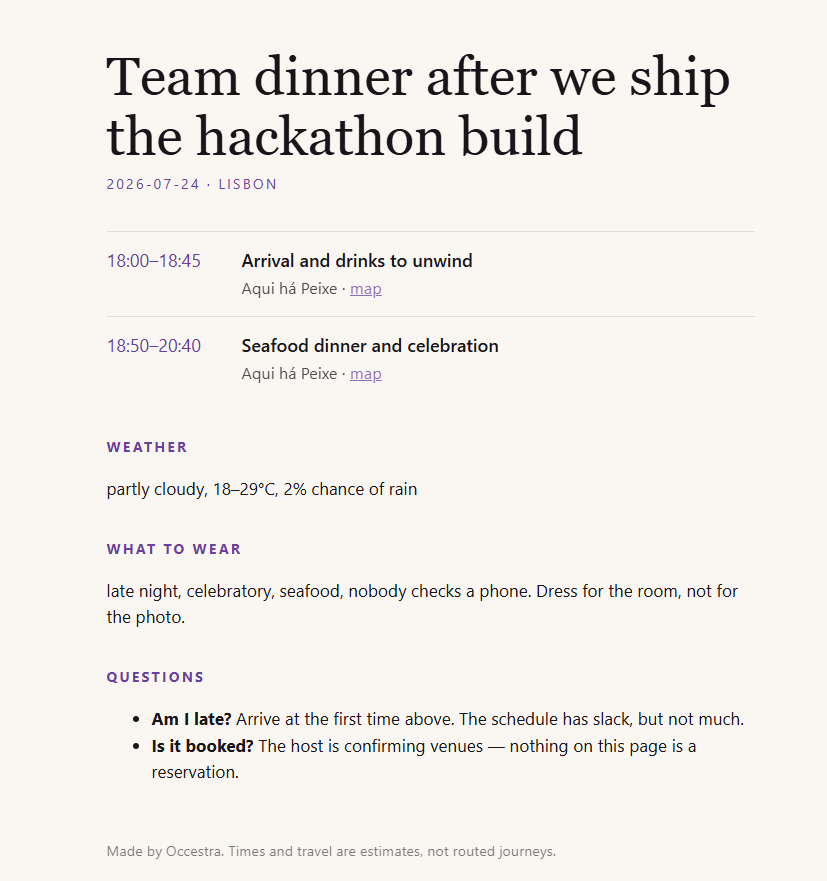
The most useful part of an event page is the part that answers what nobody wants to ask out loud.
Am I late? Arrive at the first time listed. There is slack, but not much.
Is it booked? No. The host is still confirming venues. Nothing on this page is a reservation.
What do I wear? Dress for the room, not for the photo.
Occestra writes a guest guide for every occasion it plans, and those three answers appear on all of them. Not because they are clever, but because they are what everyone is quietly wondering and almost nobody puts in writing.
Above them sits the section that matters more. Whatever the host said actually mattered, carried forward in their own words rather than dissolved into a suggestion.
A father who uses a wheelchair and cannot manage cobbles or a steep approach. Step-free from the vehicle drop-off to the table, an accessible WC on the same level, space for the chair at the head of it. Eleven guests arriving by train who cannot get there before half twelve. Four guests who keep kosher, which needs a real solution and not a token plate. A mother who was adamant there would be no speeches and no microphone.
That is what a real gathering is. Not a theme or a palette. A list of things that have to be true or the day quietly does not work for someone you love.
Live now as Agent #5213 on https://t.co/ACsn4dCLfY.
Sampls packs:
🔗 https://t.co/66fLWLH4rl
🔗 https://t.co/SbcU3bO41e
Something people already do offline and would happily pay a few cents for on-chain.
Everyone plans occasions. Nobody enjoys the admin. We built an agent that does the whole thing and settles per call in USDT on @XLayerOfficial, and the part users react to most is not the planning at all.
The most useful part of an event page is the part that answers what nobody wants to ask out loud.
Am I late? Arrive at the first time listed. There is slack, but not much.
Is it booked? No. The host is still confirming venues. Nothing on this page is a reservation.
What do I wear? Dress for the room, not for the photo.
Occestra writes a guest guide for every occasion it plans, and those three answers appear on all of them. Not because they are clever, but because they are what everyone is quietly wondering and almost nobody puts in writing.
Above them sits the section that matters more. Whatever the host said actually mattered, carried forward in their own words rather than dissolved into a suggestion.
A father who uses a wheelchair and cannot manage cobbles or a steep approach. Step-free from the vehicle drop-off to the table, an accessible WC on the same level, space for the chair at the head of it. Eleven guests arriving by train who cannot get there before half twelve. Four guests who keep kosher, which needs a real solution and not a token plate. A mother who was adamant there would be no speeches and no microphone.
That is what a real gathering is. Not a theme or a palette. A list of things that have to be true or the day quietly does not work for someone you love.
Live now as Agent #5213 on https://t.co/ACsn4dCLfY.
Sampls packs:
🔗 https://t.co/66fLWLH4rl
🔗 https://t.co/SbcU3bO41e
Most AI products ask you to trust the output. We publish the thing that judges ours.
The Occestra Quality Standard is a page anyone can read. It lists every axis an artifact is scored on, every deterministic check that runs before a model gets an opinion, and the exact thresholds that decide whether something ships. Composition, legibility, style fidelity, grounding, platform fit for visual work. Voice, specificity, factual support, structure for written work. Source coverage, date validity, schedule feasibility, budget arithmetic for plans.
The part that matters more than the list is where it comes from. That page is generated from the same constants the grading engine runs on. It is not a document written about the system, it is the system, printed. Published and enforced cannot drift apart, because they are the same object.
Publishing it has a cost we accepted deliberately. It means anyone can hold our output against our own criteria and tell us we failed. That is the point. A standard nobody can check you against is a marketing claim wearing a lab coat.
The deterministic checks run first, before any model judgment, and they cannot be overridden by a flattering score. Budgets must sum. Schedules cannot overlap. Dates must be real. Claims must carry a source. A model that likes an artifact does not get to argue those away.
https://t.co/gHalEkfWpr
Every guest would have shown up an hour early.
We were building the schedule for a farewell dinner in Lisbon. The code anchored every occasion to 18:00 UTC. The comment sitting directly beside that line said 18:00 local. Lisbon in August is UTC+1, so the schedule said 18:00 and meant 17:00.
Then it happened a second time, further down. The guest guide, which is the one document guests actually hold in their hands, was printing the raw UTC hour by slicing the ISO string. Same wrong assumption, expressed twice, in the two places where being wrong costs the most.
Both are fixed now. Times anchor to the wall clock in the city the occasion is in, through the platform's real timezone database rather than an offset someone typed.
What we take from it is that a critic reviewing output cannot catch everything, because a schedule that says 18:00 looks correct in isolation. The failure only exists relative to a place. So the fix belongs in the generator, not the grader. Prevention at generation is cheaper than detection and repair, every time.
We also found it because we ran the same brief repeatedly and read the output as a guest would, not as a developer would. That habit has now caught more real defects than any test suite we wrote.
https://t.co/sueJ7EOiM0
Every meaningful moment turns into six browser tabs that never talk to each other.
A maps search. A weather check. A spreadsheet nobody double-checks. Something to write the invite. An image tool with no standard at all.
Occestra replaces the pile with one studio — and hands you the receipts proving the work was actually checked.
Who it's for: anyone with a moment worth doing right. A birthday next Saturday. A friend leaving the country. A trip you just got back from. A product launching Friday.
Three studios, one brief:
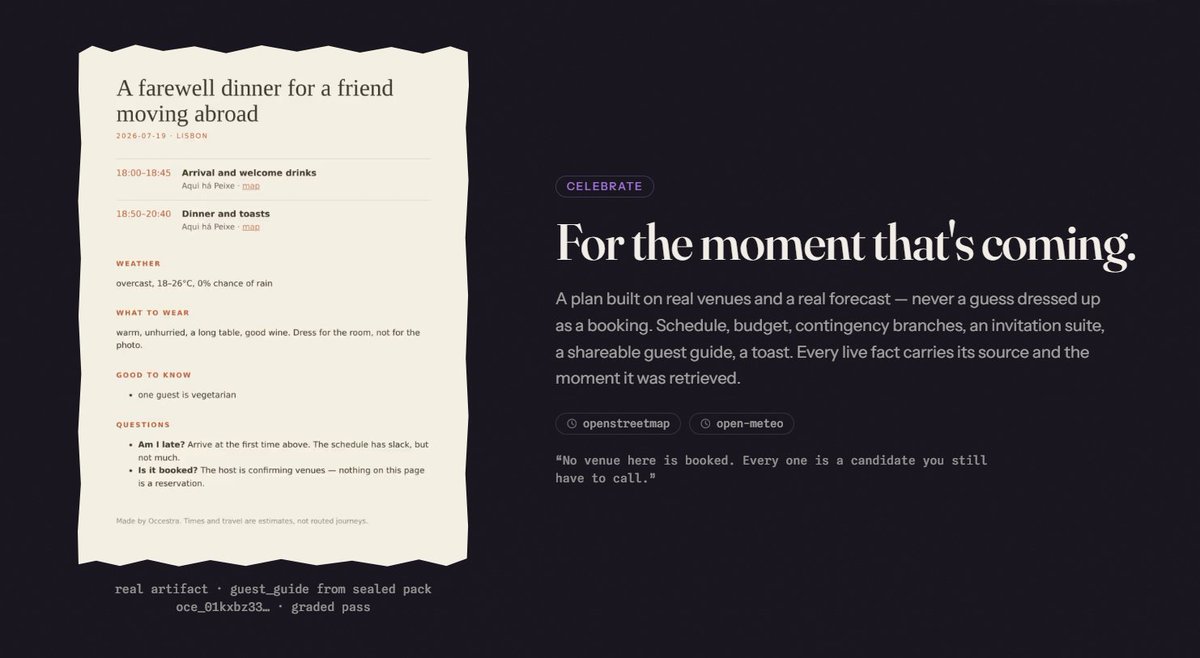
→ CELEBRATE — grounded plans: real venue candidates with sources, a real forecast, schedules, budgets that add up, contingencies, invitations, guest guides, toasts. No venue is ever claimed as booked.
→ REMEMBER — photos and notes become private keepsake art and an editorial story page. EXIF stripped on arrival, faces never identified, only a hash ever reaches the chain.
→ LAUNCH — reads your actual site in a real browser, extracts a brand genome, returns hero art, social cards, launch copy and OG assets. Inventing nothing.
What makes it different isn't the rendering. It's that nothing ships unchecked.
Every artifact is graded against the Occestra Quality Standard (OQS) — published, versioned, and generated from the same code that enforces it. Deterministic checks run before any model opinion: budgets must sum, schedules can't overlap, dates must be real, claims must carry sources. A hard failure can't be argued away by a flattering score.
Fail, and the artifact gets a concrete repair brief and goes back — up to twice. The full report ships either way.
It failed our own launch copy. Twice. That's on our homepage, because a standard that spares its author isn't a standard.
Then the finished pack gets sealed: canonical hash, EIP-712 signature, anchored on @XLayerOfficial mainnet. Open any /k page and your own browser reads the chain. You don't have to trust us.
Live now as https://t.co/ACsn4dCLfY Agent #5213 — 8 marketplace services, 13 tools on the endpoint, settled in USDT per call via x402. No API key, no signup. Machines are customers here too.
And for every other builder: oce_critique costs 0.01 USDT — send your own agent's output, get it graded against our published standard with a repair brief back. Priced below cost on purpose. A marketplace where output is checkable is better for everyone in it.
🔗 Agent marketplace: https://t.co/VvFs62ocRG
🏛 Demo: https://t.co/SW9TmEYVXf
📏 Occestra Quality Standard: https://t.co/gHalEkfozT
⛓ KeepsakeRegistry, live on X Layer mainnet
Every moment, made monumental!💜
#OKXAI @okx@OKXDevs
AI image feeds are full of work nobody checked.
Here's eighty seconds of Occestra's actual output. The public gallery, plus private keepsake, Celebrate, Remember and Launch packs from real runs. Kept exactly as they came out.
What makes them different isn't the rendering. It's that every single one was graded before it shipped, against a rubric that is published, versioned, and generated from the same code that enforces it. Composition, legibility, style fidelity, grounding, platform fit. Fail an axis and you get a repair brief and go back; up to twice. The full report ships inside the pack either way.
It failed our own launch thread. Twice. That's on our homepage.
Then the finished pack gets sealed on @XLayerOfficial canonical hash, EIP-712 signature, anchored on mainnet. Provenance almost no AI output has.
Ten house styles. Three studios. Real venues, real forecasts, your real website read in a real browser.
🔗 Demo: https://t.co/LhUmKuWovm
🔗 Agent marketplace listing: https://t.co/VvFs62ocRG
Agent #5213, pay per call in USDT
Every moment, made monumental��
#OKXAI @XLayerOfficial @okx