Welcome to Ocean Life of the Day. Every day, we dive into the incredible world beneath the waves from beautiful sea creatures to strange deep-sea discoveries.
One creature.
One day.
One fascinating story.
Follow along and discover something new from the ocean every day.
@JesusChris17530 Our page focuses on sharing facts about ocean life and marine conservation, so unfortunately, we can't connect you with tuna fishermen directly. But I hope you find the right people and get to experience it.
Best of luck.
Imagine a single fish selling for over $3 million.
Bluefin tuna can fetch incredible prices because of their rich, fatty meat, prized for premium sushi and sashimi. At Japan’s famous New Year auctions, fierce bidding can send prices soaring.
Its high market demand has contributed to intense fishing pressure, making sustainable management crucial to protecting wild populations.
📸 Black Magic Tackle
ocean life of the day: atlantic bluefin tuna
(Thunnus thynnus)
~ found in: Atlantic Ocean and Mediterranean Sea
~ habitat: open ocean and coastal waters
~ eats: fish, squid and crustaceans
~ special feature: warm-blooded abilities that help it thrive in cold waters
~ size: up to 4.5 m (15 ft)
~ weight: up to about 680 kg (1,500 lb)
📸 Koi Knives
Weddell seals can use their teeth to keep breathing holes open in Antarctic sea ice. They also produce an extraordinary range of underwater sounds, including whistles, trills and chirps that make them sound almost otherworldly.
ocean life of the day: weddell seal
(Leptonychotes weddellii)
~ found in: Antarctic waters
~ habitat: sea ice and coastal waters
~ eats: fish, squid and crustaceans
~ special feature: can dive for over an hour and reach depths of around 600 m
~ size: up to 3.3 m (11 ft)
~ weight: up to 600 kg (1,320 lb)
~ lifespan: around 30 years
📸 National Geographic
ocean life of the day: wolf eel
(Anarrhichthys ocellatus)
~ found in: North Pacific Ocean
~ habitat: rocky reefs, caves and crevices
~ eats: crabs, sea urchins, clams and mussels
~ special feature: powerful jaws and a long, eel-like body
~ size: up to 2.4 m (8 ft)
~ weight: up to 18.4 kg (41 lb)
~ lifespan: up to 25 years
📸https://t.co/gBNxFO4NmK //Scuba Scribbles
A decorator crab is like a walking disguise artist. It attaches bits of its surroundings to hooked hairs on its body, helping it blend into the reef and avoid predators. Some even change their decorations as they move through different habitats.
ocean life of the day: decorator crab
(Camposcia retusa)
~ found in: Indo-Pacific waters
~ habitat: coral reefs and rocky seafloors
~ eats: algae, small invertebrates and other organic matter
~ special feature: decorates its body with seaweed, sponges and other materials for camouflage
~ size: around 5–10 cm
📸Decorator crabRoundglass Sustain
Bir adam, deniz kaplumbağasının ağzına yapışan kabukları dikkatlice çıkarırken kaplumbağanın sakince yanında durup kendisine güvenerek yardım etmesine izin verdiği anları paylaştı;
hii #animaltwt#dinotwt I've been posting about dinosaurs every day, sharing bits of prehistoric history, but barely anyone sees them
follow If you enjoy learning about dinosaurs, and the world they lived in millions of years ago.
once I get numbers I'll post more facts
The Atlantic bluefin tuna is built for speed and endurance. Unlike most fish, it can keep parts of its body warmer than the surrounding water, helping its muscles work efficiently during long, powerful swims.
ocean life of the day: atlantic bluefin tuna
(Thunnus thynnus)
~ found in: Atlantic Ocean and Mediterranean Sea
~ habitat: open ocean and coastal waters
~ eats: fish, squid and crustaceans
~ special feature: warm-blooded abilities that help it thrive in cold waters
~ size: up to 4.5 m (15 ft)
~ weight: up to about 680 kg (1,500 lb)
📸 Koi Knives
Sea pigs sometimes carry tiny king crabs on their backs! Scientists have observed juvenile crabs hitching rides on them, although they’re still investigating why the crabs do this. Sea pigs are actually deep-sea sea cucumbers, not pigs.
ocean life of the day: sea pig
(Scotoplanes spp.)
~ found in: deep oceans worldwide
~ habitat: muddy seafloors, often thousands of metres deep
~ eats: organic matter from sinking food particles
~ special feature: tube-like feet and plump, pink body
~ size: usually around 4–15 cm, depending on species
📸 Wikipedia//WIRED
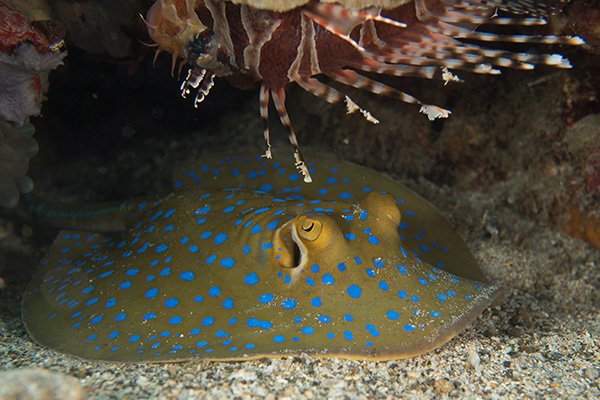
Despite its bright blue spots, this ray spends much of its time hiding beneath coral ledges or partly buried in sand. It can pump water through openings behind its eyes while resting, allowing it to breathe without moving its mouth
ocean life of the day: blue-spotted ribbontail ray
(Taeniura lymma)
~ found in: Indo-Pacific waters
~ habitat: shallow coral reefs and sandy lagoons
~ eats: crabs, shrimp, worms and small fish
~ special feature: electric-blue spots and a long tail with venomous spines
~ size: up to about 35 cm across the disc
~ status: near threatened
📸 Siladen Resort//Thai National Parks
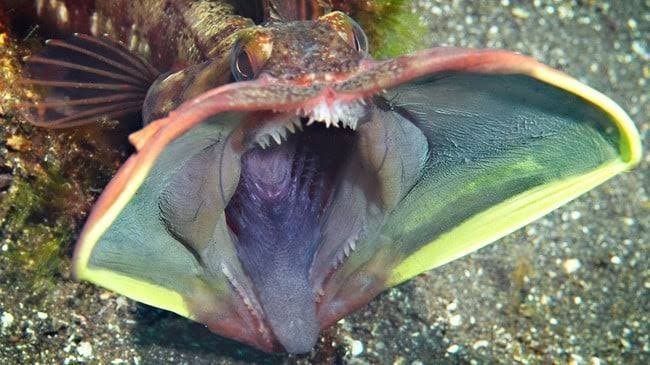
When two sarcastic fringeheads fight over territory, they open their huge mouths and press them against each other, almost like a bizarre kissing contest. The fish with the larger-looking gape often intimidates its rival into backing down!
ocean life of the day: sarcastic fringehead
(Neoclinus blanchardi)
~ found in: Pacific coast of California and Baja California
~ habitat: shallow coastal waters, hiding in burrows and crevices
~ eats: small fish, crustaceans and other tiny animals
~ special feature: enormous, colorful mouth used in territorial displays
~ size: up to about 30 cm
📸 ScienceAlert//BBC Wildlife Magazine