While the NY State museum undergoes its “major transformation.” We’ll be here telling you why, sharing our discovery, findings and work with the public.
Consider The Source, Starting With Your Own
New York State runs a program whose name sounds like a dare.
Consider the Source New York: Teaching with Historical Records
It is the public face of the @nysarchives a program of the @NYSEDNews and the Archives Partnership Trust, the nonprofit that funds the Archives' educational work. Its premise is disarmingly simple: Go to the primary sources. Don't take the tidy synthesis on faith. Put the record in front of students and let them reason from the evidence itself. The site offers teachers more than 4,000 historical documents and a library of ready-made learning activities. In June 2026, the Trust announced a $1 million gift from the Robert David Lion Gardiner Foundation, the largest single contribution in its history, to build an "Educational Resource Center for New York State History." Commissioner Betty Rosa framed the mission as helping students "see themselves in the people, places, events, and ideas that shaped New York and our nation."
Good. Dare Accepted.
Because a motto like teaching with historical records cuts both ways. If the standard you market to schoolchildren is to return to the record, weigh the evidence, and distrust the convenient summary, then that standard binds the institutions that print it on their letterhead first. Consider the source. Including your own.
Let's be precise about the map. Consider the Source is the Archives' platform, built for K-12 classrooms, based on archival records. The New York State Museum is a different institution, with its own collections and its own publications, and nobody expects Archaic burial ceremonialism in a fourth-grade lesson plan. This is not a complaint about a children's database. It is about the standard the database teaches. The Archives, the Museum, and the State Library are sibling programs of the same Office of Cultural Education, housed in the same Cultural Education Center in Albany. The program that tells students to go to the source and the shelves that hold the source in question sit under one roof.
And on the subject of ocher, the State's own source is not thin. It is foundational. It has been sitting in the State's own stacks for the better part of a century, under the State's own imprint.
William M. Beauchamp did his work under the banner of the New York State Museum, cataloging the material culture of Indigenous New York across a long shelf of State Museum bulletins. William A. Ritchie was the State Archaeologist of New York, and his The Archaeology of New York State remains the standard synthesis of the field that every serious student of the subject still starts from. And in 1955 the State published, under its own seal, Ritchie's Recent Discoveries Suggesting an Early Woodland Burial Cult in the Northeast (New York State Museum and Science Service, Circular 40): burials with powdered red ocher, reported by the State's own named authority, printed in Albany, seven decades ago. This is not fringe scholarship or amateur speculation. It is the State's own primary record.
So here is the question worth putting to Jonathan Lothrop, the Museum's Curator of Archaeology, the office that inherited both men's work.
Why is it omitted?
Lothrop's own specialty is sourcing. His published research is titled, in as many words, "Coupling Lithic Sourcing with Least Cost Path Analysis to Model Paleoindian Pathways in Northeastern North America" (American Antiquity, 2018). Tracing a material back to its source and mapping how people moved it across the landscape are not incidental to his work; they are at its center.
And yet, when the material is ocher, the sourcing question goes quiet. The record Beauchamp and Ritchie had already begun building drops out of the synthesis. The citation disappears.
You cannot run a program called Consider the Source and decline to consider your own.
This is the whole of the point, and it is not a complicated one. The State has built a well-funded, publicly celebrated apparatus around a single civic virtue: fidelity to the primary record. It asks teachers to teach it and students to practice it. But an institution does not get to hold the record sacred for schoolchildren and optional for itself. The Beauchamp and Ritchie shelf is exactly the kind of primary institutional source the State says it honors. It belongs in the Museum's own synthesis. Its absence is not a small gap. It is the standard the State teaches its children, unmet where the State writes its own science.
So consider the source, @nysmuseum Lothrop. You don't have to go far. It's Beauchamp. It's Ritchie. It's shelved in your own building, published under your institution's name, waiting to be read back into the record it never should have left.
Consider your own sources.
@GovKathyHochul Did you tell him how you felt about Native Americans and your current attempt to suppress a Paleoindian ceremonial landscape in the Adirondacks?
https://t.co/XlLtz5GYyq
From Albany to Under Oath before Congress - unfortunately, political choreography and organized messaging have no effect on irrefutable, overwhelming evidence. Attempted indigenous cultural erasure in real time by definition. Go to https://t.co/lRzlqZXsIy check out the interactive map, read their own words and emails, see it all for yourself. All the way to Congress - UNDER OATH
Six commitments. In writing. From Albany to sworn testimony before Congress.
The Smithsonian's American History director, under oath, July 2026: "Honest history means adding the evidence, the voices, the objects that earlier tellings left out."
New York State Parks, official initiative: ask "who or what is missing from the current primary narrative?"
State Parks again, 2025: hired an Interpreter of Native American History to bring Indigenous stories to 35 state sites.
New York's tourism industry: uncover the "often overlooked, and historically marginalized narratives" of the state's heritage.
The new State Museum director, announced by the Smithsonian's own Director Emeritus: "a national model of relevance, inclusivity, and innovation."
The State Archaeologist, published pledge: change underrepresentation "at all stages of the production of knowledge."
Every commitment above is on the record, in their own words. They have all known about this discovery for the past seven years, and now they're in a panic because we went public and they're marketing what they have been refusing to acknowledge: a Paleoindian ocher mine in a ceremonial landscape memorialized in a palm-sized portable art carving of the mountain itself, finished in red and yellow ocher.
Evidence. Voices. Objects earlier tellings left out.
Congress heard the words. Albany has the file.
Six commitments. One standing test. Seven years.
https://t.co/vTN2968T5q
@Reuters@FoxNews@WhiteHouse
The Secretary of the Smithsonian says the White House report is "not a fair characterization" of the National Museum of American History.
Fairness is a question of record. Here is the record.
2022 - The New York State Education Department presents Secretary Lonnie Bunch with its Empire State Archives & History Award, alongside Commissioner Betty Rosa.
2025 - Brent Glass, Director Emeritus of the same National Museum of American History named in that report, chairs the search that selects the New York State Museum's next director (Jennifer Saunders)
That director, Jennifer Saunders, arrived with public praise for her Indigenous sovereignty work in Washington State. The institution she now leads has been well aware of the Paleoindian ocher mine and ceremonial landscape in the southern Adirondacks for seven years.
The network does not stop at the museum door.
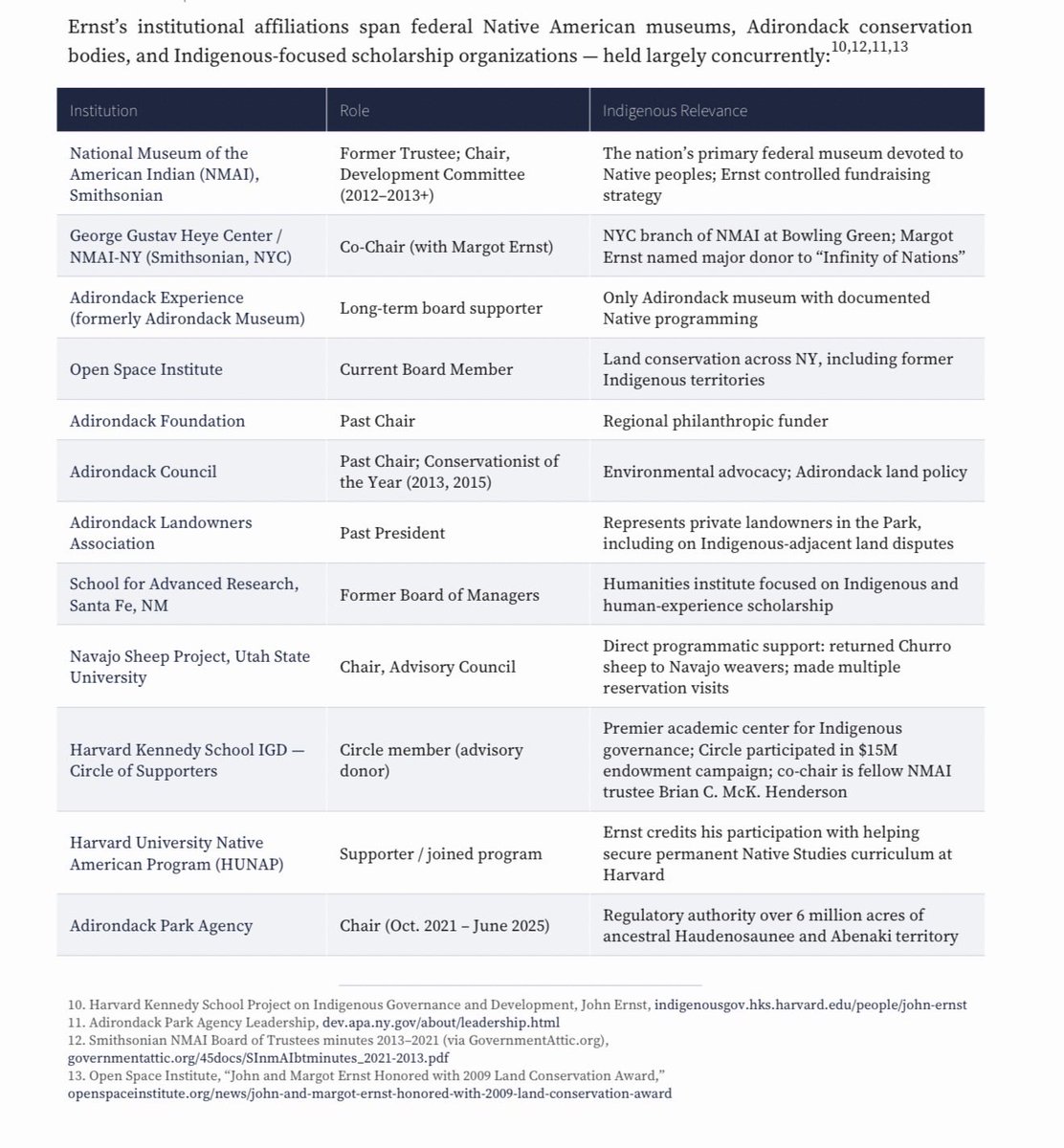
John Ernst, a former trustee of the Smithsonian's National Museum of the American Indian, chaired the Adirondack Park Agency while serving on the board of the Open Space Institute. New York's Office of Parks, Recreation and Historic Preservation, the agency that houses the State Historic Preservation Office, drew successive leadership from that same land conservancy network.
Three state agencies. Two rolodexes. One documented pattern.
This is not a claim about anyone's intent. Every fact above sits in public records: search committee rosters, trustee lists, agency appointments.
For the first time in years, a real spotlight is on how the nation's cultural institutions operate. Here is what it looks like from the ground.
In the southern Adirondacks stands an entire mountain of evidence. A Paleoindian ocher mine that would be only the second documented prehistoric ocher mine north of Mesoamerica, after Powars II in Wyoming. Memorialized in a palm-sized 3D stone carving finished with red and yellow ocher that, according to the archaeological record, is the only known place-depicting Paleoindian portable art in the Western Hemisphere. A mountain rendered in the palm of a hand, thousands of years ago, by The First People telling THEIR STORY that this place mattered.
A claim that size should be easy to test. One site visit. Seven years of submissions to the New York State Museum, OPRHP, and SHPO, and it has never received either.
And we all know how this ends, because documented evidence does not expire, nor does an entire mountain of evidence. We're only getting louder and certainly not going away.
New York's institutions wrote the record themselves, one unanswered year at a time, for seven years. The silence is the story, and the silence is theirs.
@GovKathyHochul Your museum, your parks agency, and your historic preservation office have known since 2019 the emails are coming next. One site visit settles it. The invitation is standing.
The full documentation, sources included, is at https://t.co/lRzlqZXsIy
The mountain is waiting. So arte we.
@NYstateparks@nysmuseum@smithsonian@usachp
While Bunch tells staff the White House report isn’t a “fair characterization” of the Smithsonian’s “totality,” the same stacked circle still oversees New York’s institutions. Bunch. Glass. And now the “Revisioning Task Force.”
2022 — Bunch receives the Empire State Archives & History Award from NYSED Commissioner Betty Rosa.
2025 — Former Smithsonian NMAH Director Brent Glass is brought in to select the next Director of the New York State Museum. Same people. Same institutions. Same revolving door.
Here’s what no “Revisioning Task Force” can erase:
A Paleoindian ceremonial landscape, home to a prehistoric ocher mine that would be the second known Paleoindian ocher source north of Mesoamerica. Megaliths, curated ceremonial deposits, oversized, non-utilitarian tools, ocher-soaked stone tools, and more. This site is densely ceremonial — and that is an understatement.
The piece that says it all alone: a palm-sized, three-dimensional stone carving of the mountain itself, finished with red and yellow ocher — an absolute masterpiece from the last ice age. PLACE ANCHORED ART.
This masterpiece terrifies New York State and its entire system because it cannot be explained away, and everyone can see it for themselves. We’re not just talking about lithics and chipped stone; we’re talking about art doing what it’s meant to do: tell its OWN STORY. That’s why all they can do is remain silent; that's how powerful that piece is.
Acknowledging it would end the story they’ve been protecting for decades. They are so committed to the empty Adirondacks myth that they will destroy themselves. That should make you ask a lot of questions because, well, they certainly are not into cultural heritage work. And their actions, by definition, qualify as indigenous cultural erasure in real time. Actively trying to erase a sacred landscape is the highest level of cultural erasure. That is exactly what they are attempting to do, and it will not work out for them. Guaranteed.
We already know how this ends.
The truth is standing on the mountain, and it’s no longer asking for permission.
#MuseumAccountability #CulturalErasure #ProtectSacredSites
The White House has just accused the Smithsonian of “extreme political activism,” claiming its leadership has subordinated historical scholarship to ideological agendas.
The Smithsonian’s reply: “For more than 180 years, we have served the American public with nonpartisan and independent scholarship. Trust us.”
"Trust you," Brent Glass, director emeritus of the Smithsonian's National Museum of American History, selected the NEW New York State Museum director after conducting a national search (that headline came after our YouTube video mentioning that New York State knew all about our discovery for the past seven years) and here's your America 250 exhibit.
They do all of this while systematically trying to erase a Paleoindian ceremonial landscape in the Adirondacks. memorialized in a portable art figurine of the mountain itself painted with ocher, home to a prehistoric ocher mine that New York State has been aware of for seven years and refuses to acknowledge because that's not the story they want to tell.
How's that for a hate crime? Institutionalized indigenous cultural erasure by definition in real time. The show is over we gave them seven years to act responsibly, ethically, morally, and legally.
Don't trust. Verify. Here is New York's org chart, straight from official press releases:
NY State Museum: 2025 director search chaired by Brent Glass, Smithsonian NMAH Director Emeritus, whose private firm consults on executive recruitment for museums (https://t.co/K6N90tXqNn). He picked the new director and stayed on as her advisor.
OPRHP (which contains SHPO): Commissioner Erik Kulleseid came from the Open Space Institute, ran the agency 2019 to 2024, then returned to OSI as President and CEO. His permanent successor, Kathy Moser, came from OSI too, where she was Chief Conservation and Policy Officer.
APA, the agency governing the Adirondacks, was chaired from 2021 to 2025 by John Ernst, an OSI board member and former trustee of the Smithsonian's National Museum of the American Indian.
And the record those desks share: seven years of documented submissions of a Paleoindian ceremonial landscape in the southern Adirondacks, memorialized in a portable art stone figurine of the mountain itself, finished with ocher. A police anchored story in stone from the last Ice Age - evidence that doesn't allow them to choose the story they want to tell. That's what this is all about.
https://t.co/lRzlqZXsIy
The White House just accused the Smithsonian of "extreme political activism." The Smithsonian's reply: 180 years nonpartisan, trust us.
Don't trust. Verify. Here is New York's org chart, straight from official press releases:
NY State Museum: 2025 director search chaired by Brent Glass, Smithsonian NMAH Director Emeritus, whose private firm consults on executive recruitment for museums (https://t.co/K6N90tXYCV). He picked the new director and stayed on as her advisor.
OPRHP (which contains SHPO): Commissioner Erik Kulleseid came from the Open Space Institute, ran the agency 2019 to 2024, then returned to OSI as President and CEO. His permanent successor, Kathy Moser, came from OSI too, where she was Chief Conservation and Policy Officer. The Adirondack Explorer called it a "trade."
APA, the agency governing the Adirondacks: chaired 2021 to 2025 by John Ernst, an OSI board member and former Smithsonian National Museum of the American Indian trustee.
Two rolodexes. Three agencies. Every desk that decides what counts as New York's deep past.
And the record those desks share: seven years of documented submissions on a possible Paleoindian ocher source in the southern Adirondacks, with a carved stone object that may be unique in the Western Hemisphere. NYSM. OPRHP. SHPO. Unanswered.
https://t.co/lRzlqZY0y6
The White House just accused the Smithsonian of "extreme political activism." The Smithsonian's reply: 180 years nonpartisan, trust us.
Don't trust. Verify. Here is New York's org chart, straight from official press releases:
NY State Museum: 2025 director search chaired by Brent Glass, Smithsonian NMAH Director Emeritus, whose private firm consults on executive recruitment for museums (https://t.co/K6N90tXqNn). He picked the new director and stayed on as her advisor.
OPRHP (which contains SHPO): Commissioner Erik Kulleseid came from the Open Space Institute, ran the agency 2019 to 2024, then returned to OSI as President and CEO. His permanent successor, Kathy Moser, came from OSI too, where she was Chief Conservation and Policy Officer. The Adirondack Explorer called it a "trade."
APA, the agency governing the Adirondacks: chaired 2021 to 2025 by John Ernst, an OSI board member and former Smithsonian National Museum of the American Indian trustee.
Two rolodexes. Three agencies. Every desk that decides what counts as New York's deep past.
And the record those desks share: seven years of documented submissions on a possible Paleoindian ocher source in the southern Adirondacks, with a carved stone object that may be unique in the Western Hemisphere. NYSM. OPRHP. SHPO. Unanswered.
America's 250 years gets exhibits. 13,000 years of First Peoples gets silence.
Every fact above is sourced from state press releases and public records. Check them yourself: https://t.co/lRzlqZXsIy
You might expect that when issuing a major press release about the “museum transformation,” they would at least explain what caused it. We did, when we went public. They’re not transforming anything; they're desperate to preserve the Richies’ empty Adirondack narrative. Considering the years of evidence and detailed site information we’ve provided, it constitutes present-day cultural erasure, yet they use words like "diversity," "inclusion," and "marginalized voices." Political games don't work in the face of overwhelming evidence.
The White House has just accused the Smithsonian of “extreme political activism,” claiming its leadership has subordinated historical scholarship to ideological agendas.
The Smithsonian’s reply: “For more than 180 years, we have served the American public with nonpartisan and independent scholarship. Trust us.”
"Trust you," Brent Glass, director emeritus of the Smithsonian's National Museum of American History, selected the NEW New York State Museum director after conducting a national search (that headline came after our YouTube video mentioning that New York State knew all about our discovery for the past seven years) and here's your America 250 exhibit.
They do all of this while systematically trying to erase a Paleoindian ceremonial landscape in the Adirondacks. memorialized in a portable art figurine of the mountain itself painted with ocher, home to a prehistoric ocher mine that New York State has been aware of for seven years and refuses to acknowledge because that's not the story they want to tell.
How's that for a hate crime? Institutionalized indigenous cultural erasure by definition in real time. The show is over we gave them seven years to act responsibly, ethically, morally, and legally.