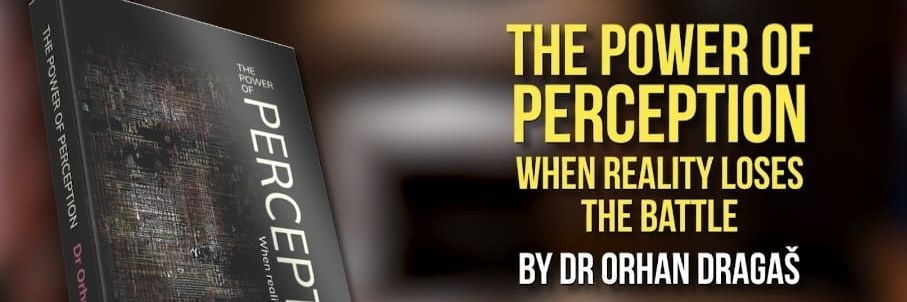
When the appearance of truth overtakes truth itself, trust breaks. The BBC scandal proves it again. When a story outweighs facts, credibility disappears. That’s exactly what I examine in The Power of Perception. Reality is fragile.
@chiselbury@Waterstones@goodreads@AmazonUK
Ukraine is not merely a matter of solidarity with a country defending itself. It represents a test of Europe’s ability to protect the principles upon which the postwar order was built. Accepting the logic of force would fundamentally alter the way states think about their own security. The paradox of @GiorgiaMeloni is not that she changed her mind about Russia. The paradox is that a politician from whom many expected hesitation became one of Europe’s most reliable voices in defense of Ukraine. As Ukrainians have learned over the past several years, allies should be judged not by reputation but by actions. When the political history of this war is eventually written, it will also matter how individual European leaders responded when forced to choose between old political reflexes and a new strategic reality. @GiorgiaMeloni made a choice that surprised many of her critics.
https://t.co/1q9IVHVg1S
The Meloni paradox: how Italy’s Prime Minister became a pillar of Europe’s support for Ukraine https://t.co/JUnafh3mD0 Her story deserves to be remembered as a reminder that political leadership is ultimately defined by choices. Opinion by @ODragas@GiorgiaMeloni
For those following the fate of the Russian-Serbian oil company NIS, the U.S. OFAC has extended the deadline for the sale of the Russian stake until 1 July 2026 (License No. MUL-2025-1447098-6).
The Trump administration continues to display remarkable leniency towards Putin, exactly as many had anticipated. Serbia is left to bear the political and economic cost, while Russia is granted yet another reprieve.
For everyone interested in the future of NIS, the Serbian-Russian oil company, let me put it simply: MOL will not acquire NIS (or, if you prefer, the Russians will not sell their stake in NIS to the Hungarian company MOL). In other words, there will be no deal.
For everyone interested in the future of NIS, the Serbian-Russian oil company, let me put it simply: MOL will not acquire NIS (or, if you prefer, the Russians will not sell their stake in NIS to the Hungarian company MOL). In other words, there will be no deal.
МОЋ ПЕРЦЕПЦИЈЕ
Др Орхан Драгаш
Књига не нуди утешне одговоре, већ јасно структурисану анализу и ��куп принципа „перцептивне писмености“ – како да препознамо манипулаци��у, сачувамо аутономију мишљења и обновимо минималан консензус око чињеница.
You are watching an avatar speaking about a book on perception.
The uncomfortable question is not whether this video is real.
The question is whether reality still matters.
I wrote this book because we are entering a world in which perception no longer needs reality.
@srdjanmil037 A kakav je vaš stav Srdjane o eventualnom dolasku Zelenskog u Beograd? Šta je vaš stav uopšte o ruskoj agresiji na Ukrajinu? Da li je loše da Zelenski dodje u posetu Srbiji?
From the very beginning of Russia’s aggression against Ukraine, I publicly warned Western analyst colleagues, wrote articles and analyses, and repeatedly said that this was not merely Putin’s war, but Russia’s war against Ukraine. I warned against the relativisation of Russian responsibility. Many accused me of Russophobia and claimed that the Russian people were against this war.
At the time, I called for stricter visa regimes for Russians. Pro-Russian, corrupt Western analysts warned me that my position resembled Nazi methods. Today, we see hundreds of thousands of Russians operating across Europe, spying for the Kremlin, and Europe cannot get rid of them!
And I repeat: Russians are responsible because they support Putin!
Yesterday’s 45-minute Moscow performance, staged for the May 9 celebrations, was a touching lesson in historical decline. Red Square once shook under the tracks of machines that terrified the world. Yesterday, the only sound was the echo of Putin’s footsteps in the emptiness. Watching the “Tsar” attempt to preserve his dignity before a military formation with nothing left to show, surrounded by leaders whose main talent is surviving on other people’s crumbs, was almost uncomfortable.
Here is the “magnificent” elite that came to glorify isolation:
Alexander Lukashenko: The lifelong doorman of the Russian barracks once known as a state. A man who traded Belarusian sovereignty for three minutes of shoulder-patting and the right to move into Putin’s storage room. He is not a guest. He is inventory, brought out onto the podium whenever the host needs the illusion that at least one man still sees him as a “big brother.”
Kassym-Jomart Tokayev and Shavkat Mirziyoyev: Central Asian virtuosos who came to Moscow only to check whether Putin is still awake, while already carrying Chinese investors’ business cards and NATO security protocols in their pockets. They came to shake his hand and quietly check his pulse at the same time.
Thongloun Sisoulith (Laos): A geopolitical giant from Southeast Asia serving as visual proof that Russia is “not alone.” His presence carried about the same weight as an amateur theatre group appearing at the Oscars.
Sultan Ibrahim (Malaysia): Probably the only man on the podium there out of tourist curiosity, just to see what an empire looks like when it shrinks faster than a wool sweater washed at ninety degrees.
Robert Fico: The Slovak “revolutionary” sneaking around Moscow like a cheating husband afraid to answer calls from his wife (Brussels). He came to lay flowers, but carefully enough that nobody important would notice, pretending to be a bridge in a place where all bridges collapsed long ago.
Milorad Dodik (BiH, Republika Srpska): The most persistent geopolitical groupie in history, landing in Moscow more often than the average person visits the dentist. Back home he plays the Balkan strongman, while in the Kremlin he serves exclusively as cheap scenery and a statistical error whose name Putin forgets before the plane even leaves the runway. He is the uninvited guest convinced he has “special ties” with the star of the evening, while the host actually uses him as a remote control for creating chaos in the neighbourhood and filling an empty chair in the camera frame.
North Korean “extras”: For the first time on Moscow asphalt, soldiers serving as human currency with which Kim Jong Un pays for Russian grain and oil. Their presence is the final proof that the “world’s second superpower” has been reduced to importing human flesh from the darkest basement on the planet.
And while the “powerful” guests yawned and the tanks remained in garages (or somewhere in the mud of Donbas) Putin stood there alone. The man who wanted to redraw the world’s borders ended up hosting the saddest gathering imaginable, where the main attraction was a single old T-34 tank, as lonely as his politics.
A perfect picture of Russia in 2026: full of history, with no future at all, and guests who are there only until the bill arrives.
The EU has finally adopted its 20th package of sanctions against Russia - the most extensive so far. For the first time, the measures also target entities that help Russia sell and procure goods: banks, ports, insurance companies, shipping, and digital payments, including crypto. Everyone should understand that any assistance to the aggressor Russia comes at a cost - and it is a high one. After this, even Serbia, which has not imposed sanctions on Russia, can no longer conduct any kind of business with it.
https://t.co/NQZhuEQA96
The Trump administration is definitely working for the Russians. The operating licence for the Russian-Serbian oil company NIS has been extended until June because the Russians have not yet completed negotiations on the sale of their stake in the company, so the Americans are effectively helping them by extending the deadline.
Finally in Serbian!
The Power of Perception – When Reality Loses the Battle is now published by @SluzbeniGlasnik , following its UK edition (@chiselbury ) and Italian edition (@cacuccieditore ).
Romanian and Turkish translations are currently underway.
Hungarians and Serbs share one thing: they don’t like outsiders meddling in their internal affairs, especially in elections.
Mr. @sandrogozi will help Vučić’s opponents just as much as @JDVance helped Viktor Orbán — by supporting him.
The idea of a "Serbian Magyar" is politically attractive but analytically unsustainable – because in Hungary there was a conflict between a pro-Russian and a pro-European option. That conflict does not exist in Serbia.
https://t.co/MHRguA4CNr