We need to bring more attention to the situation we have with npm. Drizzle releases are completely blocked by npm because of "too many published versions" (we have 1397 versions)
There is no way for us to delete old versions, unpublish old versions, or really do anything except contact the support team. Of course, we did that >3 weeks ago, but there has been no action from the npm team at all. Drizzle has >11.5M downloads/week and is used by hundreds of thousands of developers across the globe, yet we're getting no help from npm
It's not like only 10 people are blocked. There are many teams and developers waiting for us to ship important features, improvements, and fixes (Imagine receiving a security report in this situation and having zero ways to release a patch). Npm support keeps sending bot replies saying they need more time to handle the case
I'm begging someone to help us find anyone from the npm team who can help us delete old versions that are not used by anyone anymore, or at least give us a way to ship releases again
ps why is having 1397 releases a problem at all?
@rickyfm@jantimon@jherr I get it, so Intersection Observer is not necessarily because of smart selective hydration, and everything other from this list is achievable with React 19 API 's
May I ask you about possible loadable replacement, what we can do to combine Suspense+use+Lazy, but preload CSS?
@rickyfm@jacobrask Big part of the problem - this heavy Footer component loading/parsing/compilation time (and also React tree construction aks createElelement calls as I understand how it works)
@rickyfm@jantimon@jherr Without RSC, in SSR React applications, how can we improve application load performance, if for some part of the page we don't need to add interactivity (load JS then hydrate) before visibility?
This article have a good problem explanation - https://t.co/DTnzOWoGKO
@rickyfm@jacobrask Footer is a perfect example, because links list often dynamic and footer can have A/B test and experiments.
Delayed hydration with lazy footer JS import (and loadable for SSR) can give a huge performance win.
Only problem is that CSS can't be delayed.
Also built reactive-framework-test-suite — 180 test cases for reactive signal semantics across 13 libraries. PRs welcome to add more frameworks or test cases.
https://t.co/fPiL6wg2Dr
Everyone setting --max-old-space-size in Kubernetes is doing it wrong.
Here's why your Node.js app keeps getting OOMKilled despite your "careful" heap tuning 🧵
🚨 How the TanStack npm attack actually happened:
1. Attacker opened a normal-looking pull request (#7378) on the TanStack repo.
2. GitHub automatically ran CI tests on that PR.
3. Code inside the PR stole the workflow's GitHub Actions Cache write token during the test run.
4. The attacker used that token to plant poisoned files in the shared build cache. The PR could be closed afterwards. The poisoned cache stays.
5. The official release workflow later pulled from the cache, baked the malicious files into the build, and signed and published 84 malicious package versions to npm.
SECURITY ADVISORY — TanStack npm packages
A supply-chain compromise affecting 42 @tanstack/* packages (84 versions total) was published to npm earlier today at approximately 19:20 and 19:26 UTC. Two malicious versions per package.
Status: ACTIVE — packages are deprecated, npm security engaged, publish path being shut down.
Severity: HIGH — payload exfiltrates AWS, GCP, Kubernetes, and Vault credentials, GitHub tokens, .npmrc contents, and SSH keys.
If you installed any @tanstack/* package between 19:20 and 19:30 UTC today, treat the host as potentially compromised:
• Rotate cloud, GitHub, and SSH credentials immediately
• Audit cloud audit logs for the last several hours
• Pin to a prior known-good version and reinstall from a clean lockfile
Detection — the malicious manifest contains:
"optionalDependencies": {
"@tanstack/setup": "github:tanstack/router#79ac49ee..."
}
Any version with this entry is compromised. The payload is delivered via a git-resolved optionalDependency whose prepare script runs router_init.js (~2.3 MB, smuggled into each tarball at the package root).
Unpublish is blocked by npm policy for most affected packages due to existing third-party dependents. All 84 versions are being deprecated with a SECURITY warning, and npm security has been engaged to pull tarballs at the registry level.
Full technical breakdown, complete package and version list, and rolling status updates:
https://t.co/Zy8qG7PA9f
Credit to the security researcher for responsible disclosure.
@platformatic@matteocollina Hi! One question prevent me today from sleep - how with Watt, or in general with worker_threads, share any in-memory caches between, like lru-cache?
Just can't get how to effectively solve concurrency and serialization costs...
@ryanflorence@matteocollina SSR in meta-frameworks is mostly React rendering API and choosen http server request handling, this is baseline in React ecosystem when we're measuring CPU working time.
Anything other - is framework-specific features and some unnecessary work.
To do less - always a good job)
@platformatic Full benchmark data, flamegraphs, and reproducible infrastructure are open source.
You can run these benchmarks yourself on your own AWS account.
Blog post: https://t.co/m9xfWPjJVf
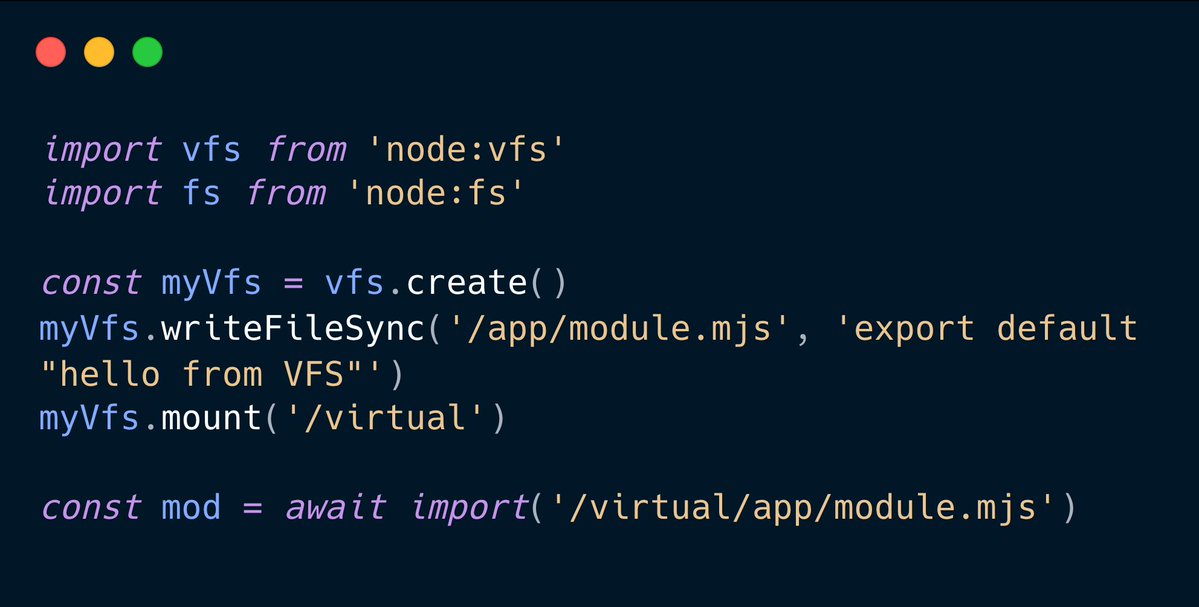
.@nodejs has always been about I/O. Streams, buffers, sockets, files. But there's a gap that has bugged me for years: you can't virtualize the filesystem.
You can't import a module that only exists in memory. You can't bundle assets into a Single Executable without patching half the standard library.
That changes now 👇