IDB Lab, the Inter-American Development Bank's venture arm, funds CBWeb3, a Cosmos IBC project for cross-border central bank money in Latin America. Cosmos tech powers more than 150 independent blockchains.
@cosmos
Cosmos now connects bank core ledgers to Swift's blockchain shared ledger, built with more than 40 financial institutions, for 24/7 cross-border payments. It works with Fiserv, FIS, Jack Henry, Temenos and Hogan core systems.
@cosmos
Wells Fargo, the 4th largest US bank by assets, is building its tokenized deposit engine on Cosmos, starting with 24/7 dollar to pound transfers for corporate clients this fall.
@cosmos
Big day at @cosmos! Today we're announcing the Cosmos Partner Network!
17 firms - one job: get banks, credit unions, and financial firms from tokenized-deposit pilot to production using the Cosmos Tokenization Suite
A 🧵 on who's in and what each one solves.
THE BLOCK: Robinhood has struck a deal with https://t.co/3hCfj8Qgth and https://t.co/oTVptPekHA to expand its prediction markets offering, including routing a selection of event contracts to https://t.co/oTVptPekHA.
Robinhood will also take equity stakes in https://t.co/3hCfj8Qgth and https://t.co/oTVptPekHA, with the deal beginning with football contracts.
39 state banking associations formed the BankChain Alliance.
They want bank-owned blockchain infrastructure for tokenized deposits, stablecoins, and automated settlement.
The RFP phase is complete, with technology partners now under evaluation and a 2027 launch targeted.
Check it out: https://t.co/7hRF9pfc2Y
Dr. Ravi Chamria, CEO of @0xZeeve, argues that interoperability will decide whether tokenized deposits can move across banks and ledgers without creating systemic risk.
The Inter-Blockchain Communication protocol (IBC) is the solution, and its 5+ year production history demonstrates its battle-tested nature.
To all the $ATOM trolls still mad about their bad trade decisions:
Wells Fargo didn’t build on Ethereum, Solana, or some random L2.
They picked the Cosmos SDK for a proprietary chain handling real bank money.
That’s the biggest institutional stamp of approval the stack has ever gotten. $ATOM
Fragmentation is the reason a lot of bank infrastructure spending never delivers full ROI.
Banks have already invested in systems that work well on their own, but struggle to connect to other key business platforms and counterparties, and that gap is exactly where the returns disappear.
In this video, Ian Kane @IamIanKane, our Head of Partnerships, explains how Cosmos solves that fragmentation problem.
James Dyson failed 5,126 times.
In a shed. For 15 years. While his wife taught art to feed the kids.
Prototype 5,127 built a global empire.
He's 79. Owns every share.
Here are 9 things he said on Founders
1. He kept every failure. Numbered them all.
Lots of discussions around Aave so I want to clarify a few things:
• First off, there is NO WAY we’d sell AAVE at a 70% discount lol.
• 100% of Aave Protocol and GHO revenue goes to the $AAVE token. This was established in the Aave Will Win proposal.
• AWW also applies to all product revenue, including the Aave App, Aave Pro, and Swaps.
• No protocol or product revenue goes to Aave Labs, which is a service provider to the DAO responsible for building and growing Aave.
• Aave Labs owns an allocation of AAVE that multiple market participants have discussed purchasing, directly or indirectly, through deeper long-term partnerships. The article’s framing is inaccurate.
• Aave is currently generating $134M in annualized revenue, which goes to the Aave DAO.
• As defined in AWW, all intellectual property, including the Aave brand and any software built for Aave, belongs to $AAVE.
• We haven’t shared much on this yet, but the Aave team is designing Aavenomics 3.0, which includes a new automated and non-discretionary buyback mechanism. More on this later.
• Aave is building not only for the crypto TAM, but for the entire finance asset TAM, including RWAs.
• Everyone at Aave Labs and Aave DAO works for $AAVE.
We’ll be hosting our quarterly call in the next couple of weeks. Join us if you want to catch up on what we’ve been working on and get some cool updates on the Aave roadmap.
Every counterparty in a transaction increases the risk of hacks and scams for all participants.
The Inter-Blockchain Communication Protocol (IBC) allows bank ledgers to communicate peer-to-peer, reducing counterparties to 1: the recipient.
Your institution has complete control over your cybersecurity profile.
IBC connects any ledger to any system that supports signing, without any third-party intermediary in between.
Barry Plunkett @BPIV400, co-CEO of Cosmos, breaks down what makes IBC different.
Attention EEA & Switzerland users! 🇪🇺 🇨🇭
We’ve added more convenient deposit channels to the @cryptocom App!
You can now deposit cash via:
✅ Credit/Debit Card
✅ Apple Pay
✅ Google Pay
Observing the market and not ready to buy? You can deposit to earn yields while you wait for the right moment to make your move. 👉https://t.co/uYBjHiunCl
Regulated institutions are legally mandated to retain oversight and accountability over their infrastructure.
The infrastructure underlying a tokenized deposit has to sit within the bank's own governance perimeter, with compliance controls the institution sets and enforces directly.
The Cosmos Tokenization Suite (CTS) is designed around that. It is built on the Cosmos stack, production-proven across 150+ digital ledgers.
CTS lets banks tokenize their own deposits on infrastructure they govern directly.
It integrates with existing core banking systems, and workflows, with no replacement of existing systems required.
Control and connectivity come built in.
Cosmos Ledger includes a feature that allows banks and enterprises to run their own Cosmos ledger with minimal infrastructure.
Matthew Matuszak, VP of Operations, and Alex Johnson @cozartshmoopler, Cosmos Stack Engineering Manager, explain the benefits of this setup:
Il y a une phrase que j'adore : "Je suis communiste avec ma famille, socialiste avec mes amis, libéral avec mon pays, et capitaliste avec le reste du monde."
Cette phrase est brillante parce qu'elle résume l'erreur numéro un que font les gens quand ils réfléchissent aux systèmes économiques : appliquer ce qui marche à petite échelle à grande échelle sans comprendre que la complexité des systèmes change tout.
Le communisme avec ta famille ça marche. Tu partages tout, tu ne comptes pas, chacun donne selon ses capacités et reçoit selon ses besoins. Et ça fonctionne. Parce que tu es 4 ou 5 personnes, que tu connais tout le monde intimement, que la confiance est totale, que la tricherie est impossible à cacher, et que l'amour remplace les incitations économiques.
Le socialisme avec tes amis ça marche aussi. Un groupe de 20-30 personnes. Tu partages les restos, tu aides un pote à déménager, tu files un coup de main sans compter. La réciprocité est naturelle parce que tu connais chaque personne et que ta réputation est en jeu.
Mais dès que tu passes à l'échelle d'un pays, 68 millions de personnes, tout s'effondre. Pourquoi ? Parce que la complexité des systèmes est non linéaire. S'organiser à 5 c'est trivial. S'organiser à 50 c'est difficile. S'organiser à 50 millions c'est un problème d'une complexité fondamentalement différente. C'est pas juste "plus dur". C'est qualitativement un autre problème.
À grande échelle, tu ne connais plus les gens. La confiance disparaît. La tricherie devient invisible. Les passagers clandestins prolifèrent. L'information nécessaire pour coordonner 68 millions de personnes dépasse la capacité de n'importe quel planificateur central. C'est le problème du calcul économique de Mises (1920) et de l'information dispersée de Hayek (1945). Un cerveau central ne peut pas traiter l'information que des millions de prix de marché transmettent en temps réel.
C'est exactement pour ça que le communisme produit des familles heureuses et des pays morts. Le modèle ne scale pas. Pas parce que les gens sont méchants. Parce que la complexité des systèmes rend la coordination centralisée impossible au-delà d'un certain seuil.
Et c'est l'erreur de jugement fondamentale que font la plupart des gens qui adhèrent aux thèses marxistes. Ils prennent leur expérience du partage en famille ou entre amis, un modèle qui marche à 5-20 personnes, et ils l'extrapolent à 68 millions de personnes en ignorant complètement l'émergence de la complexité. "Si ça marche chez moi, ça devrait marcher pour le pays." Non. La physique des systèmes complexes dit exactement le contraire.
Le marché libre c'est le seul système qui scale. Parce qu'il ne dépend pas de la confiance personnelle, ni de la bonne volonté, ni d'un planificateur omniscient. Il dépend de prix qui transmettent l'information, d'incitations qui alignent les comportements, et de la concurrence qui corrige les erreurs. C'est un système conçu pour fonctionner avec des inconnus, à n'importe quelle échelle.
Sois communiste avec ta famille. Socialiste avec tes amis. Et libéral avec tout le reste. Parce que la taille du système détermine le modèle qui fonctionne. Pas tes bonnes intentions.
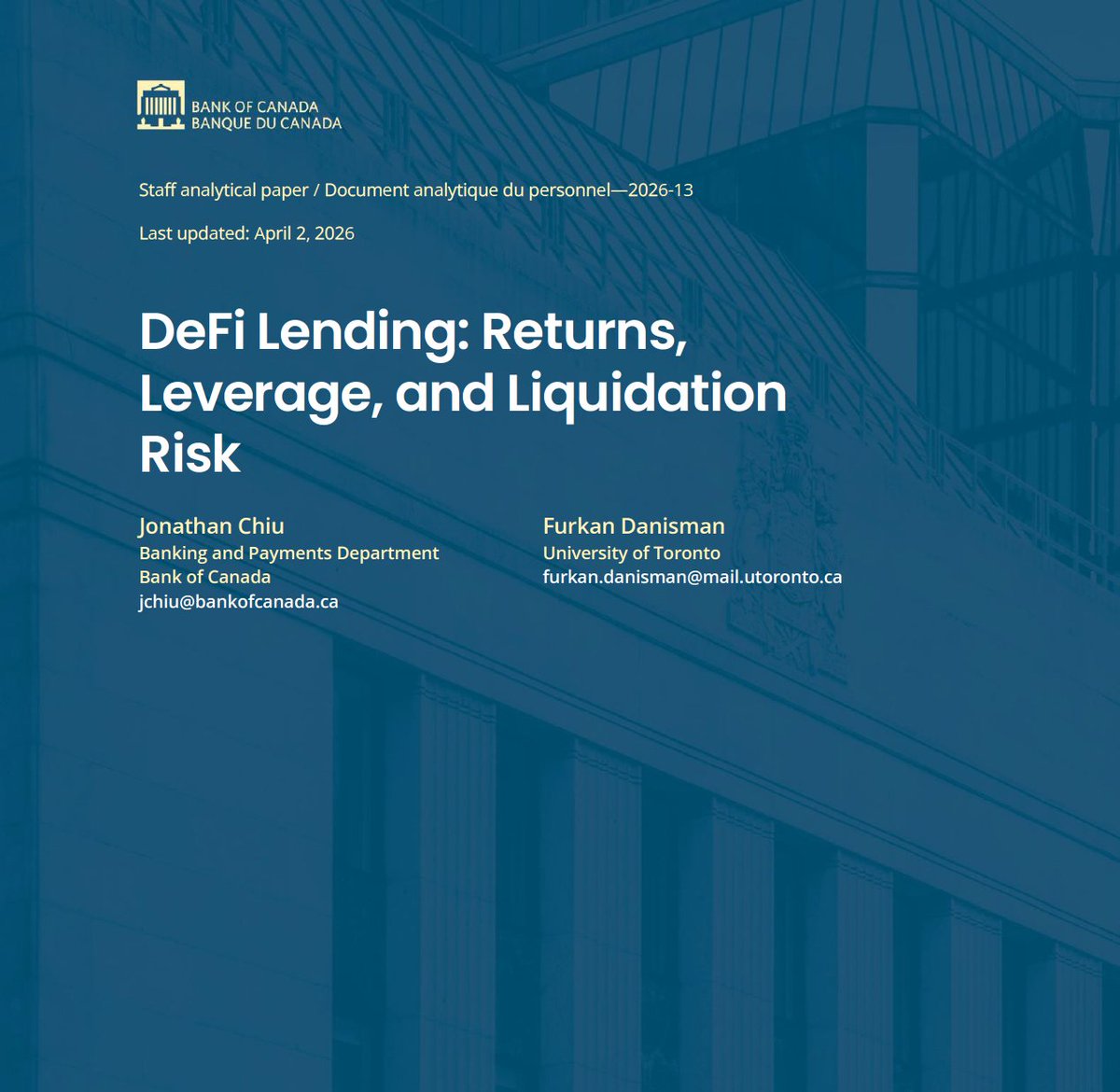
BREAKING: The Bank of Canada published a report on Aave.
It concludes that lending without traditional intermediaries is technically and operationally viable, with the system running continuously, transparently, and at minimal overhead.