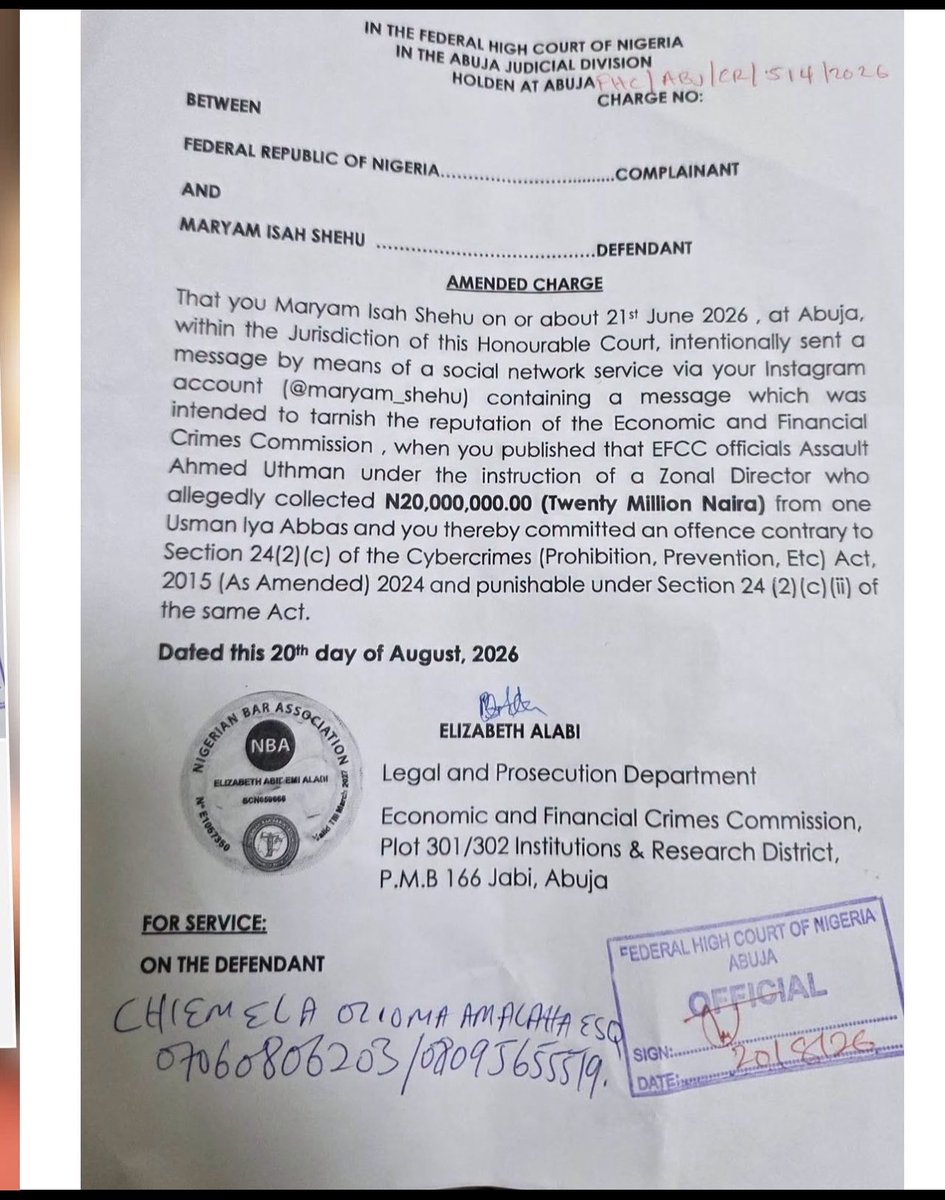
After making the complaint public yesterday, having personally witnessed the egregious violation of the rights of two young Nigerians including Bayero University Kano (BUK) student Maryam Isah Shehu, the @officialEFCC has now terminated the charges against them.
Unfortunately, the Federal High Court judge who sat yesterday and remanded them in Kuje and Suleja prisons respectively has not sat all day today, so their release is still being delayed.
We are glad that wisdom finally prevailed at the @officialEFCC
We must also thank Deji Adeyanju, @adeyanjudeji who, despite being on vacation in Paris, weighed in heavily; human rights attorneys @Abbahikima and Hamza N Dantani; and all the lawyers on the ground, particularly Chimela, Esq who have not rested all day, working tirelessly on the necessary paperwork to secure their freedom.
I was also informed that the leadership of the National Association of Nigerian Students (@NANSNIG was at the Federal High Court today to lend its support and help secure Maryam’s freedom. Their solidarity is greatly appreciated.
We sincerely hope that Justice Joyce Abdulmalik will still show up and sit, even briefly, today so that Maryam can regain her freedom and commence her final examinations tomorrow.
If that does not happen in time, we urge the authorities of Bayero University Kano @BUK_Nigeria to take special notice of the extraordinary circumstances surrounding her detention and ensure that she is given the opportunity to rewrite any examinations she misses as a direct consequence of her detention.
An injustice against one is an injustice against all.
No one shall be left behind!
ATTENTION!!!
Dear @officialEFCC
We are aware of the EFCC’s arraignment of Maryam Isah Shehu and Abubakar Shuraim Abdulhamad over allegations of cybercrime, false information, fabrication and alleged damage to the Commission’s reputation.
But Nigerians deserve to ask a fundamental question: is defending the EFCC’s reputation through criminal prosecution part of the Commission’s statutory mandate?
The EFCC was established primarily to investigate and prosecute economic and financial crimes. If a person publishes false information or fabricates an official document, and that conduct constitutes an offence under the Cybercrimes Act or another applicable law, then the appropriate legal process should undoubtedly take its course.
However, where the central complaint is defamation or damage to reputation, Nigerians need clarity on the appropriate legal and institutional avenue.
Defamation is traditionally addressed through the courts, and public institutions should not be able to use criminal proceedings simply because they feel criticised or embarrassed.
The bigger concern is the potential chilling effect on citizens, journalists, activists and social media users who raise questions about the conduct of government agencies.
If allegations made against the EFCC are false, the Commission has every right to seek redress through the law. But that process must be transparent, lawful and consistent with the limits of its statutory powers.
EFCC, Nigerians are asking for clarity: what specific criminal offence is being prosecuted in these cases, and how does prosecuting alleged attacks on the Commission’s reputation fall within your mandate?
Accountability must work both ways. Government agencies must be accountable to the people, while citizens must equally be accountable for knowingly spreading criminal falsehoods.
The courts should determine the facts not the power or reputation of the institution involved.
#AskQuestions
The @officialEFCC under Ola Olukoyede is inherently evil.
I sat through two separate court sittings today in which two individuals, including Maryam Isa Shehu, a female student of Bayero University Kano (BUK), were arraigned before Justice Joyce Abdulmalik by the Economic and Financial Crimes Commission (@officialEFCC) for allegedly “cyberbullying” the agency.
In each case, the defendants had already spent close to 30 days in detention before they were brought before the court. Yet, instead of being allowed to return home while their cases proceed, they were both remanded in prison custody, Maryam was sent to Suleja Prison, while the other defendant was sent to Kuje Prison, where they are expected to remain until August 31.
What makes Maryam’s situation even more disturbing is that she is a final-year university student who is due to begin her final examinations this Saturday.
None of that appeared to matter.
An anti-corruption agency should be fighting corruption, not turning itself into an institution for hunting down, detaining and prosecuting citizens over criticism or alleged “cyberbullying.”
What kind of institution detains a university student for nearly a month, arraigns her for allegedly cyberbullying the agency, and then seeks to keep her behind bars while her final examinations are about to begin?
if u ever see me stepping back on something its not bcox i dont want it again, but for my peace, for our peace, i rather be a fool and silent than to be arguing on something that didn’t worth arguing for, no matter what person do there always a payback, and the table bout to turn