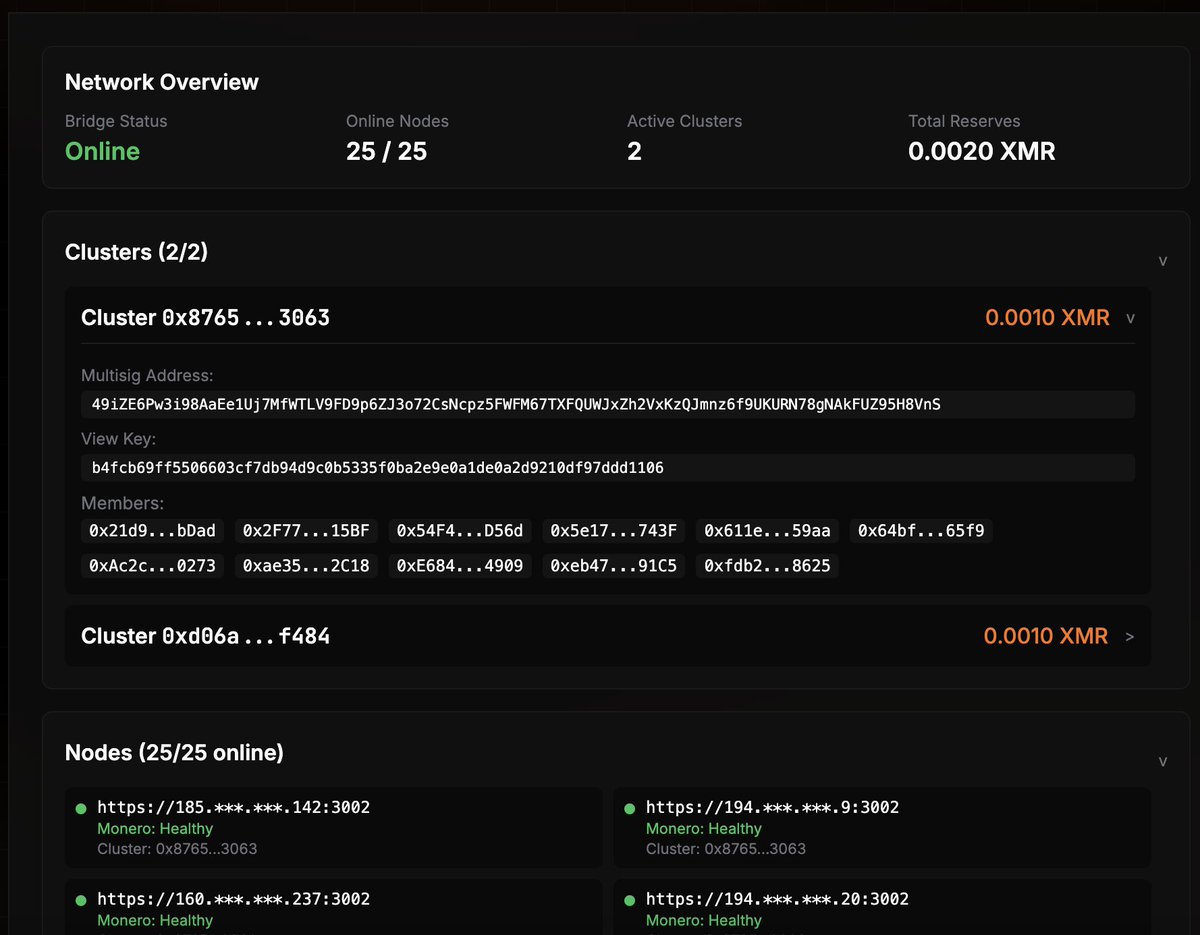
@JohnSmithypei We already had a live working prototype with community members running nodes and processing transactions. We're now building the real deal.
We’ve made significant progress in building robust bridge infrastructure aimed to operate safely and reliably under mainnet conditions. We’ll be sharing our progress by the end of this month.
Working on the Monero wallet management algorithm.
Testnet runs have revealed a few weak points where UTXO consolidation triggers are being overlooked under certain circumstances causing some withdrawal requests to fail.
A wallet may have sufficient balance to fulfill a withdrawal request however if the coins are too fragmented the total TX weight may be too high to broadcast. Our algo is being designed to calculate and schedule periodic UTXO consolidation when necessary to keep withdrawals running smoothly indefinitely.
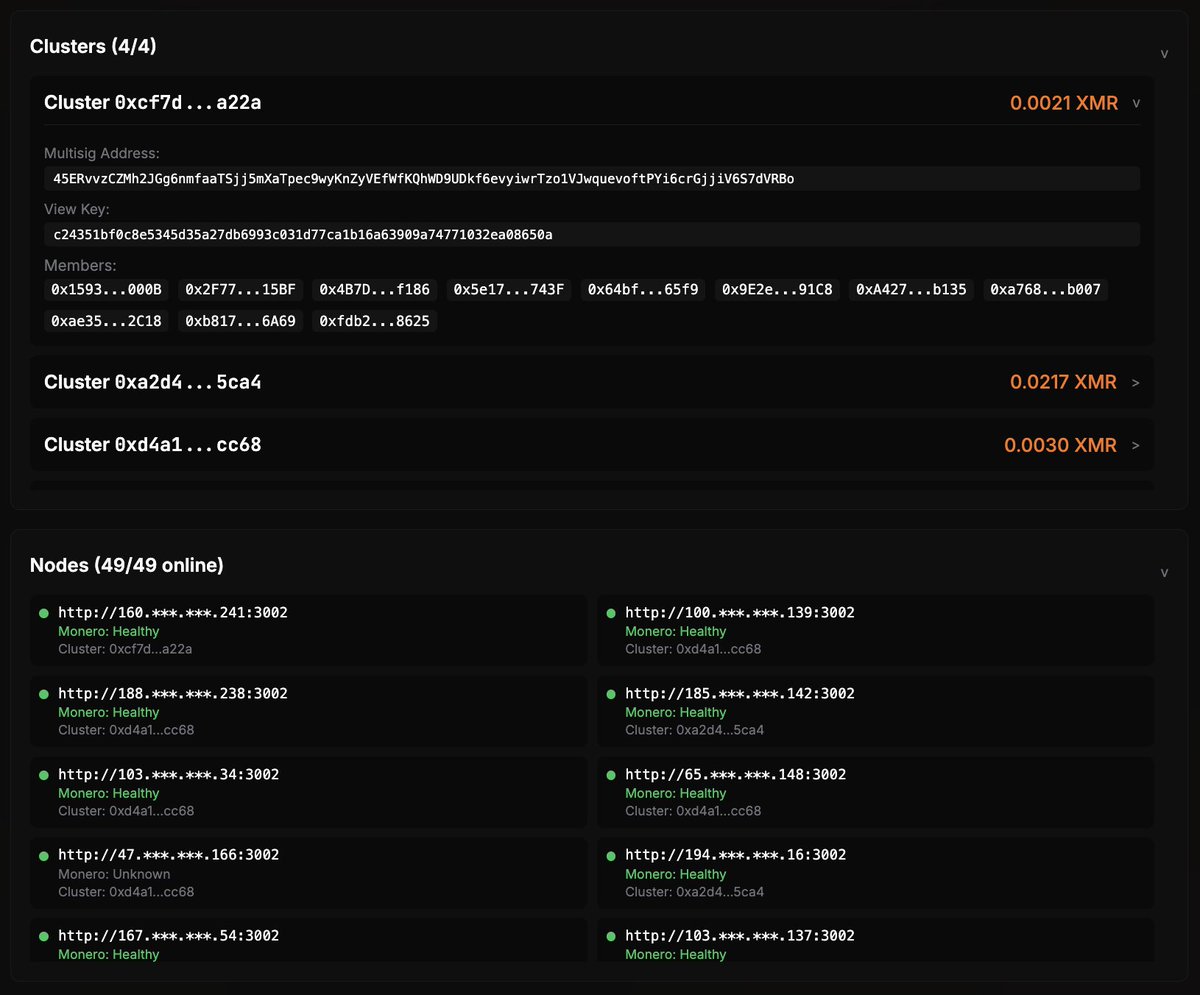
64 nodes (and growing!) are currently powering the world’s first decentralized trustless Monero bridge on Sepolia testnet.
1 zXMR is backed by exactly 1 XMR, which is held by a network of nodes running collective multisig wallets.
1 node = 1 key share
1 $zXMR = 1 $XMR
We are working on znode v2.2.4, which will further harden our decentralized Monero bridge.
We are currently focusing on the following:
-Smart transaction routing between clusters
-Cluster ledgers
-Merkle root verifiable transaction history
-Continuous multisig state sync
And much more
$XMR is coming to $ETH 🌉
Our fully decentralized and permissionless Monero Bridge is now live (on Testnet). Currently, 44 nodes across 4 clusters validate mint and burn transactions while receiving and sending native XMR from their multisig wallets.
Test bridging here: https://t.co/CbcQSKRK0t
Join the discussion here: https://t.co/PQmendOWsS
Run your own node here: https://t.co/gV9qeHdF6M
$XMR $ETH
2026 is the year that we take back lost ground in terms of self-sovereignty and trustlessness.
Some of what this practically means:
Full nodes: thanks to ZK-EVM and BAL, it will once again become easier to locally run a node and verify the Ethereum chain on your own computer.
Helios: actually verify the data you're receiving from RPCs instead of blindly trusting it.
ORAM, PIR: ask for data from RPCs without revealing which data you're asking, so you can access dapps without your access patterns being sold off to dozens of third parties all around the world.
Social recovery wallets and timelocks: wallets that don't make you lose all your money if you misplace your seedphrase, or if an online or offline attacker extracts your seedphrase, and *also* don't make all your money backdoored by Google.
Privacy UX: make private payments from your wallet, with the same user experience as making public payments.
Privacy censorship resistance: private payments with the ERC-4337 mempool, and soon native AA + FOCIL, without relying on the public broadcaster ecosystem.
Application UIs: use more dapps from an onchain UI with IPFS, without relying on trusted servers that would lock you our of practical recovery of your assets if they went offline, and would give you a hijacked UI that steals your funds if they get hacked for even a millisecond.
In many of these areas, over the last ten years we have seen serious backsliding in Ethereum. Nodes went from easy to run to hard to run. Dapps went from static pages to complicated behemoths that leak all your data to a dozen servers. Wallets went from routing everything through the RPC, which could be any node of your choice including on your own computer, to leaking your data to a dozen servers of their choice. Block building became more centralized, putting Ethereum transaction inclusion guarantees under the whims of a very small number of builders.
In 2026, no longer. Every compromise of values that Ethereum has made up to this point - every moment where you might have been thinking, is it really worth diluting ourselves so much in the name of mainstream adoption - we are making that compromise no longer.
It will be a long road. We will not get everything we want in the next Kohaku release, or the next hard fork, or the hard fork after that. But it will make Ethereum into an ecosystem that deserves not only its current place in the universe, but a much greater one.
In the world computer, there is no centralized overlord.
There is no single point of failure.
There is only love.
Milady.
Testnet Update:
An upgrade to znode is coming in the next few days after identifying several issues reported by users while running a node, especially issues with “faulty” nodes bricking cluster formation. While orchestrating withdrawal transactions between nodes was previously unstable, no errors have been reported in transaction processing this time (both deposits and withdrawals). Progress is being made ✅
Our decentralized wrapped Monero (zXMR) on Ethereum bridge is now live on Sepolia testnet. Visit https://t.co/EPhedcv6LP
to try it out! (Not optimized for mobile)
You can test bridging XMR (mainnet) <> ETH (Sepolia). Please keep your bridge transactions small since things can (and likely will) go wrong. Recovery may or may not be possible. Front end can be slow it's because it's pulling its data directly from the nodes.
You can claim testnet ZFI on the page and run your own node, form a cluster, stake, delegate, and process transactions. Github: https://t.co/D8UyClRE0u
Join us on 👉 https://t.co/BVXZYa3H9A
$XMR $ETH $zXMR
Eleven nodes running znodev2.1.0, distributed globally, all part of the same 7-of-11 Monero multisig wallet unwrapped zXMR to native XMR. We are getting closer to a truly decentralized XMR <-> ETH bridge. $XMR $ETH #privacy
Public testnet coming very soon!
Join us 👉https://t.co/PQmendOWsS
Burn tx:
https://t.co/9sQTluU6aT
We are building the worlds first 1:1 backed and decentralized Wrapped Monero token on $ETH.
11 nodes, each running on their own unique VPS servers, all part of the same 7-of-11 Monero multisig wallet, just validated and minted XMR on ETH in around 10 seconds. $XMR $zXMR $ZFI
To follow our progress👉https://t.co/PQmendOWsS