I work in biotech R&D. But I also have a passion for biotech investing, particularly viewed through the lens of options markets.
Several years ago I started logging every biotech and pharma options trade into a personal database, mostly out of curiosity. The database is now tens of millions of trades deep, and it's become my favorite tool for understanding what's moving in the sector and why.
It also turns up some remarkable, "unusual" stories. For example, back on March 27 of this year, someone bought $11,616 of short-dated, OTM $APLS calls. Four days later, Biogen announced it was acquiring Apellis, and the value of those calls skyrocketed to $982,520 (!).
I recently started Off-Label Trades on Substack to share it all: a daily interactive report of the most interesting biotech options trades, the day's biggest winners, and occasional deeper dives on retrospective case studies like the $APLS example above.
The newsletter is free to sign up, no paywalls. Whether you are a seasoned options trader, a biotech professional, or just curious about the intersection between options trading and the highly volatile biotech and pharma sector in general, I'd love to have you follow along.
The largest trade I flagged today was $315K of $SMMT December 18 $10 puts, 1,750 contracts bought at or above the ask at 6.8x normal size, all of it a new position.
This trade comes ten days after the FDA turned down Summit's ivonescimab in EGFR-mutant lung cancer, and five days before the company's November 30 update call. Bernstein cut its target to $8.30 on November 18.
A trader bought $110K of out-of-the-money $EWTX January 15 $50 calls today, after I logged three buys of the same calls yesterday (the biggest was 250 contracts for $95,000).
The November 6 reports said Edgewise had hired advisers to explore a sale, and no deal has been announced so far.
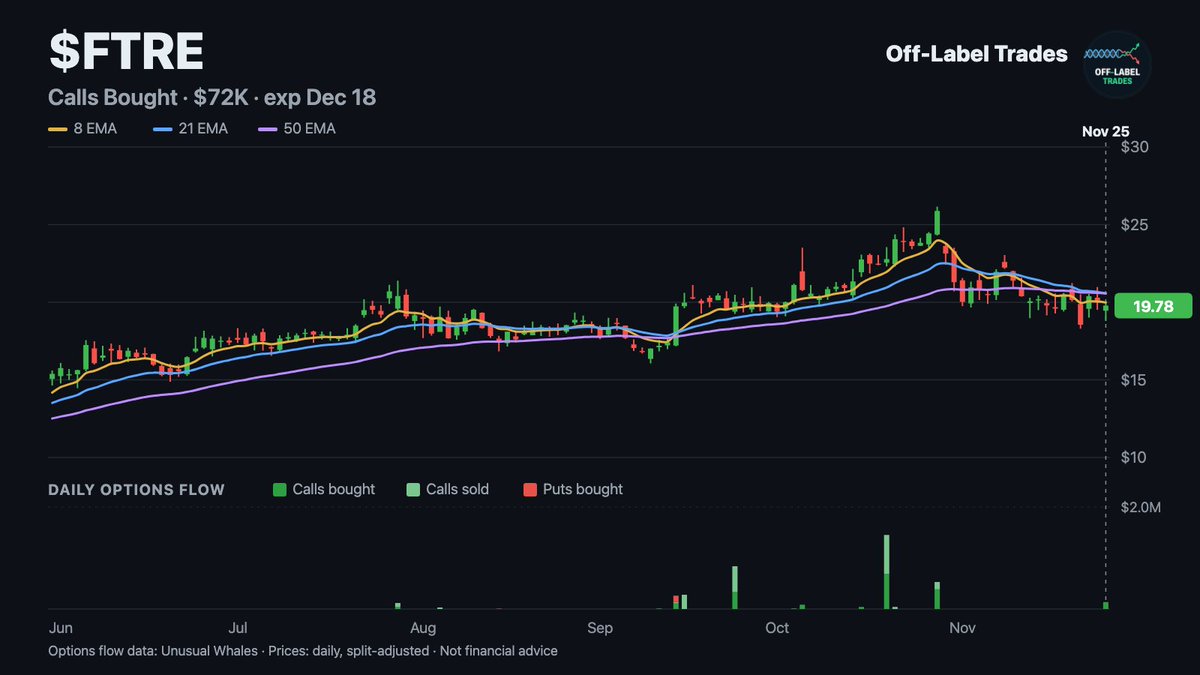
I logged three orders in the $FTRE December 18 $20 calls today, 924 contracts and $137K in all, and the biggest was a $72K buy of 500 at or above the ask, more than the open interest this morning.
The stock has dropped from $25.88 to $19.54 since October 28, mostly after management said fourth-quarter revenue would probably come in below the third's. Maybe this buyer is hoping the fireside chats at Evercore on December 1 and Citi on December 2 help the stock get some of that back.
A buyer opened a new $192K position in $COGT January 21, 2028 $25 calls today, a day after the FDA approved EKITNA for previously treated GIST six days ahead of schedule.
The next FDA decision, in NonAdvSM, is due December 30. Yesterday I also logged 1,000 of the January 15, 2027 $40 calls bought for $125,000. This trader may want plenty of time to see how the launch goes.
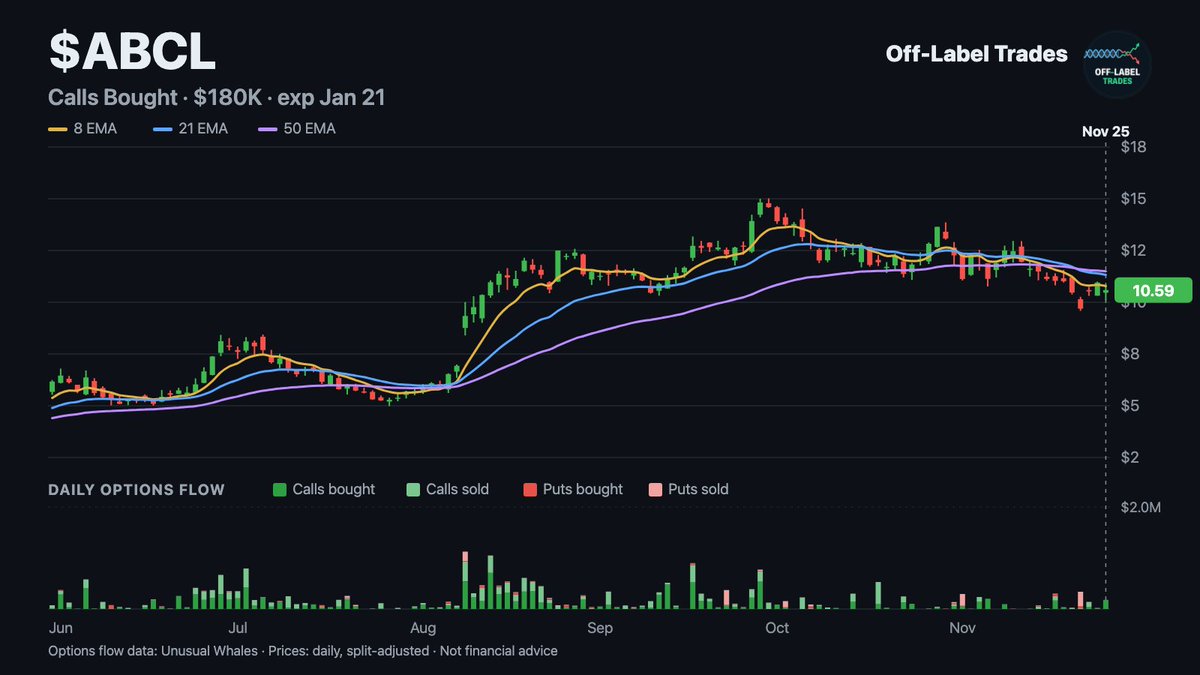
I logged a $180K buy of $ABCL January 21, 2028 $7 LEAPs today, filled at or above the ask, with the calls already in the money and implied volatility in only the 3rd percentile.
AbCellera shows new phase 2 analyses for ABCL635 at the San Antonio Breast Cancer Symposium on December 9, and the CEO is aiming for a phase 3 start around mid-2027.
A buyer spent $673,149 on $CCCC December 17, 2027 $3 calls today, worked through the session in 115 prints, all at the ask. I haven't logged anything notable on this name in a long time, and these options are about as cheap as they've been for this stock. C4 expects full cemsidomide plus elranatamab data in mid-2027.
@bioinvestor24 Genuine question -- do you not think the liability resulting from any potential patent litigation between $RVMD vs $ERAS would scare any buyers away from $ERAS until that dust settles?
Anyone care to chime in on $CELC lately? Seems undervalued. Considering opening a sizable position on the stock and would love to hear arguments for or against doing so
I logged a trader buying $814,045 in $SMMT calls today, 2,669 at the $15 strike and 2,669 at $20, split between January and March expiries and 10.6× normal size.
This trade comes eight days after the FDA turned down ivonescimab in previously treated EGFR-mutated lung cancer. The HARMONi-3 squamous readout is guided to the fourth quarter, but this buyer may be giving themselves some room in case it slips into early 2027.
About once a month for the past three months now, someone has been buying unusually large blocks of calls on $STRO, which almost never sees any flow. Today, a buyer took 625 of the $STRO December 18 $7.50 calls at or above the ask, $87,500 in all, in a contract that had no open interest this morning. The next STRO-004 update isn't planned until the first half of 2027, so maybe this buyer is looking at something smaller (?), like the STRO-227 IND submission Sutro has pointed to for late 2026? Sort of interesting trade pattern.
At least your $SLNO report was based on actual in-human data.
What you're saying about $ABVX is late to the story wet lab speculation that has already debunked by the existing in human data which very clearly show malignancy rates within or below the expected background rates...Which even your own tables show!
BTW, you seem not to know this, but institutional investors ran these lab studies that you just did years ago already, and those same people ended up becoming some of the company's biggest bulls and current investors. I know you think you published something new here - you didn't. The AhR stuff is old old news. Years late to the story, and the in human data have already played out to $ABVX's favor.
I could go on and on listing the absurdities in this document...discussing monkey tox concerns at 500mg/kg/day (~1000x the human dose!!!), concerns over "Chinese data" when ABTECT-2 had literally ZERO Chinese trial sites.
You point out preclinical phototoxicity signals and speculate that the company didn't know or didn't do anything about it...yet enhanced skin surveillance was BUILT INTO THE STUDIES PROSPECTIVELY by the company! The company itself not only knew about this, but literally specifically designed the studies to test phototox concerns and either confirm it or rule it out....WHICH IT ULTIMATELY DID rule out.
Pointing out that the parent molecule is lipophilic and using that to call it an "agrochemical"... Just laughable sensationalism. We have known the structure of this molecule for over a decade. And BTW, plenty of drugs have lipophilic properties. This is a bizarre and irresponsibly over-sensationalized bit...calling it an "agrochemical"...
BTW, your own malignancy event table shows a malignancy rate BELOW background rates....???
You point out that there were zero remissions the placebo arm in one of the trials in the US and call that an outlier that will concern regulators....the expected number of patients to respond in that arm per the results of the rest of the study would have been 1.6 responders on the placebo arm! 0 instead of 1...that's an anomolous signal to you?
So ultimately your bear argument is this: "This drug has NOT shown increases in cancer in patients. In fact, it has shown rates at or even BELOW the rates of other drugs approved for this disease that have no black box warning for cancer. But hey, who knows, maybe that will change someday down the road!"
BTW, you're aware there's an FDA approved AhR drug on the market already right? One with no cancer risk...
You're claiming that AhR agonism is the top secret *true* mechanism of $ABVX's obefazimod and that this is bad because you claim AhR agonism is going to cause cancer... Again, not only is the AhR agonism theory that you're treating as a revelation actually a point that $ABVX *bulls* have believed for literally years already (i.e. not news from you), but there is actually a drug ON THE MARKET today that literally has that as its exact mechanism of action...and it has no labeled risk of carcinogenicity and no studies in humans or animals supporting carcinogenic risk....So you go through all this bluster about AhR pretending it is news (it isn't) and then claiming it is going to cause cancer (even though the data we have very clearly show that it HASN'T), meanwhile, there's already been an AhR drug on the market for years that has never shown a single piece of evidence for carcinogenicity...
Like I have said in the past - I had previously agreed with some of your work. This piece is irresponsibly poorly done and the use of the word "fraud" is absolutely egregious and slanderous when your thesis ultimately boils down to..."well, they haven't shown cancer signals yet, but maybe they will someday!" Calling this fraud with the evidence you provide sincerely rises to the level of libel, in my opinion.