Estevao onside goal disallowed.
Gabriel head kick on Martinez.
Brobbey penalty.
Palmer no penalty.
Handball vs Hull City.
Tarkowski knocking out Caicedo.
Every single game, a decision has gone against us.
When is enough, enough?
-Portrait of Zaga Christ (1610–1638), son of the Emperor of Ethiopia, walking through the streets of Paris, c. 1635.
Engraving from "Paris à travers les siècles" by Gourdon de Genouillac
-Portrait of Zaga Christ by Giovanna Garzoni, 1635.
#ethnographxt
BREAKING: Claude Code found 14,219 photos of my face on my Android that I never took. Phone was secretly taking them almost every time I picked it up. Even when I was just lying in bed. Even at home.
Not screenshots. Real frames from the front camera. On the train. In the car. At home. When I just grabbed it to check the time.
They were just sitting in a system cache. Timestamps and GPS on them. Nothing in Gallery. Nothing in Recently Deleted.
Plugged the phone into my laptop, made a full backup, told Claude Code to look for any front-camera files that weren’t in my photos. It pulled /data/system/users/0/faceunlock/cache and another folder inside Google Play Services. Over 14 thousand files. Normal ones and infrared from Face Unlock. Every single one had time and location.
Started scrolling. Almost everything from the last 15 months. Then I saw a file created 2 seconds ago. I was still looking at the folder. Phone kept taking photos while I was reading this.
Google and the phone makers say Face Unlock turns everything into a mathematical model and deletes the image right away. On this phone the raw frames were just sitting there. Some of the processes writing to that folder were from system diagnostics. Couple of old apps that still had camera permission could also get in.
Turned off diagnostics, revoked camera access from everything that doesn’t need it, cleared the cache. But how many of these frames already went somewhere else, I don’t know.
If you want to check yours, plug it in, make a full backup or use ADB, and ask Claude to look for front-camera files outside your Gallery. Path above is where mine were.
#Daily_Brief: #Russian military intelligence officer in reported intrusion at #AU Commission chairperson’s residence identified
Addis Abeba - A Russian military intelligence officer covertly entered the African Union Commission chairperson’s residence in Addis Abeba in April 2025 while Mahamoud Ali Youssouf and his family were staying there, an investigation by The Insider published on 23 October 2026 has reported.
https://t.co/y8Lxw2QBlB
Ethiopia ranks among the least affordable places for housing in Africa right now, driven by rapid urbanization and strong population growth that the supply of homes has not kept up with.
China used more cement between 2011 and 2013 than the United States used across the entire 20th century. Like Ethiopia, the state owns the land, but China paired that with heavy government infrastructure spending and incentives for private developers. That combination drove massive construction, modernized cities, and supported economic growth for years.
The Chinese model was not perfect. Overbuilding created empty buildings, high debt, and a property crisis that is still playing out. Still, the scale of what they achieved on supply shows what is possible when the focus is on building more rather than only regulating the existing stock.
Ethiopia could study both what worked and what went wrong in China and elsewhere, then adapt the useful parts to its own conditions before the housing shortage gets even harder to fix.
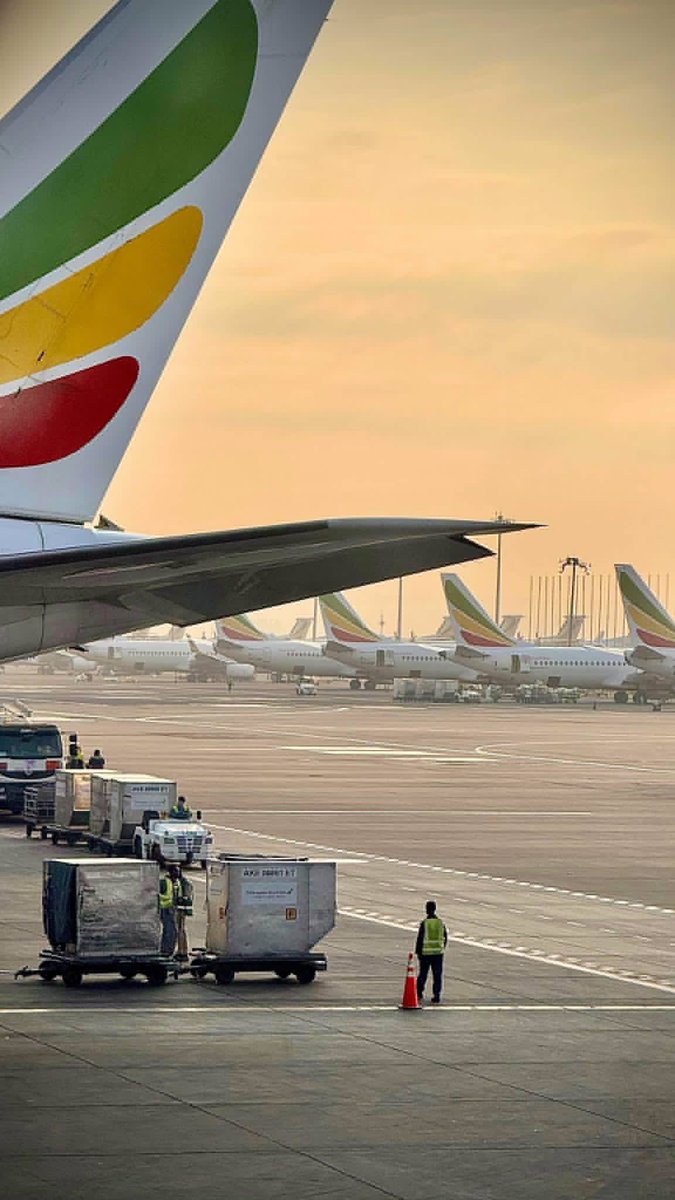
¿Cómo se explica que Etiopía tenga la flota aérea más grande y la compañía mejor organizada de toda África?
El país está en guerra, no tiene grandes minerales estratégicos y tampoco tiene acceso directo al mar...
¿Cómo lo hace? Os explico el milagro de Ethiopian Airlines ✈️👇🏽
La mina de oro de Etiopía es su geografía (el hub natural).
Etiopía no tiene minerales valiosos en su subsuelo, pero posee una ubicación geográfica privilegiada.
Adís Abeba se encuentra en el Cuerno de África, una posición geopolítica perfecta para conectar tres continentes: Asia, Europa y el resto de África.
El modelo "hub and spoke" ha sido la clave.
En lugar de depender del tráfico interno o del turismo hacia Etiopía, la compañía se transformó en el puente obligatorio para cualquiera que viaje, por ejemplo, de China a São Paulo, o de París a Nairobi.
La conexión con China es un punto crucial. Ethiopian Airlines supo anticipar antes que nadie el desembarco económico de China en África, convirtiéndose en la principal arteria de transporte para trabajadores, empresarios y mercancías entre Pekín y el continente africano.
Además, a pesar de ser una empresa 100% estatal, el gobierno etíope ha mantenido una regla de oro inquebrantable desde su fundación en 1945: cero interferencia política.
La aerolínea se gestiona con una disciplina puramente corporativa y meritocrática, al estilo de las grandes multinacionales privadas.
A diferencia de otras aerolíneas de bandera africanas (como South African Airways o Kenya Airways), que colapsaron o sufrieron graves crisis debido a la corrupción y las decisiones políticas, Ethiopian Airlines toma sus decisiones basándose estrictamente en la rentabilidad y la eficiencia.
Etiopía entendió que el mercado de su propio país era limitado, por lo que adoptó una estrategia de expansión e integración regional.
Su lema histórico ha sido unir a un continente que, paradójicamente, siempre ha estado mal conectado consigo mismo (muchas veces para volar entre dos países africanos había que hacer escala en París o Londres).
Ha ayudado a fundar, cogestionar o rescatar aerolíneas locales en otros países del continente (como en Togo, Malaui o Zambia), creando una red que alimenta de pasajeros a su centro de distribución en Adís Abeba.
Y por si fuera poco, en lugar de subcontratar servicios costosos en el extranjero, Ethiopian Airlines creó su propio ecosistema autosuficiente.
Su Aviation Academy es el centro de formación más grande y avanzado de África.
Allí cultivan su propio talento: pilotos, tripulación de cabina, ingenieros y personal de mantenimiento se forman bajo estándares internacionales en casa.
De hecho, la compañía no sólo mantiene su propia flota (una de las más jóvenes y modernas del mundo, con Boeing 787 Dreamliners y Airbus A350), sino que vende servicios de mantenimiento y formación a docenas de otras aerolíneas del continente, generando una vía de ingresos alternativa muy lucrativa.
El éxito aéreo de Etiopía demuestra que, en la economía global moderna, la conectividad logística y la excelencia institucional pueden ser activos mucho más poderosos y sostenibles que el petróleo o los diamantes.