I would like to extend my sincere gratitude to our Chief Guest, @HonAdenDuale , Cabinet Secretary of the Republic of Kenya, for honouring our invitation for the second time to the Global Somalia Entrepreneurship Forum (GSEF) 2026.
Your continued support and presence mean a great deal to us and reaffirm the importance of creating spaces where entrepreneurs, policymakers, investors and business leaders can come together to shape the future of our economies.
One of the most powerful messages from your address was the recognition that while East Africa has immense potential, we must confront challenges such as youth unemployment, barriers to investment, infrastructure gaps and unequal access to economic opportunities.
You stated:
“The future of East Africa will depend on how effectively we bring these elements together to build competitive, inclusive and resilient economies.”
This statement is particularly important because entrepreneurship does not thrive in isolation. Entrepreneurs need an enabling business environment, access to capital, strong institutions, reliable infrastructure and opportunities to access regional markets.
#GSEF2026 #Entrepreneurship #EastAfrica #Investment #EconomicGrowth
Kenyans deserve to see how their votes become election results and not simply be told whom to trust. On 22 October 2026, the National Assembly passed the Elections (Amendment) (No. 2) Bill, 2024. Parliament must now publish the approved text and account for its implications for electoral transparency.
In the published Bill, Clause 22 replaces section 39 without expressly requiring livestreaming of results announced at polling stations, while retaining electronic transmission and online publication of results forms. That is not a ban on livestreaming. But sending results to election officials and allowing citizens to watch their announcement serve different purposes. Parliament must clarify whether this omission survived the amendments MPs approved.
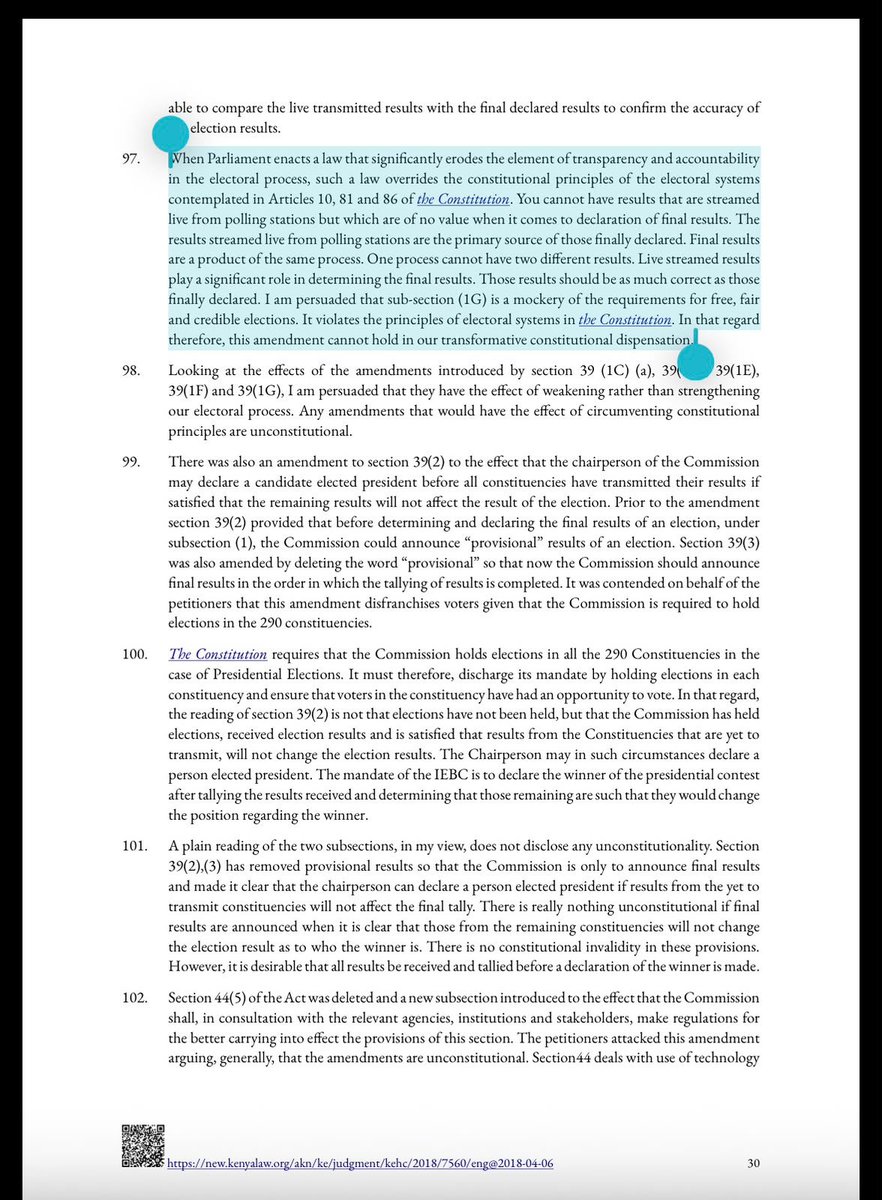
The court history cannot be ignored. On 6 April 2018, in Katiba Institute v Attorney General, the High Court invalidated section 39(1G), which required livestreaming but confined streamed results to public information and excluded them as a basis for declaration. The Court rejected that restriction for undermining electoral transparency and accountability. It did not prohibit livestreaming. The Court of Appeal upheld the invalidation on 6 October 2023 in National Assembly v Katiba Institute. The legislative task is therefore to enact a constitutionally sound obligation and not present an already-invalidated provision as an effective safeguard.
Article 86 requires a transparent, verifiable and accountable electoral system, prompt polling-station announcements, and open, accurate collation. Ahead of 2027, Parliament should expressly secure public access to live results announcements, and the IEBC must explain how citizens will follow and scrutinise the process. Electoral reform should make every vote easier to verify, not leave transparency dependent on institutional discretion. The ballot is secret but the count must be open.
The Bottom-Up Economic Transformation Agenda recognizes that meaningful economic progress begins with empowering our people with the knowledge, skills and opportunities they need to improve their livelihoods.
Through the Kenya National Library Service (KNLS), we are advancing this vision by expanding access to information, education and digital learning. The VTabu Virtual Library is bringing books, academic journals and research resources within reach of students, young people, entrepreneurs and researchers across our country, supporting skills development, innovation and lifelong learning.
At the State Department for Culture, the Arts and Heritage, we are keen to see our libraries contribute meaningfully to this transformation by strengthening digital inclusion, promoting literacy and preserving our intellectual and cultural heritage. Every opportunity to learn, acquire new skills and access reliable information is an investment in the potential of our people and the future of our country.
Today, we live under the tyranny of optimization. Every hobby must become a side hustle, every moment must be tracked by an app or captured and broadcasted for validation from strangers, and every hour must yield measurable results.
Be intentional and deliberate about preserving areas of your life that you refuse to either optimize or monetize. Read dense books purely for the joy of reading slowly, go for camping or hiking purely for the thrill and the experience, go for long walks with no destination in mind, or pick up an art you're not good at.
When you protect unoptimized spaces in your life, you assert your humanity over the industrial demand for constant output. Life is not an equation to be solved or an efficiency metric to be maximized; it is a landscape to be experienced. Sovereign inefficiency reclaims your right to exist without having to justify your existence through utility.
Governor @HonKangata thank you for this factual, candid analysis that has shaped our journey to Wamunyoro and consolidating other regions. @LindaMwananchi_
Milk has climbed to KSh 80, petrol to KSh 228 per litre, diesel to KSh 229, and a single egg now costs KSh 20. To make matters worse, SHA is failing to guarantee reliable access to healthcare, forcing households to contend with rising living costs and growing medical insecurity simultaneously.
This is an economy under siege: purchasing power is shrinking, household budgets are collapsing, and the cost of basic survival keeps rising. Yet some politicians want Kenyans distracted by TUTAM and tribal arithmetic.
Inflation does not recognise tribe. Poverty does not respect political affiliation. And hunger does not understand political slogans.
When the cost of living becomes unbearable, propaganda cannot substitute for economic relief.